Six years after the government opened the space sector to private companies, nine associations representing thousands of Isro employees have sought official clarification on the proposed transfer of the space agency’s manufacturing and operational functions to private entities.
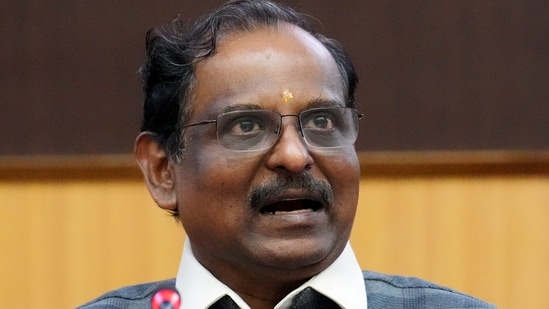
In a letter dated September 4 to Isro chairman and Department of Space (DoS) secretary V Narayanan, the associations sought clarity on the government’s privatisation policy, Isro’s future role, and the consequences for serving employees and future recruitment.
Employee bodies from several Isro centres signed the letter, which HT has seen. They include the Isro Staff Association, SHAR Employees Association, ISAC Employees Association, Isro Staff Association-LPSC, Isro Staff Association-BBU, NRSA Employees Union, Space Employees Association-BBU, Isro Staff Association-IPRC and SAC Employees Welfare Association.
Also Read | ‘Policy paralysis’ to ‘dynamism’: PM Modi returns to SRCC, maps India’s growth in 13 years
The associations wrote after Pawan Kumar Goenka, chairman of the Indian National Space Promotion and Authorisation Centre (IN-SPACe), said at a recent event that “eventually, Isro will not make any launch vehicles and will not manufacture any launch vehicles. That will all be done by the private sector or PSU.” The transition had already begun with the Small Satellite Launch Vehicle (SSLV), they said, and could extend to the Polar Satellite Launch Vehicle (PSLV) and LVM3.
{{/usCountry}}The associations wrote after Pawan Kumar Goenka, chairman of the Indian National Space Promotion and Authorisation Centre (IN-SPACe), said at a recent event that “eventually, Isro will not make any launch vehicles and will not manufacture any launch vehicles. That will all be done by the private sector or PSU.” The transition had already begun with the Small Satellite Launch Vehicle (SSLV), they said, and could extend to the Polar Satellite Launch Vehicle (PSLV) and LVM3.
{{/usCountry}}They also flagged reports about the proposed transfer of production of these launch vehicles, the movement of routine satellite manufacturing out of Isro and the opening of new launch infrastructure, including the Space Launch Complex at Kulasekarapattinam, to private entities. The letter referred to about 120 technologies already transferred from Isro to the private sector.
“These statements have received wide national publicity. They have not, however, been accompanied by any corresponding official communication from the Department of Space to its employees explaining the approved policy, its legal and administrative basis, its phasing, or its consequences for the existing workforce and for future public recruitment,” the letter said.
Also Read | US CENTCOM claims it sank oil tanker MT Kylo in Gulf of Oman as Iran war escalates | Watch
The associations said the prospect of Isro withdrawing from launch-vehicle and satellite production had created anxiety among employees and their families. Such a move, they said, could “tamper experiments after research, shrink in-house work, freeze or reduce sanctioned strength, and close promotion and skill-development avenues in technical, scientific, administrative, stores, purchase, quality, safety and industrial cadres”.
“Launch-vehicle design, realisation, integration, testing and launch operations are not merely ‘manufacturing contracts’. They are the core competence, institutional memory and strategic capability of the Organisation,” the letter said.
Existing employees could become surplus, be redeployed or be left without meaningful work, the associations warned, and reduced recruitment to Group A, B and C posts could deny young people careers in Isro.
The employee bodies said they did not oppose private participation or legitimate commercialisation through NewSpace India Ltd (NSIL) within a defined framework. “The concern is the absence of an official DoS policy document that draws a clear line between enabling private participation and dismantling Isro’s own realisation capability,” the letter said.
The associations asked whether Goenka’s remarks represented government policy, and whether Isro would remain responsible for the design, development, realisation, integration, testing and launch of PSLV, LVM3, SSLV and their successor vehicles.