Farm fires in the agrarian states of Punjab and Haryana this season could follow similar trends as the past, according to assessments of cropping patterns by a remote sensing expert from the National Aeronautics and Space Administration (Nasa), who added that it will now be crucial for on-ground administrations to step in and dissuade the practice.
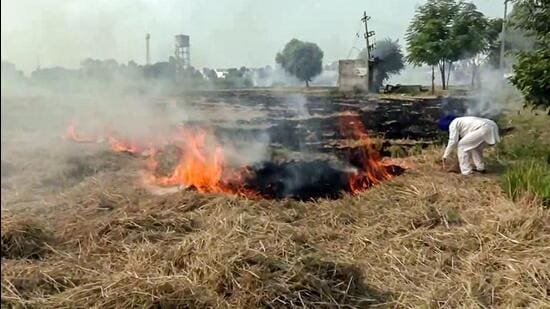
Senior aerosol remote sensing scientist at Nasa Goddard Space Flight Center, Hiren Jethva said that based on the area cultivated in Punjab and Haryana, 2023, if farmers continue “an as usual burning” practice as before, the year could record the fourth highest active fire season after 2021, 2016 and 2020.
“Rice harvest in northwest India is approaching soon. My prediction for 2023 seasonal residue fires from Aqua MODIS Sep NDVI (satellite imagery) suggests 16,000 occurrences in Punjab and Haryana under an ‘as usual burning scenario’. Prediction stands (2023) as the fourth most active fire season after 2021, 2016, 2020,” Jethva said.
He, however, added that on-ground action by state agencies could significantly reduce the number of farm fires, as it has happened in the past.
“Satellite detected 16% less fire activities than predicted in 2022 — an indication of actions on the ground to reduce instances of agricultural fires. Hoping for more momentum and efforts this year too,” he said.
{{/usCountry}}“Satellite detected 16% less fire activities than predicted in 2022 — an indication of actions on the ground to reduce instances of agricultural fires. Hoping for more momentum and efforts this year too,” he said.
{{/usCountry}}Predicting the pre-winter air quality crisis is difficult since there is wide variation in human and atmospheric factors: whether farmers choose to burn the paddy residue is a key determinant, as is the sort of weather that prevails (including wind direction).
This year, farmers have also reported using a higher proportion of a new variety of paddy which matures early and leaves shorter remnants, potentially cutting the volumes needed to be burnt closer to the critical October-end, November-beginning period when the weather too is unsuited for blowing the smoke away.
Authorities in both states have also said that they are making efforts to distribute and rent out new harvesting and seeding machines that do away with the need to burn paddy stubble.
On the other hand, delayed rains also upset sowing schedules, potentially leaving farmers with a shorter window for them to ready their fields for the winter crops --- a crunch that is among the main reasons they take to burning the paddy residue.
Data from the Union ministry of environment, forests and climate change shows that last year, 49,992 stubble fires were reported from Punjab and 3,549 stubble fires reported from Haryana. In Punjab, 71,304 fires were recorded in 2021 and 82,693 fires were seen in 2020.
Government data also showed that in Punjab last year, five districts reported the highest number of fires — Sangrur, Bhatinda, Firozpur, Muktsar and Moga.
While local residents in these areas are the first victims of plumes of smoke released from such mass burning, Delhi also bears the brunt of Punjab and Haryana’s unchecked stubble fires every year, as the wind direction during these months carries pollutants to the Capital, setting the tone for the high pollution concentrations recorded in the city during winter months.
Anumita Roychowdhury, executive director (research and advocacy), Centre for Science and Environment (CSE) said that government agencies must increase monitoring and action against early signs of stubble fires. She also said that along with increased monitoring, administration should also ensure that machines to mulch stubble is also readily available to farmers.
“The problem requires solution at multiple levels. You have to make machines accessible, provide financial incentives to farmers and also create a functional alternative for straw management. Meanwhile, on-ground monitoring of fires needs to happen more effectively,” said Roychowdhury.