JC Kumarappa (1892 -1960) was a man of many facets with great distinction. He was a thinker who was ahead of his time and an economist that successive governments at the centre likened him as an idealist than a rare visionary who combined theory with practice. He laid the foundations of Gandhian economics in India with original economic thought located in the classical worldview of integral relationship between human beings, nature and development.
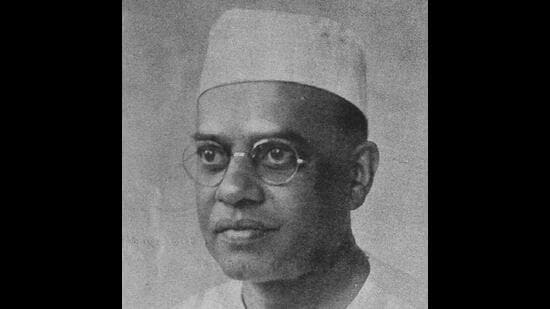
Kumarappa believed that the only social order was one what he called the “the economy of permanence” wherein human beings are content to live in harmony with nature in order to meet their needs without disrupting the natural patterns of growth and renewal. He also contended that the vision of “economy of permanence” could best be realized through a decentralised model of economic planning based on the concept of village as a basic and core concept of self-sufficient unit with optimum usage and application of local resources.
Kumarappa was a graduate in history from Madras Christian College, Chennai and took to accountancy as a qualified chartered accountant from London. His interest in education made him pursue another bachelor’s degree in business administration from Syracuse University and later a master’s degree in Economics from the Columbia University, New York.
The real turning point in his academic and professional career was his decision to undertake research on the reasons for poverty in India for his master’s thesis at the Columbia university based on his lecture series on “Why then is India poor?” which drew the attention of his professor E.R.A. Seligman who advised him to base his master’s thesis by exploring further on the same subject. Thus, began his critique of the colonial British economic policies in India and an intellectual awakening simultaneously occurring in revolt against the notion that the sole determinant of any act or policy is related to the wealth it generated as advocated by HJ Davenport who taught a course on “the Economics of Enterprise” emphasizing the values of extreme materialism. Kumarappa was deeply convinced of the moral and social dimensions of economic decisions that people and governments make. This was another soul searching experience for him as an economist and in his search for justice.
{{/usCountry}}The real turning point in his academic and professional career was his decision to undertake research on the reasons for poverty in India for his master’s thesis at the Columbia university based on his lecture series on “Why then is India poor?” which drew the attention of his professor E.R.A. Seligman who advised him to base his master’s thesis by exploring further on the same subject. Thus, began his critique of the colonial British economic policies in India and an intellectual awakening simultaneously occurring in revolt against the notion that the sole determinant of any act or policy is related to the wealth it generated as advocated by HJ Davenport who taught a course on “the Economics of Enterprise” emphasizing the values of extreme materialism. Kumarappa was deeply convinced of the moral and social dimensions of economic decisions that people and governments make. This was another soul searching experience for him as an economist and in his search for justice.
{{/usCountry}}Kumarappa never turned back and thus began his journey in public life as a nationalist with a cause for economic and environmental justice. It was only natural that his academic inquires took him close to Gandhi who considered Kumarappa was the first economist who almost resembled him with similar economic thought and philosophical orientation. At the time of Indian independence, there was a debate primarily centered around two different approaches – the Gandhian and the Nehruvian model of development. The Gandhian approach to development did not receive serious attention among the Indian planners. The Nehruvian model became the choice as it seemed more compatible with the ideological priorities involved in building a post-colonial nation-state with emphasis on industry, particularly on heavy industry.
Though agriculture was given the first place among the priorities listed in the Third Five – Year Plan, it was considered necessary for agriculture to contribute to the building up of a modern industrial sector by providing cheap labour and cheap food. After independence, Kumarappa and his economic philosophy was neither acknowledged by the Centre nor by any state government. Kumarappa faded away rapidly along with the marginalization of Gandhian institutions across the country. India’s problem was considered to be one of “primary accumulation of capital” than decentralisation, urban-rural divide, distributional justice and environmental concerns as raised by JC Kumarappa.
JCKumarappa was one of the early economists to draw attention to the environmental challenges as part of his search towards economic justice. JCKumarappa’s concept of green economics by addressing the bases of sustainable development is highly significant even today with the growing challenges of climate debate. How to distinguish between the contemporary debate on climate issues and environmental justice advocated by JC Kumarappa? He also believed decentralisation as an effective means to achieve principles of distributional justice, democracy and development. In addressing the challenges and concerns raised by JCKumarappa we need to keep in mind of the fact that there is no one India and, in fact, we are thinking of many Indias consisting of rural, tribal, marginalised, poor, and the realities of the great divide between the rich and poor.
It is a great irony that the German born British economist EF Schumacher who wrote an influential book titled “Small is beautiful” was hugely inspired by the life and ideas of JC Kumarappa who is neglected in his own country. There is a need to revisit the economic doctrine developed by JC Kumarappa for his far-sighted emphasis on conserving the environment and promoting environmental justice. JC Kumarappa’s foundational works on economic justice, distributional justice, rural-urban divide, ecology and sustainable development needs another academic, intellectual, policy-oriented review given the historical neglect meted out to his native wisdom, intellectual integrity and original ideas on development and democracy.
(Prof Ramu Manivannan is a scholar-social activist in areas of education, human rights and sustainable development through an initiative “Multiversity.”)