
 E-Paper



The JD(S) confronts an existential crisis
Karnataka election results: The JD(S) fell to its lowest seat tally of 19 since 1999 when the fledgling party first fought elections, falling from 37 in 2018


On Wednesday, minutes after he cast his vote, two-time chief minister (CM) HD Kumaraswamy beseeched the people of Karnataka to vote for his Janata Dal (Secular), or JD(S). His party would be “king”, he said.
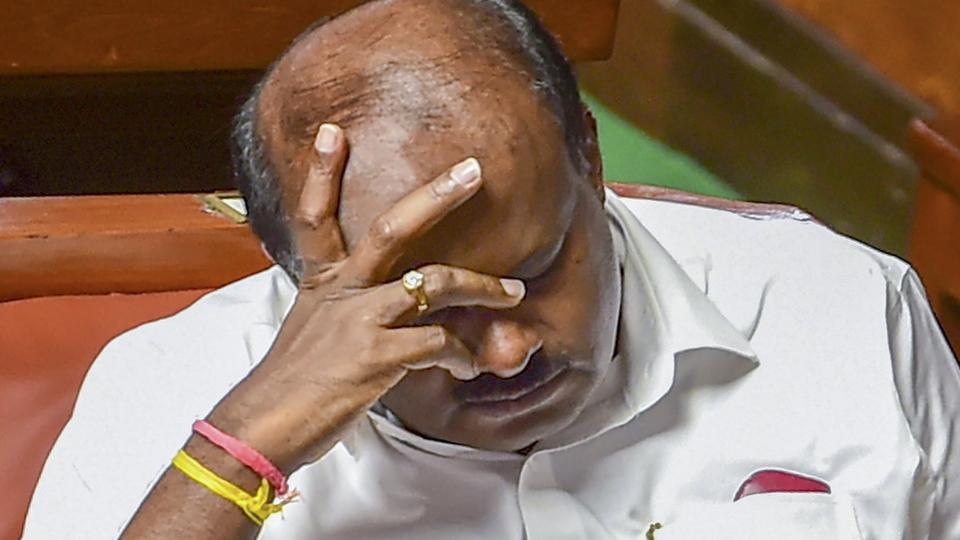
The subtext was inescapable. The term “kingmaker” has long endured in Indian politics, used to define political parties that leverage their weight in an assembly that has no clear majority; no government can be formed without them. In its 24-year history since former Prime Minister HD Deve Gowda broke away from the Janata Dal to form his own political party, ostensibly in opposition to the National Democratic Alliance (NDA), the JD(S) seemed to have mastered the art. So much so that despite having seats far fewer than the majority mark, Kumaraswamy has risen to be CM twice — once in alliance with the BJP and once with the Congress.
Cut to 2023, and the chinks in this strategy that hinge on the weakness of the mandate have been exposed. The Congress has swept Karnataka, flying past the halfway mark. The JD(S) has lost its vote share, its seat share, and arguably its political relevance.
The JD(S) campaign in Karnataka was framed around three central principles. First, an attempted expansion beyond its core areas in Old Mysuru, through a 100-day yatra helmed by Kumaraswamy and the ageing Deve Gowda, and headlined by a slew of promises to farmers. Second, a consolidation of its loyal Vokkaliga base which has been helmed by Gowda for five decades. And third, the influence of the family with multiple members fighting in their respective bastions.
The first and second principle failed — the party not only lost ground in northern and central Karnataka, but both the BJP and the Congress made inroads into the Vokkaliga bastions of Old Mysuru. Even more alarmingly for what is a family-run outfit, the third principle didn’t work either. The influence of the family in the region is wavering. HD Revanna only won Holenarasipur, the seat that has the village of Hardanahalli where Deve Gowda grew up, by less than 3,000 votes. Nikhil Kumaraswamy, Deve Gowda’s grandson, lost from Ramnagara, another family bastion in Mandya.
Overall, the JD(S) fell to its lowest seat tally of 19 since 1999 when the fledgling party first fought elections, falling from 37 in 2018. Its vote share dipped by five percentage points.
Born out of these three limited principles, the JD(S) campaign suffered from the fatal flaw of failing to capture Karnataka’s aspirations. For a state that is quickly urbanising and is the centre of India’s information technology push, the JD(S) has nothing to offer. For a state that yearned for a diverse leadership, it only has family to offer. For a state yearning for political stability, it could only offer the best case scenario of it being in government as the head of an unstable coalition. As recent history has shown, both Kumaraswamy-led governments collapsed under the weight of their internal contradictions. Voters didn’t forget.
In many ways, the party now stares at an existential crossroads. The emotional centre of the party has always been Deve Gowda, the man who rose from a village in Hassan to be the only Kannadiga prime minister in Indian political history. These elections displayed his frailty and his age; he had to be helped to the voting booth on Wednesday. He called these his last elections, and they most likely are. In his absence, Kumaraswamy and Revanna have failed to create the same connection with farmers, the party’s core base. In the absence of this direct connect, they have often been labelled power brokers. And the third generation in Nikhil Kumaraswamy has now lost both a parliamentary and now an assembly election.
Fundamentally, the JD(S) finds itself reduced to a party that only has influence in extremely limited pockets of southern Karnataka, and even there, only among a shrinking base of Vokkaligas. The Muslims have coalesced around the Congress. In its Old Mysuru bastions, the Congress and the BJP will both be circling its Vokkaliga votebase. For the BJP, the Vokkaligas present an opportunity to expand their social coalition beyond the miffed Lingayats. In DK Shivakumar, the Congress have a Vokkaliga leader who could even be chief minister, if not now then in a few years. JD(S) only has 19 seats and no positions in government to offer to its legislators, who may well be susceptible to influence from the BJP or the Congress.
To be sure, the epitaph of the JD(S) has been written before; indeed it is written every five years. In fact, there was a moment on Saturday morning, where the elections appeared to closer than the eventual results, and the JD(S) seemed to be well in play. But it is also clear that the JD(S) needs a reset. While a national party may well woo it in the future again, JD(S) needs to break out of its image of a kingmaker. It needs to broaden its base beyond just one caste and just one region. Whether it can do it without Deve Gowda at the helm is a key question that confronts the first family of the JD(S). Their political relevance, or irrelevance, in 2024 and beyond hinges on the answer.


