
 E-Paper



Jammu Kashmir Liberation Front ‘Azadi march’ elicits tepid response in PoK
People familiar with the matter said this was because of Islamabad’s continued failure to make an impact with the international community over the Kashmir issue, and the mixed signals sent over official sanction for the march.

 Prefer HTon Google


The Jammu Kashmir Liberation Front’s (JKLF) “Azadi march” from various locations in Pakistan-occupied Kashmir (Pok) to the Line of Control (LoC) has failed to elicit a rousing response from the people, forcing the organisers and the Pakistani deep state to alter their plans several times during the last three days, according to officials in the Indian security establishment who are closely monitoring the situation.
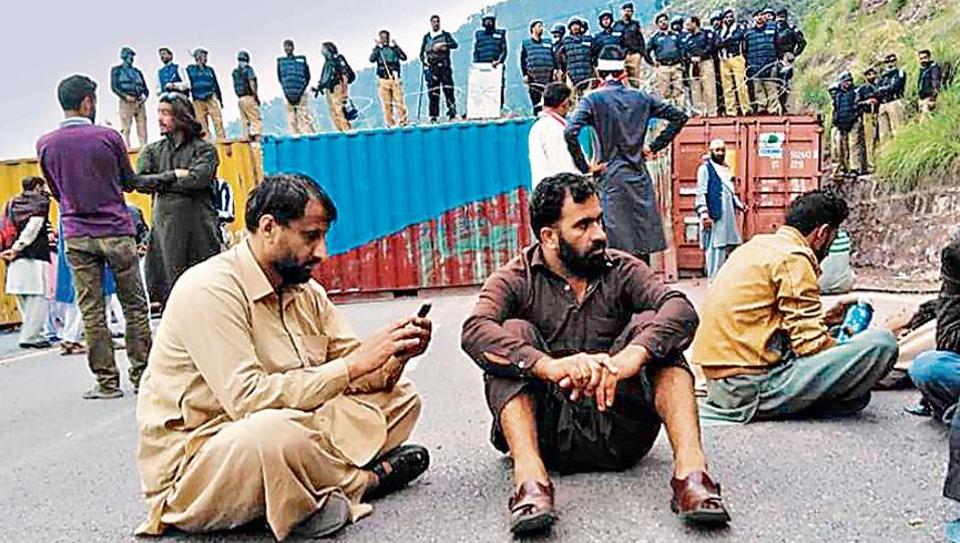
Though it was estimated that over 100,000 would participate in the march – led by JKLF’s PoK president Toqeer Gilani instead of its acting president Abdul Butt – Indian security estimates suggest that at no point did more than 7,000 to 8,000 people gather for the march.
People familiar with the matter said this was because of Islamabad’s continued failure to make an impact with the international community over the Kashmir issue, and the mixed signals sent over official sanction for the march.
“As per the scheduled plan, the breach [of the LoC] was to occur on October 4, but given the poor response, it was decided to build further momentum and mobilise more people and push the breach on October 5,” according to an internal note by the Indian security establishment. HT has reviewed a copy of the note.
The call for the march was put out by JKLF’s central spokesperson Mohammad Rafiq Dar. It began on Friday from various locations in PoK, including Bhimber, Kotli, Mirpur, Samani, Nikiyal and Bagh, and via Muzaffarabad, was to breach the LoC at Chokthi, opposite Jammu and Kashmir’s Uri.
The idea behind the march was to showcase to the global community the groundswell against India’s moves to revoke Jammu & Kashmir’s special status and to break it up into two Union Territories. The people familiar with the matter indicated that, to this end, militant groups including the Lashkar-e-Taiba and the Hizbul Mujahideen were also asked to actively associate with the march.
But, on October 5, Prime Minister Imran Khan urged the protesters not to breach the LoC, saying anyone crossing over – even if to provide “humanitarian aid” or “support” for people in Kashmir -- would “play into the hands of the Indian narrative”.
This, according to the Indian security note, was one of the “mixed signals” that led the people to believe the march was a “futile exercise” and to their “lukewarm” response.
Tensions between India and Pakistan have flared since New Delhi effectively revoked Article 370, which bestowed special status to Jammu & Kashmir, and bifurcated the border state into two Union Territories. India has consistently maintained that the decision to revoke J&K’s special status was an internal matter taken to bolster law-and-order and usher in industrial development and investments. Pakistan has tried on several occasions, including at the recently concluded United Nations General Assembly, to internationalise the issue but with little success.


