The State Disaster Management Authority (SDMA) on Thursday said that there has been no increase in crack-widths among buildings in Uttarakhand's Joshimath town in last three days. SDMA secretary Ranjit Kumar Sinha said metres, installed by the Central Building Research Institute (CBRI) to measure cracks, have not reported any increase in widths.
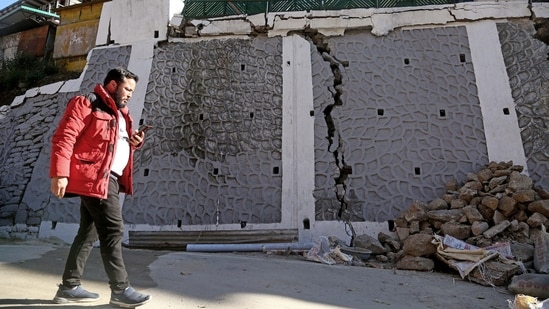
“The crack metres installed by CBRI to measure the cracks in the buildings have indicated no increase in the width of the cracks in the last three days. This is a positive sign,” Sinha was quoted as saying by news agency ANI.
Read| Uttarakhand govt announces first relocations from Joshimath
Informing about the recent meeting held between chief minister Pushkar Singh Dhami and other top officials, Sinha said the CM instructed the Urban Development Department to prepare effective town planning in each district for proper drainage and sewer arrangements. He further added that the Joshimath survey is being carried out by the Chamoli district administration and it is also consulting with the displaced.
The current water discharge rate in the town is 150 litres per minute, according to the SDMA secretary. He said there are around 615 rooms available in temporary relief camps with a capacity to accommodate 2,205 people. Cracks have been noticed in around 849 buildings.
{{/usCountry}}The current water discharge rate in the town is 150 litres per minute, according to the SDMA secretary. He said there are around 615 rooms available in temporary relief camps with a capacity to accommodate 2,205 people. Cracks have been noticed in around 849 buildings.
{{/usCountry}}The Uttarakhand government will rehabilitate over 120 families of Joshimath town to Pipalkoti, nearly 36 km away, in Chamoli district as part of the first phase of its plan to help the affected residents in the subsidence-hit town. Pipalkoti is among four sites identified by the Chamoli district administration to rehabilitate the affected residents in Joshimath. The other sites are nearby villages Dhak and Gaunk Selang, and a horticulture land in Joshimath away from the affected areas.
Read| Eastern Joshimath records maximum subsidence of 10 cm per year: Study
Meanwhile, reiterating the Indian Space Research Organisation's (ISRO) report, an analysis of satellite imagery of Joshimath revealed that maximum subsidence was witnessed in the eastern part between 2018 and 2022 with an average displacement of 10 cm per year. The analysis further reported that the western part of the town displaced at a rate of 3 cm per year followed by the upper part with 2 cm per year.
“It appears that two zones (eastern and western parts of Joshimath designated as A and B in the satellite image) have been continuously moving in the past four years (2018-2022) on the downhill part of the slope. The surface displacement rates are higher in the eastern part of the slope (unit A) with a value exceeding 10 cm per year for the period 2018 to 2022,” said the research conducted by Centre National de la Recherche Scientifique (CNRS).
(With ANI inputs)