Justice DY Chandrachud: Democracy precarious if not supported by social justice
Justice Chandrachud bore down on significance of social democracy and social justice as instruments to achieve the ideals and values enshrined in the Constitution of India.
India’s political democracy is “precarious” until it’s not supported by social democracy and social justice, emphasised Supreme Court justice Dhananjaya Y Chandrachud on Sunday, while advocating that the country’s 75th year of independence must also be an occasion for critical introspection since women and many other communities are yet to effectively “taste the fruit of democracy”.
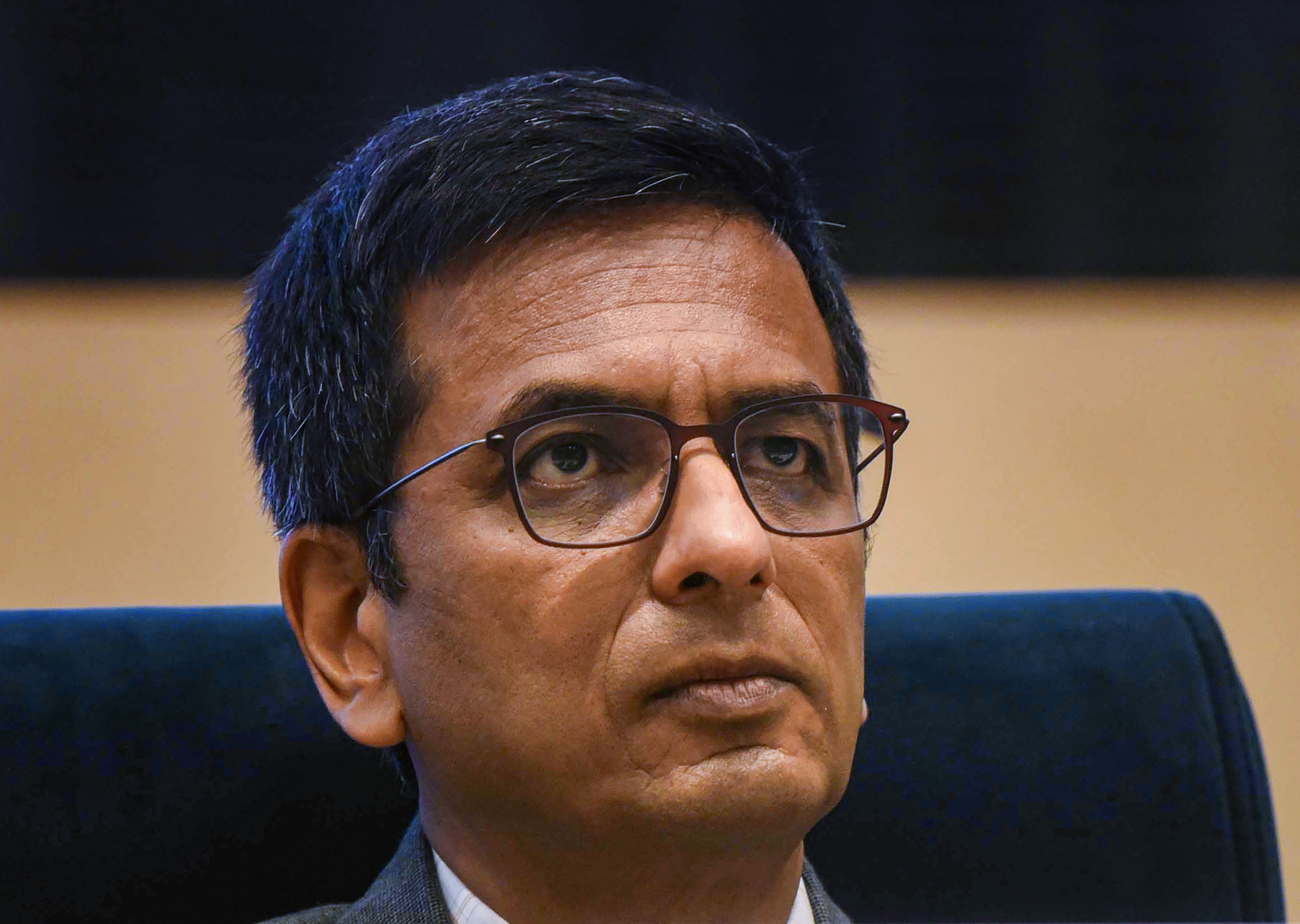
Supreme Court justice DY Chandrachud. (PTI Photo/Shahbaz Khan)
Justice Chandrachud was speaking at the convocation of the OP Jindal Global University where he bore down on significance of social democracy and social justice as instruments to achieve the ideals and values enshrined in the Constitution of India, urging people to adopt promotion of social democracy as their constitutional duty.
Acknowledging that India has taken “mighty strides” in all spheres of life since 1947, the justice cautioned that the 75th Independence Day should not become another ritualistic celebration of the freedom struggle. “Rather, it should become a site for critical introspection of our progress in fulfilling the basic ideals of our Constitution, as enumerated by our Constitution-makers,” he stressed.
Justice Chandrachud lamented that even after 75 years of India’s Independence, many individuals and communities are yet to effectively “taste the fruit of the democracy inherited by us”.
“Because of our hierarchical social and economic structures, many of our citizens are still deprived of equality in social and economic spheres. As Babasaheb Dr Bhimrao Ambedkar warned us, our present structures of political democracy are precarious until they are not supported by social democracy,” flagged the senior judge.
Social democracy, he said, is not a form of government, but a medium to secure social justice, “which, in turn, ensures that equal social and economic opportunities are available to all people in our society, regardless of their religion, race, caste, sex, gender, or place of birth”.
The judge pointed out that though laws may provide for “formal” equality of opportunity, in an asymmetrical world, opportunities are unequally distributed. “Such opportunities open many doors for the ‘haves’, but shut the door for the ‘have-nots’. Thus, in our quest for social justice, we must strive to provide equal opportunities to persons, especially from the marginalised communities, to empower them to effectively enjoy their liberties,” he highlighted.
As the constitutional culture inheres in all citizens, said justice Chandrachud, it is not just the responsibility of the government or the judiciary to promote social democracy and social justice, but for everyone to participate in the “slow, but vital everyday task of transforming our constitution from a charter of ideals to a reflection of reality”.
“We hold the responsibility and the duty which accompanies it, as the inheritors and the guardians of our Constitution, to imbibe and inculcate the constitutional ideals into our daily lives to promote social democracy. It ought to be regarded as a constitutional duty, and it surely is a moral obligation,” he added.
Justice Chandrachud exhorted that the country must also introspect in its 75th year of independence if women have been provided adequate opportunities to effectively exercise their freedoms and participate in public life, regretting that the laws which have been enacted to enhance the capabilities and freedoms of women are “inadequate and limiting”.
The judge cited a recent case before a Supreme Court bench that was headed by him. A woman was denied the right to terminate her pregnancy of 24 weeks since the relevant law did not allow an unmarried woman to do so.
“We considered the legislative intent of Parliament and purposively interpreted the provisions of the Act to uphold the right of the unmarried woman to seek safe termination of pregnancy. In this case, the petitioner had access to effective legal representation to scale the legal barriers. But think about many such women across India, who find themselves in similar situations, without access to any legal aid,” he said.
Thus, Justice Chandrachud underscored, although women may have access to various material choices, the exercise of such choices is dependent upon material pre-conditions, crafted in laws and regulations. “It is our moral and constitutional responsibility to understand these obstacles and address them to effectively empower women to enjoy their freedoms and participate in public life,” he said.
The judge appealed that every citizen must exercise her or his liberty to speak against communalism, casteism, patriarchy, homophobia, and such other harmful attitudes against marginalised communities.
In today’s age of social media, justice Chandrachud advised the young law graduates to break free from the “shackles of algorithms” and reach out to those on the other side of the spectrum and understand their perspective. “Together if we can follow these ideals, I am sure that the day is not far away when India will truly become a social democracy,” he concluded.

 E-Paper