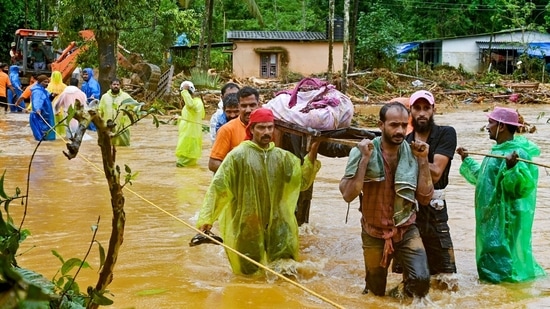
The absence of forest cover and land use change such as construction activities and expansion of monoculture plantations may have exacerbated the impact of continuous heavy rainfall that triggered landslides in Kerala’s Wayanad on Tuesday and left at least 121 people dead and scores injured, experts said.
“There has been heavy rain over two or three days in central and northern parts of Kerala. This was not sudden but continuous heavy rainfall that caused soil to become soft and runny. When the soil moisture is very high, it is saturated and can give way,” said former earth sciences ministry secretary and climate scientist M Rajeevan. “It is also true that human intervention may have played a role in accentuating the impact. These [Western] Ghat regions that once had thick forest cover, mostly have plantations now which are commercially more viable.”
Rajeevan said rubber tree roots, for example, cannot hold the soil together. “Other local trees however can slow down soil slip or hold the soil together. This needs to be investigated further.”
Read more: Kerala landslide: Eco-sensitive zones along Western Ghats yet to be notified
Indian Institute of Tropical Meteorology scientist Roxy Mathew Koll said it was too early to understand the specifics of the Wayanad landslides but admitted that “monsoon patterns are increasingly erratic, and the quantum of rainfall we receive in a short period has increased”. That comes with its own challenges, he explained. “ As a result, we see frequent instances of landslides and floods along the Western Ghats, from Kerala to Maharashtra. In addition, La Nina [defined by unusually cooler waters] conditions are currently underway in the Pacific, which generally results in a stronger monsoon flow.”
{{/usCountry}}Indian Institute of Tropical Meteorology scientist Roxy Mathew Koll said it was too early to understand the specifics of the Wayanad landslides but admitted that “monsoon patterns are increasingly erratic, and the quantum of rainfall we receive in a short period has increased”. That comes with its own challenges, he explained. “ As a result, we see frequent instances of landslides and floods along the Western Ghats, from Kerala to Maharashtra. In addition, La Nina [defined by unusually cooler waters] conditions are currently underway in the Pacific, which generally results in a stronger monsoon flow.”
{{/usCountry}}Koll said roughly half of Kerala is hilly and mountainous, where the slope is more than 20 degrees, making the land prone to landslides amid heavy rains. “Landslide-prone areas are mapped and available for Kerala. Panchayats with hazardous areas should be identified and sensitised. We need to monitor rainfall data in these hotspots and prepare early warning systems for hazard-prone areas. This is possible with the current technology and know-how and could save lives and livelihoods”.
Koll said other than climate change, there is also a need to evaluate land use changes and development activities in landslide-prone areas. “Often landslides and flashfloods occur in regions where the impact of both climate change and direct human intervention in terms of land use changes are evident. At the same time, there have been many severe landslides in regions with minimal land use changes.”
Read more: Kerala landslide: Houses washed away; many still missing
In an interview with HT in 2021 Western Ghats expert and ecologist Madhav Gadgil flagged “extremely destructive activities” in the name of so-called development. “Road projects cutting through hillsides are common.... In 2019, I traveled to Puthumala in Kerala after the landslides and saw several small landslide sites leading up to the big one. There was...a road construction project. Rock quarries are proliferating along these construction sites to provide construction materials. This is leading to a gradual crumbling and weakening of the hills.”
The Western Ghats Ecology Expert Panel, which the central government constituted under Gadgil’s chairmanship, in 2011 recommended that 75% of the 129,037 sq km of the Western Ghats spanning Gujarat, Maharashtra, Karnataka, Goa, and Kerala be declared an environmentally sensitive area because of its dense, rich forests and a large number of endemic flora and fauna. The panel’s recommendations were not implemented.
In 2019, a village was wiped out as a hillside almost melted away, bringing down everything in its path at Puthumala in Wayanad. A hillock collapsed in Mallapuram and buried a village of 44 families around the same time.
The disasters occurred in what Gadgil-led panel in 2011 and a high-level working group on the Western Ghats, which former Indian Space Research Organisation chief K Kasturirangan headed, in 2023 described as the “ecologically sensitive zones”.
So did Tuesday’s landslide.