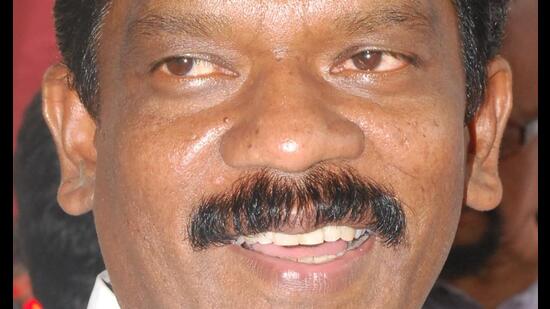
Kerala’s minister for temple affairs and SC/ST welfare K Radhakrishnan on Wednesday stuck to his allegations that he faced caste discrimination at a temple in Kannur district in January, while dismissing the counter-clarifications issued by the temple’s priest and a body of chief priests in the state.
No case has been filed by the police in connection with the incident.
Radhakrishnan, a senior Communist Party of India (Marxist) leader, belonging to the Scheduled Caste (SC) community, had alleged on September 17 that two priests of a temple, after lighting a lamp during a function, declined to hand him the flame (used to light up a bigger lamp) and instead put it down on the ground. “They thought that I would pick up the flame from the ground and light the lamp. Should I light the lamp? I said get lost. You don’t consider the money given by me as untouchable, but you consider me as untouchable,” the minister had said, while addressing a programme of a community organisation in Kottayam.
Though the minister didn’t specify the details of when the alleged caste discrimination took place, the local media reported along with video evidence that the incident took place on January 27 this year at the Nambiatrakovval Siva temple, managed by the state-run Malabar Devaswom Board, in Payyanur in Kannur district.
{{/usCountry}}Though the minister didn’t specify the details of when the alleged caste discrimination took place, the local media reported along with video evidence that the incident took place on January 27 this year at the Nambiatrakovval Siva temple, managed by the state-run Malabar Devaswom Board, in Payyanur in Kannur district.
{{/usCountry}}Reacting to the development, the temple priest Subrahmanyan Namboothiri told reporters that he had only maintained ‘sanctity’ while performing the rituals and did not engage in discrimination against anyone.
He said, “There shouldn’t have been a situation that led to the minister being distressed. But we haven’t intentionally done anything. There is no question of caste discrimination here. As part of pujas at the temple, that’s how we do. I lit the lamp first and then gave it to the next priest who put it down on the ground. He had to perform puja later. Inside the temple, the priest must have sanctity and cannot touch anyone even if it’s a family member or a friend.”
However, the priest’s claim was rejected by the minister Radhakrishnan.
The minister on Wednesday said, “I have visited temples many times but what I saw there, I have not seen anywhere else. Visuals showed that the priest came outside the temple and lit the lamp in the presence of many people. He may have touched many people before going back inside. Is that right? Shouldn’t the entire temple be purified then? The priest can take money from anyone, there’s no untouchability there. There’s only untouchability for humans, which I cannot agree with.”
The minister also said earlier that he didn’t intend to pursue legal action over the incident and that he had raised it merely to sensitise the public about the ills of the caste system.
Meanwhile, the Akhila Kerala Tanthri Samajam, a body of temple priests, said in a statement that the minister had misunderstood customs of a priest maintaining sanctity for temple rituals as caste discrimination.
“Priests at a temple do not welcome the faithful on the basis of caste. A priest who comes to the temple does not touch anyone until all the godly rituals are completed. It does not matter if that person is a Brahmin or not. The controversy at the temple is also the same. In the absence of the ‘tantri’ [chief priest], the temple priest had to come to the compound to light the lamp in the middle of rituals. After lighting the lamp, he returned to the temple as well. His act is not a part of any untouchability,” the outfit said on Wednesday.