
 E-Paper



Key to fatal Air India crash mystery: 32 seconds in flight deck
In the final moments of Air India Flight 171, a crucial pilot exchange raises questions about engine cutoffs, amid an investigation into the cause.

 Prefer HTon Google


In the final seconds of Air India Flight 171, as both engines lost power and the Boeing 787 began its fatal descent, a crucial exchange unfolded between two experienced pilots that investigators believe holds the key to understanding what went wrong.
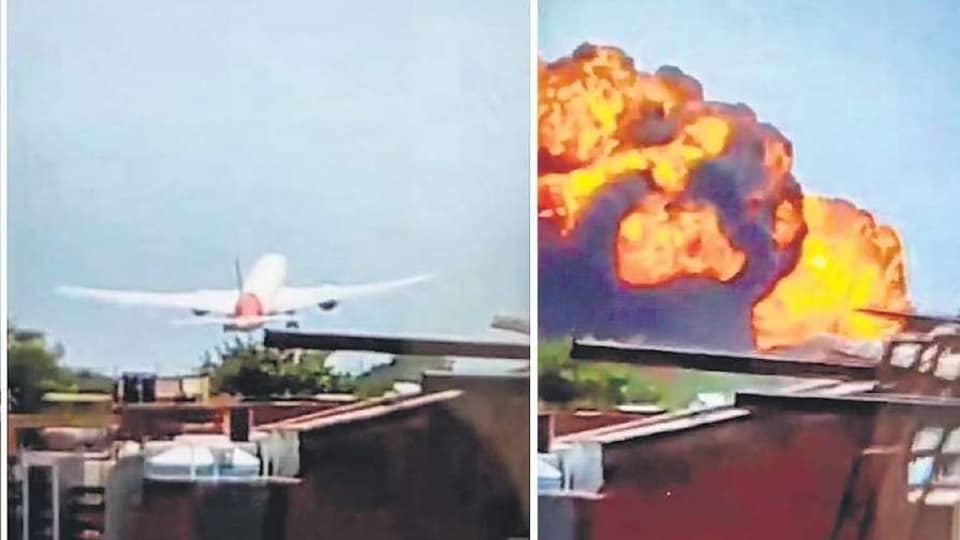
“One of the pilots is heard asking the other why did he cutoff. The other pilot responded that he did not do so,” according to the Aircraft Accident Investigation Bureau’s preliminary report. Those paraphrased words are at the centre of a complex investigation into whether the accident was caused by human error, mechanical failure, or an emergency procedure gone catastrophically wrong.
The cockpit was staffed according to standard procedures, with first officer Clive Kunder, 32, serving as the pilot flying while captain Sumeet Sabharwal, 56, monitored the flight. Both had passed pre-flight breath analyser tests and met all rest requirements, the report noted.
Kunder, the junior pilot, had 1,128 hours on the Boeing 787 and was responsible for controlling the aircraft during the critical take-off phase. Sabharwal, with 8,596 hours on the same type of jet, was tasked with monitoring systems and providing oversight—a standard arrangement designed to combine experience with operational currency.
JS Rawat, former joint director general of DGCA, cautioned against drawing conclusions from the limited cockpit voice recorder information. “While nothing can be ascertained with a paraphrased sentence in the report that mentions one pilot asking the other if he switched off the fuel switches and the second pilot denying the same, nothing can be positively said at this stage,” he said.
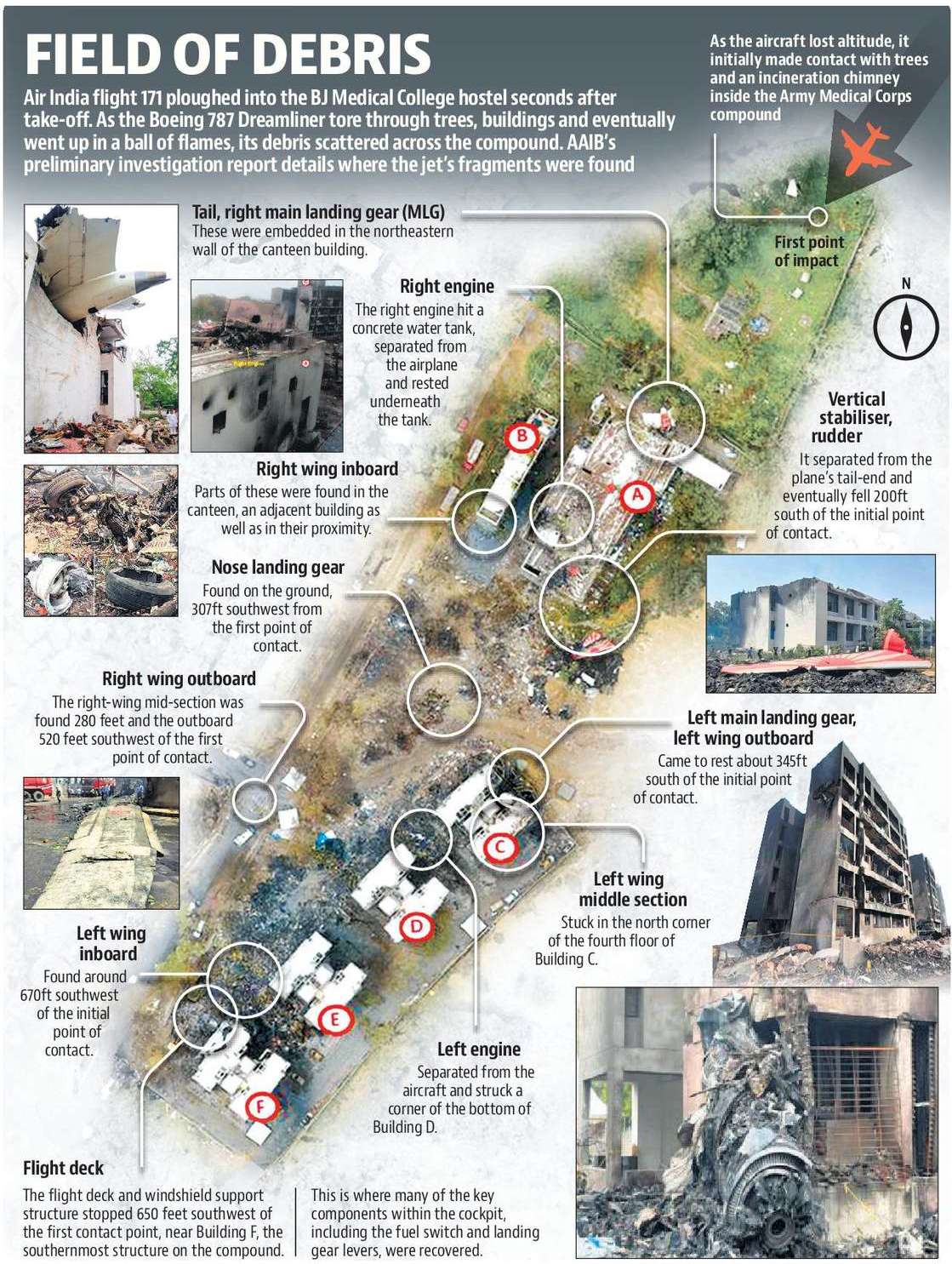
The preliminary report provides a precise timeline of the crew’s actions. Citing flight data from the EAFR (the integrated blackboxes), it states the switches moved to cutoff state one second apart—engine 1 first, followed by engine 2, almost immediately after the plane lifted off from the ground.
“The aircraft achieved the maximum recorded airspeed of 180 Knots IAS at about 08:08:42 UTC and immediately thereafter, the engine 1 and engine 2 fuel cutoff switches transitioned from RUN to CUTOFF position one after another with a time gap of 01 sec,” it stated.
An experienced airline commander, requesting anonymity, questioned the plausibility of pilot error during this critical phase. “It is highly unlikely that any pilot, especially during take-off, would want to fiddle around with switches behind the thrust levels. At best, you’d focus on raising the landing gear which is located in the front panel of the cockpit, or raise the flaps,” he said.
A second pilot framed the phase as a time when pilots are laser-focused on flight instruments in the front, and not the centre console, where the fuel switches are located. “No pilot is inept to want to play around with switches in the middle section of the cockpit when all attention is focused on forward flight cockpit instruments located in front of the pilots, during take-off and landing,” this person said.
At a subsequent moment after the cutoff – the report does not mention when or in what words exactly – came the exchange between the pilots about how the fuel flow stop was engaged.
Roughly 10 seconds after the first engine cutoff was recorded by the flight data recorder, one of the pilots – it is unclear who -- returned the first engine’s switch to “RUN” position. Engine 2’s switch followed another four seconds later.
The four-second interval between restart attempts could indicate pilots following emergency protocols or the time needed to recognise the first engine’s restart attempt before moving to the second. “In my view the 4 second interval was part of emergency protocols and call-outs etc. That is why the entire CVR transcript was essential,” Aviation expert Sanjay Lazar said.
Once they engaged the fuel switches in the run mode, the Boeing 787’s Full Authority Digital Engine Control (FADEC) systems automatically began a sequence to restart the engine.
The crew then issued a Mayday call at 08:09:05 UTC (Co-ordinated Universal Time; 5 hours and 30 minutes behind IST)—23 seconds after the initial fuel cut-off and just six seconds before the flight recorder stopped working.
Both pilots brought significant experience to the cockpit. Sabharwal had accumulated 15,638 total flight hours across multiple aircraft types, while Kunder had logged 3,403 hours overall. Their flying experience was current, with both pilots having flown more than 230 hours in the previous 180 days.
That the report does not identify which pilot made which statement in the crucial exchange reflects investigative protocol designed to avoid prejudging crew actions. Determining whether the pilot flying or pilot monitoring moved the switches—and why—will be crucial to the final investigation.
“What surprises is the intentional mystery with the crew communication transcript documented in the PIR. It’s impossible that during an emergency the cockpit would be so quiet. For starters, take- off checklist and emergency call out phrases are left out in the report allowing the reader to be creative with making assumptions. Clearly critical aspects that are known to the investigators have been withheld,” said Mark Martin, CEO of Marin Consulting, an aviation consulting firm based in Asia.
Peter Goelz, a former managing director of the US’s NTSB, told the BBC: “There’s likely much more on the cockpit voice recorder than what’s been shared. A lone remark like ‘why did you cut off the switches’ isn’t enough,” he said.


