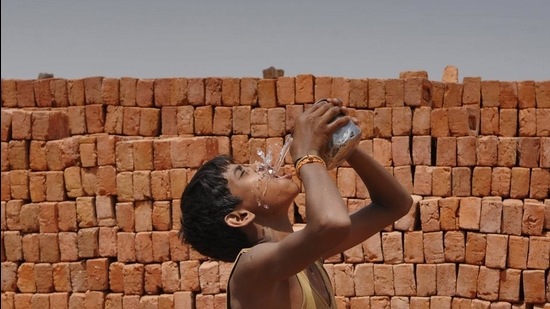
Frequency and duration of heatwaves, droughts, flash floods, urban floods, short intense rainfall events, probability of cyclones to become severe storms will increase in the coming years due to climate change, said M Rajeevan Nair, secretary ministry of earth sciences at Hindustan Times Environment Conclave.
At a session on Climate Change and Green Economy, he said India needs to be ready and come up with specific projection models for how these changes are going to affect agriculture, health, water resources, energy and other sectors to cope with impact.
Agreeing with him, Sunita Narain, director general of Delhi-based advocacy group, Centre for Science and Environment (CSE), said the ministry’s study shows that the impact of climate change was intensifying and India needs to amplify its vulnerability at the international global negotiations, which are expected to get steam with the United States deciding to re-join the Paris Climate Agreement.
Narain said the absolute emissions of US have increased in the four years of Donald Trump government and it is an opportunity for India to push for three agendas at the negotiations.
“One, the world is today talking about how we can involve markets in the reduction of greenhouse gas emissions. India needs to push for transformational markets, a market mechanism that pays us the true cost of carbon dioxide reduction. We don’t want any cheap convoluted market-based mechanism which takes away our cheapest options,” she said.
{{/usCountry}}“One, the world is today talking about how we can involve markets in the reduction of greenhouse gas emissions. India needs to push for transformational markets, a market mechanism that pays us the true cost of carbon dioxide reduction. We don’t want any cheap convoluted market-based mechanism which takes away our cheapest options,” she said.
{{/usCountry}}Also read | Climate crisis can be new area of cooperation for India, US: Antony Blinken
Narain said the second agenda that India should push is the role within markets of land-based sinks. “Sinks are those which absorb carbon dioxide. And there is a huge debate on how accurate is the estimation of the role of sinks in carbon dioxide reduction. India needs to put this on the table because the fact is our forests are the habitats of our very poor people. And we cannot look at forests just as carbon sinks. If we can come up with the right formula and invest in the livelihoods of forest-based communities, build our forest resources, it will be good for us,” she said.
Lastly, she said, the world will have to move towards much tougher emission reduction targets. “Today’s targets set under the Paris Agreement amount to nothing. We must drive the issue of equity in the target setting. We must insist that countries have to take reductions based on the contributions to the problem. And we must ask for burden-sharing in the target setting when it comes to Paris Plus, when it comes to talking about what we will do to reduce emissions so that we can stay within the phase two threshold,” she said.
Coming back to India’s vulnerability, Nair said based on the climate change projections and past data, it has become evident that though Indian monsoon is robust, rainy days are coming down, dry spells are increasing, India is warming equal to global warming elsewhere in the world and cold waves are reducing.
“This will have a serious impact on agriculture and farmers need to devise ways to cope up with these changes,” he said.
Stressing that Indian climate change models are improving day by day, Nair said for the first time India has developed an Indian climate model from which it has started making future climate change projections.
“And for the first time, our climate change projection model will be included in the IPCC (The Intergovernmental Panel on Climate Change) report coming in 2022 or so. We are collaborating with foreign scientists and improving our projection models and reducing uncertainty in projections,” he said.
Under Paris Agreement of December 2015, the goal is to limit global warming to below 2, preferably to 1.5 degrees Celsius (°C), compared to pre-industrial levels by turn of the century. Studies shows at the present rate of emissions the temperature rise would be 3°C.