E-Paper



Long-lost, tattered Town Hall diary, signed by leaders from Zhou Enlai to Saddam, restored
From Soong Ching-ling to Tito, a rediscovered visitors’ book from Town Hall chronicles Delhi’s pivotal role in the post-colonial world.

 Prefer HTon Google


On a December afternoon in 1955, Soong Ching-ling – known better as the “Mother of Modern China” – stood beneath the high grand Victorian Edwardian-style arches of Chandni Chowk’s Town Hall, bathed in the warmth of applause.
“India, China. Two nations resurgent. Peking, New Delhi. The new Asia arising. Peace, Friendship. One Billion Pairs of hands. Your protectors! Hindi-Chini Bhai Bhai. Hindi-Chini Bhai,” she wrote in the Town Hall’s visitors’ book in Chinese, sealing the moment with the optimism of the short-lived Hindi-Chini friendship of the 1950s. Soong, an honorary president of the People’s Republic of China and a revolutionary figure in her own right, had come to New Delhi in the dawn years of India’s independence.
Back then, Delhi’s Town Hall was more than a civic building – it was the city’s diplomatic salon. Under its colonnades, mayors welcomed presidents, poets, and heads of state. Civic receptions were staged with the gravity of statecraft: symbolic keys to the city exchanged hands, garlands draped over shoulders, abhinandan patra (formal letters of congratulations) read aloud as cameras clicked.
For decades, those encounters seemed to live only in fading photographs, and in the memories of dignitaries and officials who were part of these meetings.
Then, during a routine record room cleanup last year, a municipal heritage team stumbled upon a piece of history.
A battered, leather-bound visitors’ book. Its spine cracked, its pages foxed and crumbling, the ledger held in its hand-inked lines the ghost of an era — signatures, messages, and sketches from foreign dignitaries who passed through Delhi from the 1950s to the 1980s.
“It’s a treasure,” said a senior official from the Indira Gandhi National Centre for the Arts (IGNCA), which is now restoring the book. “Every page tells you what the world thought of India in those formative years, and how Delhi presented itself to that world.”
The first pages record Soong Ching-ling’s flourish in 1955, followed by a neat November 1956 note from Zhou Enlai, China’s premier. He wished for the “peaceful construction” and “long friendship” of two nations, ending with “Hindi Chini Bhai Bhai” in carefully brushed Chinese characters — hope inked just years before the 1962 war would shatter it.
Two lines down, a royal signature: Haile Selassie, the Ethiopian emperor whose reign bridged the colonial and post-colonial worlds. His 1956 visit was steeped in solidarity. Ethiopia still remembered India’s support during Italy’s brutal occupation two decades earlier. Selassie came to speak with then Prime Minister Jawaharlal Nehru about African and Asian decolonisation, Delhi at that moment being the nerve centre of what is now known as the Global South.
These grand gestures often unfolded under the watch of Ram Niwas Agarwal, president of the Delhi Municipal Committee from 1954 until 1958, just before the creation of the unified Municipal Corporation of Delhi (MCD).
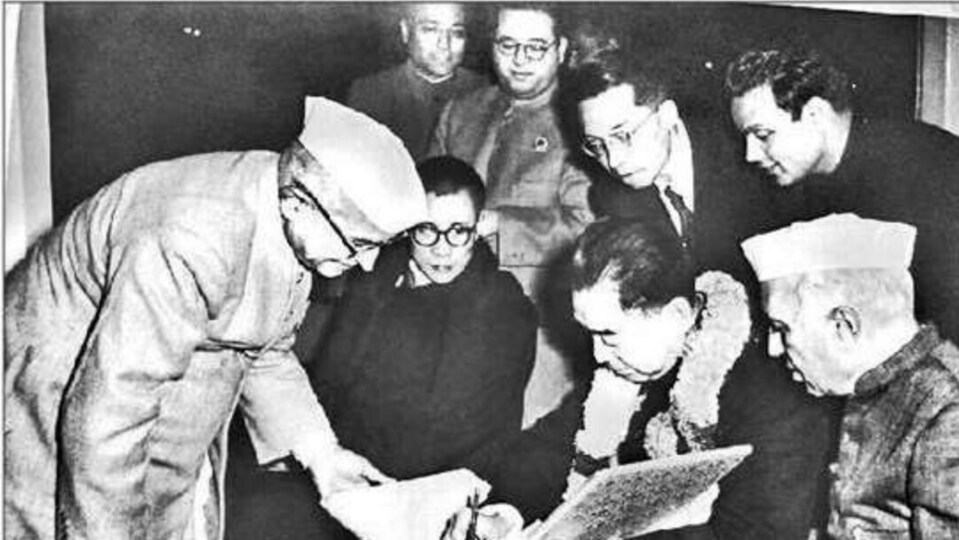
His granddaughter, Mahika Agarwal, has preserved photographs in a family album she calls Bauji’s Delhi: her grandfather alongside Nehru and Marshal Tito of Yugoslavia; her grandmother welcoming Soraya, the Empress of Iran, in February 1956; her grandfather greeting Queen Elizabeth. Also among these photographs are one of Zhou signing the book, flanked by Nehru and a young Dalai Lama in 1956 – three years before the Tibetan leader fled to India and sought refuge.
In the book, Tito’s words appear – a typewritten note from November 15, 1956, during the Unesco General Conference held in Delhi: “The days which we spend in New Delhi will remain as an unforgettable memory. The warm reception given to our delegation by the citizens of this beautiful and blooming city has left a deep and pleasant impression on us.”
The 1956 UNESCO conference, which was the first to be held east of the Mediterranean, transformed Delhi into a diplomatic amphitheatre. For a month, global faces debated science, education, and culture even as the Suez Crisis and Hungarian Revolution shook the world. Tito’s friendship with India would later be immortalised in the naming of Josip Broz Tito Marg in south Delhi.
The ledger, which became a chronicler of that historic summit, reads like a roll call of mid-century history.
There is Nehru’s own signature in 1955, then President Rajendra Prasad’s in the same year, Japanese PM Nobusuke Kishi in 1957, Harold Macmillan and his wife in 1958, New Zealand’s PM Keith Holyoake, and Mohammad Zahir Shah, the last king of Afghanistan, in February 1958.
In 1959, Edwina Mountbatten – the last Vicereine of India – signed her name during a visit from then Burma, a reminder of the colonial past still in memory.
“This was a time when the city, through its mayor, was part of international diplomacy,” said a municipal heritage official.
The Town Hall’s embrace was not limited to politics. On November 21, 1957, Marian Anderson – the celebrated African American contralto whose voice became a weapon against segregation – is found mentioned as well.
Anderson was a poignant figure in American civil rights movement. Two decades earlier, barred from performing before an integrated audience in Washington, Anderson had sung instead on the steps of the Lincoln Memorial in a concert arranged by Eleanor Roosevelt. By 1957, she was a goodwill ambassador for the US State Department, touring Asia.
In Delhi, under the gaze of Gandhi’s statue behind Town Hall, she performed “Lead Kindly Light” – the first Westerner to sing at his memorial.
Some entries, meanwhile, are more surprising, especially in hindsight.
In 1974, a young Saddam Hussein – the then deputy leader of Iraq’s Revolutionary Command Council – filled half a page in Arabic, praising “shared experiences and historic relationships” between the two nations. Back then, he was a rising regional figure; decades later, his name would be synonymous with war and dictatorship.
By the late 1970s, the tone of the book changes. Many entries are signed not by presidents and premiers but by committee members, bureaucrats, and cultural delegations. Pages are missing, torn, or water-damaged. Officials suspect the gaps conceal other major visits – or perhaps that they were lost during Delhi’s political upheavals in the 1980s and ’90s, when the corporation was suspended for years.
Today, about 140 pages have been painstakingly restored.
Conservators humidify the brittle paper, flatten creases, and reinforce torn corners with Japanese tissue. The fragile handwriting – from elegant calligraphy to hurried scrawls to foreign scripts – is being digitised, each name cross-referenced with archives, newspaper clippings, and family collections. Photographs and, where possible, film footage are being sourced to accompany the book in a planned municipal museum gallery.
Saroj Kumar Pandey, a conservator working on the conservation project, said that such brittle papers with handwritten notes using ink require extra care. “Paper has not strengthened and torn pages are are filled in with Japanese rice paper. We use gluten-free starch as an adhesive. Each paper is tested through bleeding test and ink signatures are stabilised using chemicals after removing stains.”
In Chandni Chowk, Town Hall stands restored on the outside, its mustard-yellow façade bright against the jostle of traders and rickshaws. Inside, the council chambers are silent. But in the ledger’s pages, Delhi’s voice is vivid – hopeful, confident, eager to be seen.
The rediscovered visitors’ book is more than civic memorabilia. It is an atlas of mid-century diplomacy mapped onto one city’s address book.
And in that sense, the book serves as a memory of how Delhi imagined itself – as a Capital not just of India, but the epicentre of the post-colonial world.