Madras high court on Monday passed an interim order restraining the Tamil Nadu government’s Hindu Religious and Charitable Endowments (HR&CE) department from establishing new institutes using temple funds. It also stated that the functioning of four educational institutions run by the department would be subject to the result of a PIL against this move, and sought a report from HR & CE in three weeks.
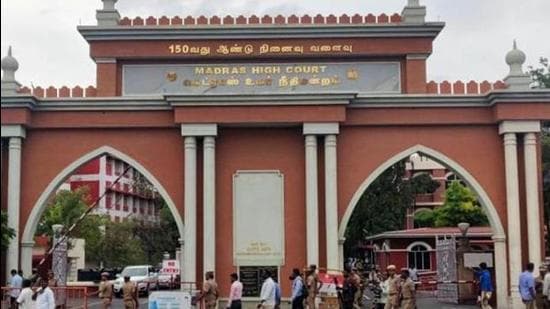
“It must be appreciated that however pious the intention may be to use perceived surplus funds for the purpose of education, these funds are out of offerings for a particular cause and, ordinarily, the cause must not be forgotten, and the same must be espoused with a part of the funds, even though the larger sphere of education may also be addressed,” the court said in its orders.
Chief justice Sanjib Banerjee and justice P D Adikesavalu issued the interim orders while hearing the PIL filed by T R Ramesh, who petitioned that funds of the temples should be used for the restoration and renovation of the temples and that decisions on financial matters can be taken only by the trustees of the temples.
The judges said that apart from the four colleges that are ready to open for admissions at Kolathur (chief minister M K Stalin’s constituency) in Chennai, Tiruchengode Taluk in Namakkal, Ottanchathiram in Dindigul and at Vilathikulam in Thoothukudi, no steps should be taken to set up other proposed colleges. “In other words, educational institutions on the basis of Section 36 of the Act (Tamil Nadu Hindu Religious and Charitable Endowments Act, 1959) or Section 66 thereof or even Section 97 thereof should not be instituted at this stage till trustees at the relevant temples are first put in place and the leave of this court is obtained in such regard.”
{{/usCountry}}The judges said that apart from the four colleges that are ready to open for admissions at Kolathur (chief minister M K Stalin’s constituency) in Chennai, Tiruchengode Taluk in Namakkal, Ottanchathiram in Dindigul and at Vilathikulam in Thoothukudi, no steps should be taken to set up other proposed colleges. “In other words, educational institutions on the basis of Section 36 of the Act (Tamil Nadu Hindu Religious and Charitable Endowments Act, 1959) or Section 66 thereof or even Section 97 thereof should not be instituted at this stage till trustees at the relevant temples are first put in place and the leave of this court is obtained in such regard.”
{{/usCountry}}The DMK, which formed the government in Tamil Nadu in May, had on October 6 passed a government order from the higher education department to open these colleges using temple funds. Advocate General R Shanmugasundaram informed the court that funds from the ‘common good fund’ are being utilised for this purpose.
The court directed the HR & CE department to introduce a new subject on Hindu religion in the four colleges under the department that have already started functioning. The court noted that in the four colleges BBA, B Com and other similar courses have been offered without any regular course in religious instructions in the Hindu religion. “It will be a condition precedent to the four colleges opening that a stream of religious instructions in Hindu religion is introduced. If such a course is not introduced within a month of the college starting, the further functioning of the college cannot continue,” the court said.
The matter has been posted for December 20.