The actual target of Tuesday’s Maoists attack in Sukma was the district superintendent of police and the rebels blew up the anti-landmine vehicle presuming the officer was travelling in it, police officials said on Wednesday.
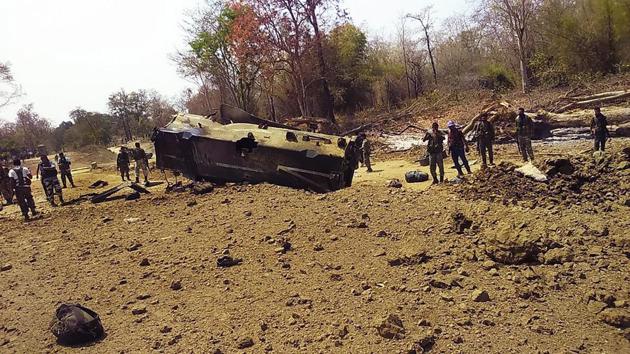
The IED blast triggered by the Maoists on Tuesday killed nine Central Reserve Police Force (CRPF) personnel and injured three other troopers in the Bastar region of Chhattisgarh.
”The main target was SP Sukma Abhishek Meena and ASP Suman Saurabh. Both had a narrow escape as they had passed by the same spot just 10 minutes earlier. They (Maoists) thought the SP would be in the heavy vehicle hence they targeted it,” said Inspector General of Police, Bastar, Vivekanand, who goes by his first name.
There were 10 CRPF jawans in the anti-landmine vehicle. Three of them were returning from leave and were going to Palodi camp while the others were returning from Kistaram bazaar on Tuesday.
Police officials claimed that the attack was planned and executed by 26-year-old Maoist commander Mandvi Hidma and his team.Hidma was also reported to be behind the April 2017 attack in which 25 CRPF troopers were killed and dozen others injured.
{{/usCountry}}Police officials claimed that the attack was planned and executed by 26-year-old Maoist commander Mandvi Hidma and his team.Hidma was also reported to be behind the April 2017 attack in which 25 CRPF troopers were killed and dozen others injured.
{{/usCountry}}“This is the main area of the battalion headed by Hidma and they want to target something big to stop the road construction work going on in the area. They are rattled because road connectivity is enabling the forces to enter the core area of Hidma,” The IG said.
At ground zero, the impact of the IED blast was visible even 24 hours after the attack. The mangled remains of the vehicle was still smouldering on Wednesday afternoon and the pieces of the debris could be found nearly 100 meters away from the blast crater.
Police said the Maoists had planned the operation meticulously to cause maximum casualties.
Soon after the IED blast ripped apart the vehicle, the Maoists closed in on the spot and started firing on the surviving troopers from behind the cover of trees, the police said.
“There were more than 150 Maoists and it seems that they had planned this ambush about a week ago. Over 50 kilograms of explosives were planted and triggered by a remote device. They had made markings on the trees to accurately target the vehicle and were also perched on tree tops,” said a CRPF officer involved in collecting evidences from the spot and did not wish to be named.
The CRPF officials said the Maoists wanted to send two signals through this attack. First, that they still dominate the area despite the CRPF camp set up in a small tribal village Palodi, where the Maoists had organised a women’s day function in 2015. Second, that they will not allow road construction in the area as the Kistaram to Palodi road on which the attack happened was being meant to provide better connectivity for the forces.
On Wednesday morning more than 500 personnel of the CRPF and district police cordoned off the whole area and started combing operations with the help of drone cameras. “We have detained more than a dozen people in connection with the attack and their interrogation is going on,” the IG said.