E-Paper



March ends with rain deficiency, dry air, soil over northwest India
Delhi’s Safdarjung station recorded a relative humidity of only 10 to 15% on Thursday afternoon as dry, northwesterly winds blew over the Capital


The first month of the three-month pre-monsoon season (March, April, May) ended with a rain deficiency of 45% across the country—43% over northwest India; 47% over east and northeast India; 56% over the South Peninsula, and 38% over central India, and moisture deficiency in air across northwest India, according to India Meteorological Department (IMD) scientists.

Delhi’s Safdarjung station recorded a relative humidity of only 10 to 15% on Thursday afternoon as dry, northwesterly winds blew over the Capital.
“There is no weather system which is bringing in moisture to the region. For the next 4-5 days, we expect very dry conditions over the entire northwest India. The relative humidity was 32% in the morning which had dropped to 10 to 15% in the afternoon. Whatever moisture was there is evaporating,” said Kuldeep Shrivastava, head, regional weather forecasting centre.
“In January and February, there were two Western Disturbances. In March, there were 4-5 Western Disturbances but most of them brought rain to the western Himalayas so the plains are very dry. When strong, warm and dry winds are blowing they can cause dehydration to people outdoors during afternoon hours. This is called loo, it’s normally felt in May. Those stepping out should remain hydrated or avoid stepping out during afternoon,” he added.
Also Read | ‘It’s April, but feels like May-June’: Heatwave grips north India
A Western Disturbance is expected to affect the western Himalayan region around April 4 but its impact is likely to be limited to the region. “From April 6, humidity may go up marginally after the Western Disturbance moves away,” said Shrivastava.
IMD Pune’s Standard Precipitation Index (SPI) for March 2021 suggests almost the entire northwest India and Indo-Gangetic Plains region is mildly to moderately dry.
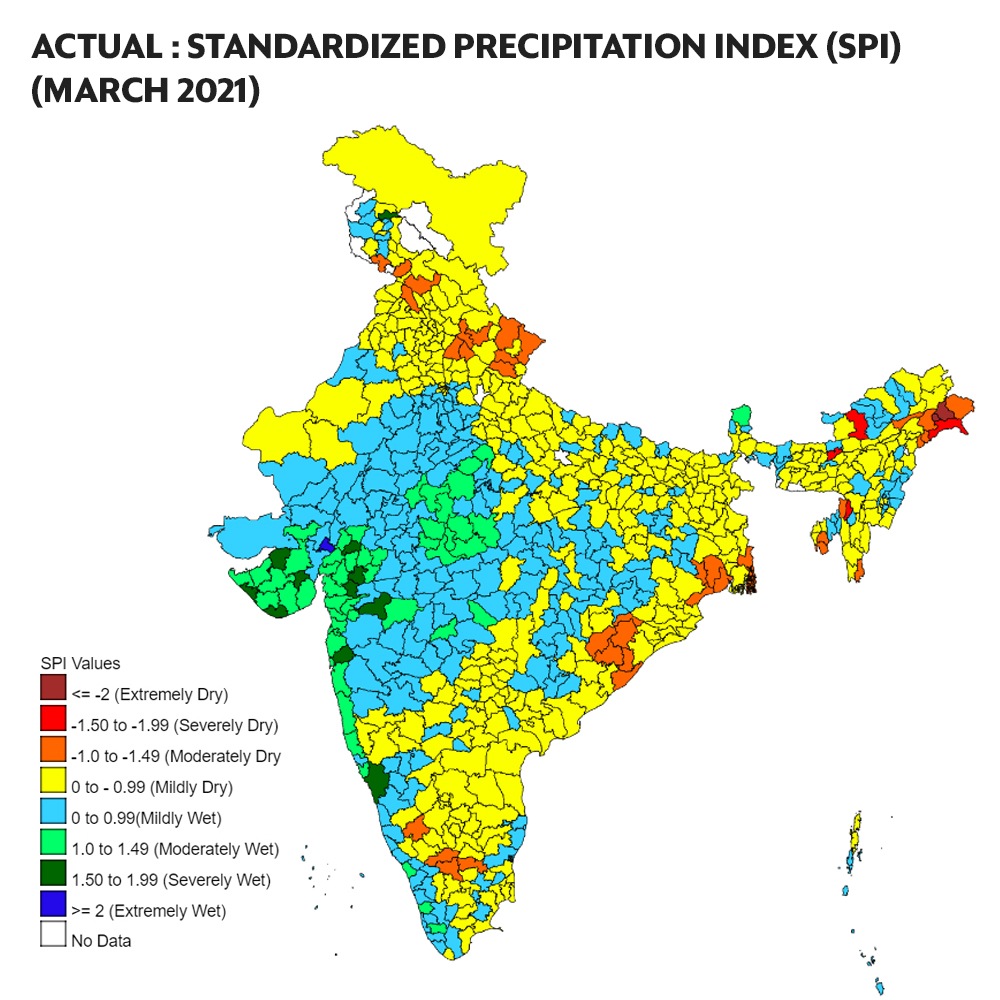
SPI is an index used for drought monitoring and is negative for drought, and positive for wet conditions. Most parts of the northeast and peninsular India are also dry with some pockets severely and extremely dry indicating drought like conditions. East Rajasthan and most parts of central India are mildly wet.
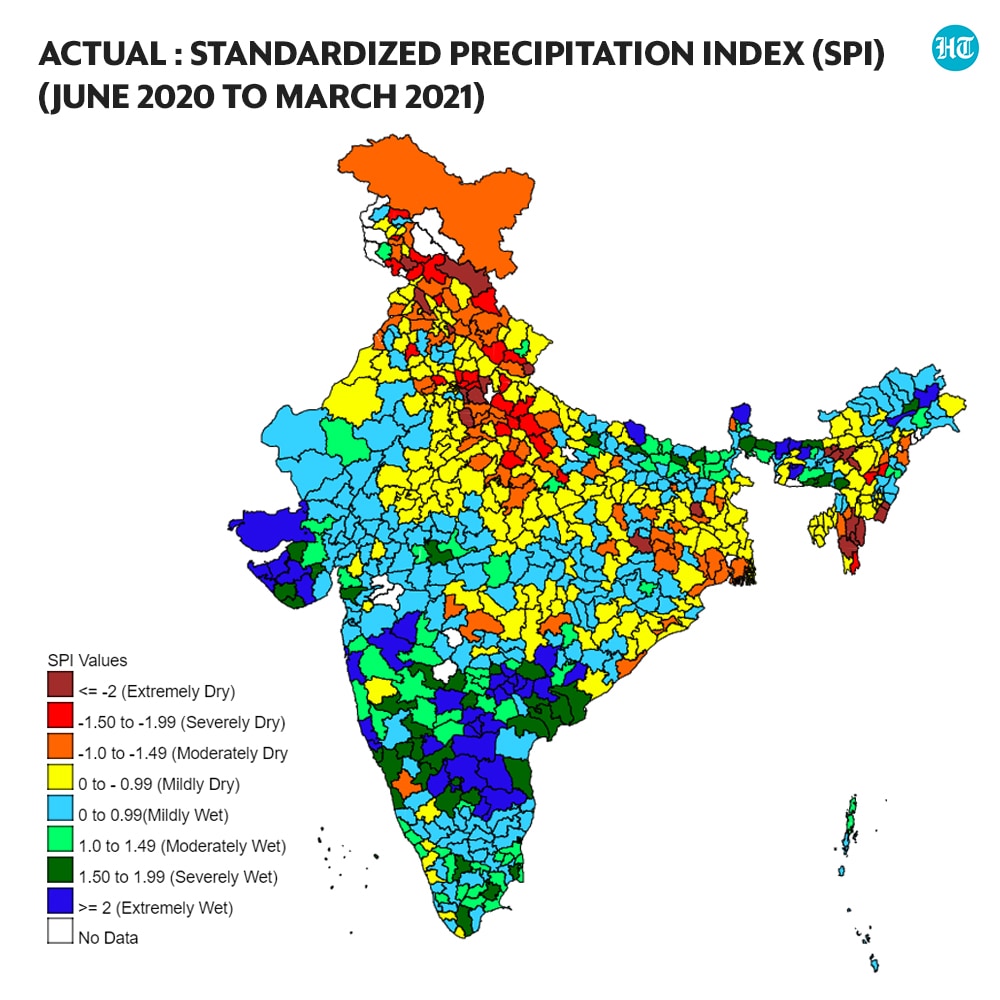
When the June 2020 to March 2021 period is considered, several districts in the Indo-Gangetic Plains region and northeast India are extremely dry.
The Haryana, Chandigarh and Delhi region has a rain deficiency of 64% during March.
No heatwave is likely over most parts of northwest and Central India during the next 2-3 days. Strong surface winds (speed reaching 30-40 kmph) are very likely over most parts of Punjab, north Rajasthan, Haryana, Chandigarh, Delhi, West Uttar Pradesh and northwest Madhya Pradesh during the next 24 hours, according to IMD’s Thursday bulletin.
“Though March is dry across a very large region, climate models are showing good rainfall activity in April, May and June. But extreme north India and northeast India are likely to remain dry. We do not issue any official forecast for this period. We are likely to transition from La Nina to ENSO neutral conditions in coming months. ENSO neutral condition has no adverse effect on the monsoon hence a normal monsoon can be expected,” said OP Sreejith, scientist, Climate Monitoring and Forecast, IMD, Pune.