
 E-Paper



Mark Carney cites ‘rupture’ in rules-based order, promises multilateral approach
The speech came as President Donald Trump posted an AI-generated image with the American flag superimposed on Greenland, the Danish territory he wants to annex

 Prefer HTon Google


With the “rupture” in the rules-based world order, Canada’s new approach will be principled and pragmatic and multilateral, as it seeks to rapidly diversify abroad while negotiating free trade deals with countries like India, Canadian Prime Minister Mark Carney said in a special address at the World Economic Forum in Davos on Tuesday.
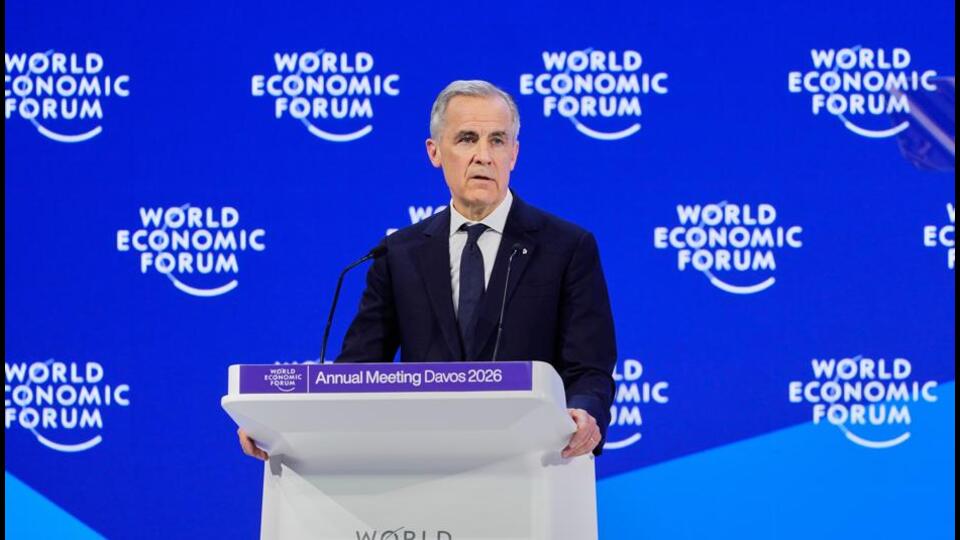
The speech was described by commentators as a “eulogy” for the current world order and came as President Donald Trump posted an AI-generated image with the American flag superimposed on Greenland, the Danish territory he wants to annex, and Canada, which he earlier said should be the 51st state of the US.
Carney addressed the “rupture in the world order, the end of a nice story”, which marked “the beginning of a brutal reality where geopolitics among the great powers is not subject to any constraints.”
He stressed that middle powers were not powerless but had the “capacity to build a new order” embodying their values. Carney said it was known “the story of the international rules-based order was partially false” with the strongest exempting themselves “when convenient” with trade rules “enforced asymmetrically.”
“And that international law applied with varying rigour depending on the identity of the accused or the victim,” he said. “This fiction was useful, and American hegemony, in particular, helped provide public goods: open sea lanes, a stable financial system, collective security, and support for frameworks for resolving disputes.”
That bargain, he noted, no longer worked. “Canadians know that our old, comfortable assumption that our geography and alliance memberships automatically conferred prosperity and security is no longer valid.”
The “new approach”, he said, rested on what Finnish President Alexander Stubb has termed “values-based realism” or, as Carney put it, “principled and pragmatic.”
Ottawa is practising pragmatism in “recognising that progress is often incremental, that interests diverge, that not every partner shares our values” and “engaging broadly, strategically, with open eyes.”
“We actively take on the world as it is, not wait for a world we wish to be,” he said, adding that Canada was “calibrating” its relationships so their depth reflects its values. “We are rapidly diversifying abroad,” he said. “We are negotiating free trade pacts with India, ASEAN, Thailand, the Philippines, [South American trade bloc] Mercosur.”
He said that to address global problems, Canada was pursuing “variable geometry”, or “different coalitions for different issues, based on common values and interests.” Carney added this was not naive multilateralism, but “building the coalitions that work, issue by issue, with partners who share enough common ground to act together.”
“In a world of great power rivalry, the countries in between have a choice: to compete with each other for favour or to combine to create a third path with impact,” he said. “The old order is not coming back. We should not mourn it. Nostalgia is not a strategy. But from the fracture, we can build something better, stronger, and more just.”
As part of the pragmatic approach, Carney has negotiated a new strategic partnership with China. He will travel to India after the budget is presented in New Delhi, to take the renewed bilateral relationship forward.


