The Opposition on Tuesday slammed the BJP government over its decision to introduce a 0.4 per cent Merchant Discount Rate (MDR) on UPI payments above ₹2,000 made to merchants. The Congress called it the "Modi tax" and alleged that a "compromised" prime minister had "surrendered" to US pressure.
After nearly six years of allowing merchants to use UPI without a transaction fee, the government announced a 0.4 per cent MDR charge on payments above ₹2,000, effective October 15.
MDR is a fee that merchants pay to banks and payment companies when a customer makes a digital payment. The new rules apply only to person-to-merchant (P2M) transactions above ₹2,000. Person-to-person (P2P) payments will continue to remain free, regardless of the amount.
Opposition targets BJP over UPI move
Pawan Khera, Congress' media and publicity department head and Rajya Sabha MP, said the 0.4 per cent MDR on UPI payments above ₹2,000 should be termed the "Modi Tax".
"He popularised UPI, wanted all the credit for building a 'cashless economy' -- and now he is taxing people for using it," Khera said on X.
The Aam Aadmi Party (AAP)'s official X account posted, “Loot the people, fill up the pockets of your own, this is the BJP’s way.”
{{/usCountry}}The Aam Aadmi Party (AAP)'s official X account posted, “Loot the people, fill up the pockets of your own, this is the BJP’s way.”
{{/usCountry}}Indian Union Muslim League (IUML) Rajya Sabha MP Haris Beeran told news agency PTI that the government has “betrayed the general public”.
“...It means that merchants will definitely have to pay. They will then try to recover the cost from customers. Secondly, this will discourage merchants from going digital,” he said.
Rahul Gandhi, Kharge on UPI charges
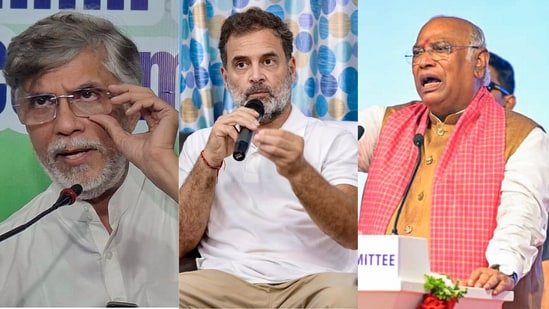
Leader of Opposition (LoP) in the Lok Sabha and Congress MP Rahul Gandhi alleged that the Modi government has quietly cleared the way for UPI charges, while Congress chief Mallikarjun Kharge said the Modi government's "loot" has now reached UPI.
"The government says no fees will be charged to customers. But where will the fees imposed on shopkeepers ultimately come from? Added to the prices, straight out of the customer's pocket," Gandhi wrote.
Gandhi alleged that US payment companies have long opposed India's zero-MDR policy, adding, "Just like with the US Trade Deal, Compromised PM Modi is once again surrendering to American pressure,"
In a post, Kharge alleged that high inflation has already put a strain on the common person's finances.
"Wholesale inflation is near 10%, and the BJP government has planned to impose a 'Digital Payments Tax' on the public, aiming to destroy whatever little savings they have left," he said in a post in Hindi on X.
Govt clarifies new UPI rules
From October 15, a 0.4 per cent MDR will apply to person-to-merchant (P2M) UPI transactions above ₹2,000. The charge will be capped at ₹300 for payments of ₹75,000 and above.
Essential and thin-margin sectors, including railways, telecom, insurance, fuel and agricultural inputs, will face a flat MDR of ₹5 on each transaction above ₹2,000. These sectors account for nearly 17 per cent of P2M transaction volume, while making up around 46 per cent of P2M transaction value.
Person-to-person (P2P) transfers, which account for 37 per cent of UPI's transaction volume and 70 per cent of its transaction value, will remain free regardless of the transaction amount.
The government said small-value transactions of up to ₹2,000 make up more than 95 per cent of total P2M volume. These transactions will not be affected by the new charge.