The Union cabinet on Monday decided to cut the salaries of the Prime Minister, other ministers, and parliamentarians by 30% for a year, and to suspend for two years, a scheme under which parliamentarians get Rs 5 crore a year to spend on developmental work, with all the money saved going into the consolidated fund of India to be used to fight the Covid-19 pandemic.
That’s expected to work out to approximately Rs 7930 crore. Of this, a total of close to Rs 29 crore will come from the salaries of MPs.
According to an official, an MP gets a Rs one lakh salary and Rs 3 lakh and 60 thousand will be the annual contribution of every MP including the prime minister, other ministers, and parliamentarians. Another Rs 7900 crore will come from the Member of parliament Local Area development Scheme.
In addition, the President, the Vice President and the governors of states have also decided to take salary cuts.
Separately, Lok Sabha speaker Om Birla too has decided to take a 30% cut in salary for the year starting April 1.
“Charity begins at home,” Information and Broadcasting Minister Prakash Javadekar said while announcing the cuts. “Cabinet has approved an ordinance amending the Salary, Allowances, and Pension of members of Parliament Act, 1954.” The cut is effective for the salary of 2020-21.
Opposition MPs welcomed the salary cuts but there was a mixed reaction to the suspension of the MPLAD scheme, with some saying it would prevent them from caring for their constituents in need.
{{/usCountry}}Opposition MPs welcomed the salary cuts but there was a mixed reaction to the suspension of the MPLAD scheme, with some saying it would prevent them from caring for their constituents in need.
{{/usCountry}}“As an MP who represents a predominately rural constituency I fully support the 30% cut in my salary. However the suspension of MPLADS is a bit of an overstretch. At this time of grave humanitarian distress that will get only worse in the months ahead.MPLADS is a targeted & nimble instrument to customise micro level interventions to alliviate distress. I think MPLAD Funds need to be restored.Plz re-think it once again. It is a knee jerk reaction much like the lockdown at a 4 hour notice. It will hurt poor most,” said Congress MP Manish Tewari.
His party colleague Jairam Ramesh, however, expressed different views.
“I welcome the decision on MPLADS. I have been arguing for long that the approximately Rs.7000 crore given to MPs & MLAs annually for development works should be used as a corpus for State funding of elections,” Ramesh said.
Congress leader Randeep Surjewala said his party supported the cut in MPs’ salaries. He, however, added that suspending the MPLADS was a disservice and will undermine the role of an MP.
CPI(M) leader Sitaram Yechury said there is enough evidence that COVID 19 is best fought at the state and local level. By suspending MPLADS, government is taking away expenditure which would have attended to unique requirements of an area. This centralization goes against federalism, development and will weaken our fight, claimed Yechury.
If there is no money with the government why doesn’t it abandon the Central vista project in Delhi, Yechury asked.
A member of parliament is paid a salary of Rs 1,00,000 plus allowances. A member of Parliament would contribute Rs 30,000 per month and Rs 3,60,000 in the year.
The salary of the prime minister of India is the same as other MPs. The President of India is paid a salary of Rs five lakh per month while the Vice President is paid Rs four lakh per month. The president, vice president and governors have also volunteered to take a 30% cut. The governors are paid Rs three lakh and fifty thousand each.
The Consolidated Fund of India is the fund into which all tax revenues flow, and the one used to make most payments.
Significantly, only the salary, and not the pension and allowances of the MPs will be reduced.
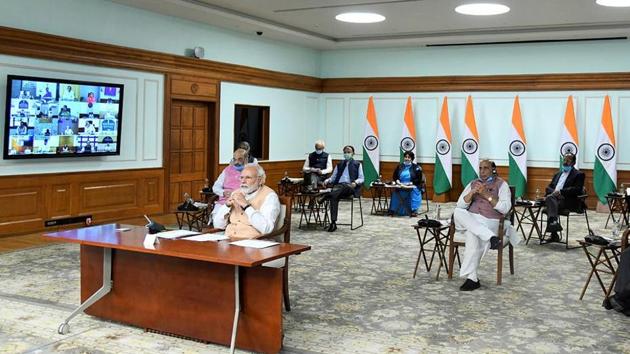
Prime Minister Narendra Modi chaired the cabinet meeting and then a meeting of his council of ministers. Both were conducted over video conference. .
Responding to a question on whether the salaries of MLAs would also be slashed, Javadekar said this decision can only be taken by the states.
Political scientist Nilanjan Sircar said that the economy was not doing well even before coronavirus so certainly some cuts had to be made in order to fund the response to the pandemic.
“That being said, it clear that when the first place you are going to is cutting MPLADS, given the tenor of all the policies that we have seen especially in the elections since 2019, I think it is genuinely pointing towards far greater political and economic centralization in the system,” he said.
Sircar added that while the fight against coronavirus necessitates some steps in funding but the question was whether this is the right one. “Taking a salary cut for MPs perhaps is okay, but I do think suspending, given that MPs especially have very little political freedom. There is anti-defection, they cannot vote against their parties, so this one area in which even those who were not necessarily connected to the ruling could distinguish themselves,” he said.