
 E-Paper



Multilateral institutes must recalibrate for relevance: Sitharaman
While participating in a book discussion on ‘Recalibrate: Changing Paradigms’, the finance minister said there is a global need to recalibrate after a series of calamities, while stressing on the need for multilateral institutions to make themselves relevant.

 Prefer HTon Google


Union finance minister Nirmala Sitharaman on Tuesday stressed on the need to recalibrate multilateral institutions such as the World Bank and the World Health Organisation (WHO) after the pandemic to remain relevant in a changing world.
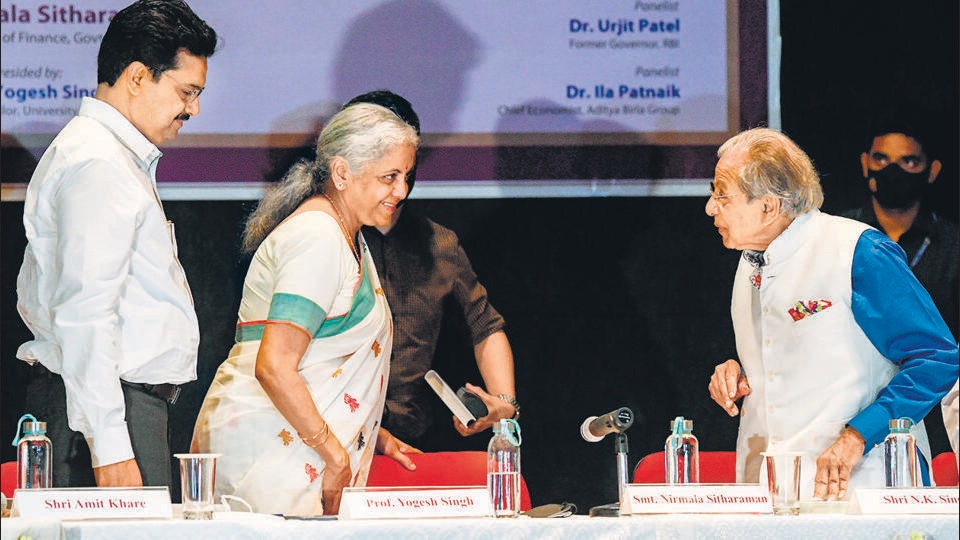
While participating in a book discussion on ‘Recalibrate: Changing Paradigms’ authored by Fifteenth Finance Commission chairman NK Singh, with select insights by PM’s principal secretary PK Mishra, the finance minister said there is a global need to recalibrate after a series of calamities, while stressing on the need for multilateral institutions to make themselves relevant.
Giving reference to one review of the book, she said, it “rightly” said that this book calls for reforms beyond the clichéd land, labour and farm reforms. “Actual statement of fact,” she said. adding that the book gives a path for further institutional reforms.
Citing from one chapter that highlights Mishra’s experience in Gujarat, she acknowledged that policymaking should be based on the principle of fairness and principle of gender equity.
Referring to another article of Mishra’s, she said, “In today’s India, we are, and we should increasingly leverage technology” citing connectivity with beneficiaries at remote places due to technology-based platforms such as Co-Win and Aarogya Setu”.
Resilience should come with resources, with technology, with adaptation, with also skilling the local people, to be able to pre-empt a disaster, and so on, she said. Referring to Nassim Nicholas Taleb’s “black swan” theory, she said, the Covid-19 pandemic could have been predicted, hence, preemptive in some ways.
Speaking about chapters written by Singh, she underscored his insights on regulators. “I think, regulators will have to be ahead of the times, always, because regulation cannot be after the damage is done,” she added.
Referring to the issue of “freebies” raised in the book by Singh, the finance minister said: “Dr Singh has complete authority in fiscal management.” She agreed that more debate on this matter is required.
On Singh’s suggestion to set up a permanent Fiscal Council to further strengthen fiscal discipline, Sitharaman said there are institutions in place although they “have to be regenerated” periodically, and will have to be recalibrated. A Fiscal Council has been proposed for better coordination between the Finance Commission and the Goods and Services Tax (GST) Council or in other words, between the Centre and the states on fiscal matters.
Sitharaman said existing institutions of India have been globally recognised for their coordinated efforts during the pandemic. “The pandemic has shown the world that India’s institutions… could rise to the occasion and address stress points of the economy…,” she said.


