
 E-Paper



Doda encounter: Recent terror attacks highlight threats across Jammu
Officials said there is now growing acknowledgement of a pattern that terrorists from across the border are now targeting Jammu’s Pir Panjal & Rajouri belts

 Prefer HTon Google


At least one army officer and three troopers succumbed to their injuries after they were critically injured in the sixth major terror attack in the Jammu region this year in Desa forests of the Doda district late on Monday, people aware of the matter said on Tuesday.
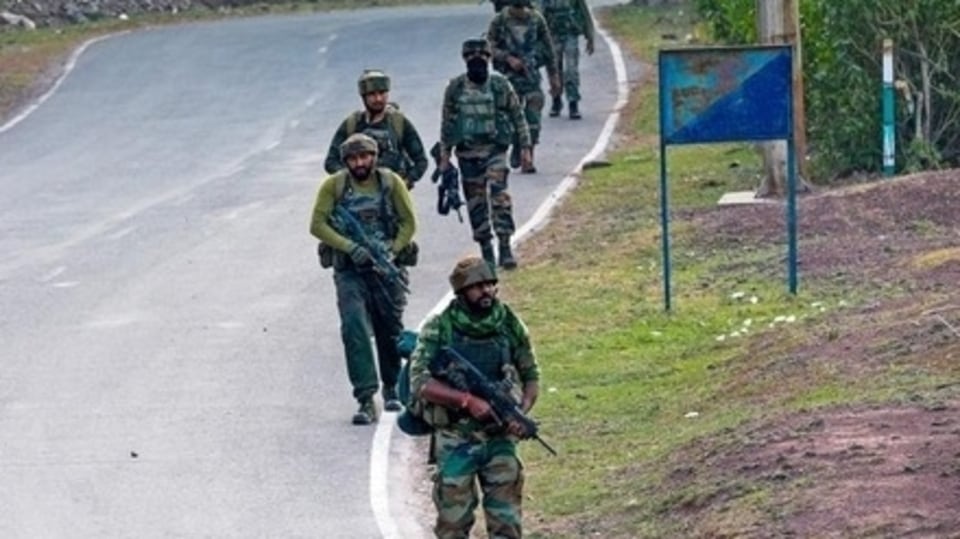
The recent spate of attacks in Jammu has shed light on the growing terrorist threat that has affected the area over the last two years.
Officials said that there is now growing acknowledgement of a pattern, first red-flagged in 2023, that terrorists from across the border are now targeting Jammu’s Pir Panjal and Rajouri belts, which have seen a series of attacks over the past two years.
In 2024 for instance, terrorists attacked a security convoy in Poonch; a social welfare department employee was killed in Rajouri by terrorists in April. Six days later, a village defence guard was killed in a gunfight with infiltrators in Udhampur, and on May 4, terrorists ambushed a security convoy, killing an IAF officer and injuring four others in Poonch.
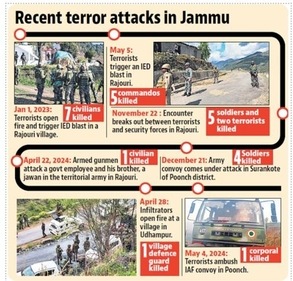
These attacks all preceded the four attacks within 76 hours in June — the first on Sunday when terrorists opened fire on a bus of devotees which subsequently lost control and fell into a gorge, leaving 9 dead and 42 injured. In the two separate encounters in Doda and Kathua on Tuesday night, spilling into Wednesday morning, one CRPF official was killed, six other security personnel and one civilian injured.
Two terrorists were killed in the exchange of fire in Kathua.
Later that day, a second group of terrorists attacked a police team in Kota Top area, 150km away from Chhattargala, and injured head constable Fareed Ahmed. In 2023 too, Jammu saw a series of significant terrorist attacks, with two each in Poonch and Rajouri leaving at least 18 security personnel dead.
In January, seven civilians were killed when militants opened fire and triggered an IED which targeted villages in Rajouri’s Dhangri village. In July 2023, officials involved in counter terrorism efforts had told HT that terror groups from Pakistan were now targeting Jammu, Rajouri, Poonch and Reasi districts, forcing security agencies to “recalibrate their responses”.
One officer had told HT at the time that there were between 30 and 40 highly trained terrorists that had crossed over into Jammu.
“While trained terrorists appear to be using the Line of Control (LoC) to enter India and hide inside the forests; their commanders are also trying to establish their bases in the Jammu region. In fact, one or two senior commanders of the terror group Al-Badr may have already come to Jammu either via Nepal or Bangladesh,” one officer had said.
Also Read: Terrorism in Jammu and Kashmir: A look at past terror attacks during Amarnath Yatra
On Wednesday, senior police officers in Jammu and Kashmir said that there is a “new batch of terrorists” which have infiltrated into Jammu with the explicit purpose of creating unrest in the region, estimating that their numbers have grown to between 70 and 80. RR Swain, Jammu and Kashmir director general of police said, “We are moving from resident terrorism to foreign terrorism. This means that numbers of our local boys, who used to join the terror ranks, have come down... as of today 70 to 80 such terrorists have come with arms and ammunition,” Swain added.
A second officer said that there was likely an attempt to create unrest ahead of the Amarnath Yatra, scheduled to begin later this month, and assembly elections— the first after the abrogation of Article 370 in August 2019—set to be held in a few months.
This included, they said, the creation of new terror proxies, pointing to the little known Kashmir Tigers which have claimed responsibility for the Doda attack. Security experts said that a challenge for the forces was the geography of the Pir Panjal region, replete with forests which provide numerous hiding places, and that the area has historically seen less attention from security forces than Kashmir.
“It is a new strategy being adopted by handlers in Pakistan, who are trying to activate the regions of Pir Pan jal, especially the Poonch, Rajouri and Udhampur axis. We also have little human intelligence here which gives terrorists the scope to escape. The area where the attacks are taking place are difficult to reach because of the hostile terrain,” said one security officer who has served in the area. But senior officials said that they have been cognisant of these new challenges and have taken steps such as training village defence guards in some regions.
Also Read: Time for Centre to redeploy troops in Jammu from peace locations: Experts
In January 2023 for instance, five civilians were killed in Rajouri’s Dhangri when armed men indiscriminately opened fire, and twelve hours later, two children under the ages of 18 were killed when an IED planted by terrorists exploded in the same village. Since then, the CRPF has arranged for training for village defence guards, once active in the 1990’s, in parts of Jammu and Kashmir to counter terror attacks in their respective areas.


