E-Paper



Navy to bolster posture in Indian Ocean with new warships, submarine
India's Navy will commission three major combat platforms on January 15, enhancing self-reliance in shipbuilding amid rising Chinese influence in the IOR.

 Prefer HTon Google


NEW DELHI: India’s shipbuilding prowess and steps being taken to bolster its maritime posture in the vast Indian Ocean Region (IOR), where China is seeking to boost its influence, will be in sharp focus as the navy gets ready to commission three major combat platforms into service on January 15, officials aware of the development said on Wednesday.
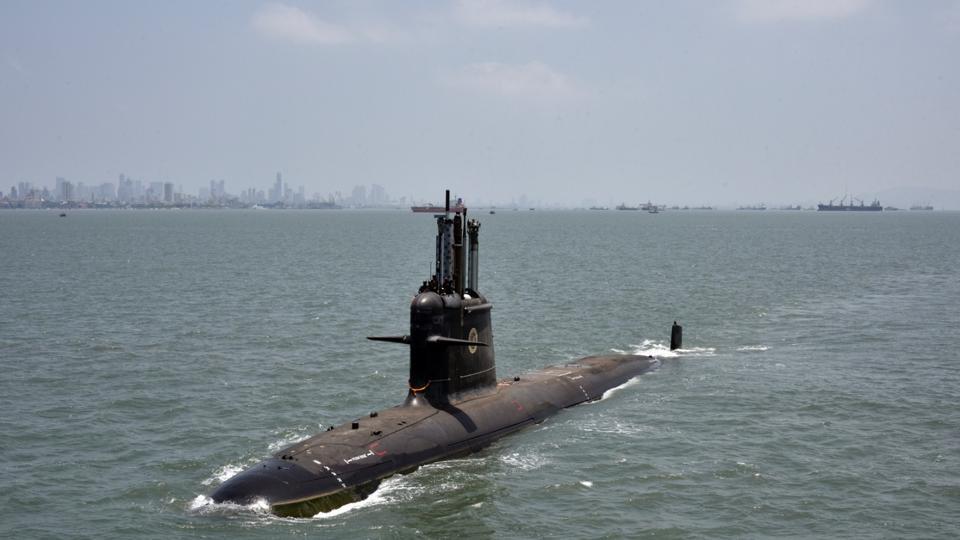
The rare simultaneous induction of two warships and a submarine at the Naval Dockyard in Mumbai will also put the spotlight on the navy’s fast-paced indigenisation and how it is working on becoming fully self-reliant by 2047 when India celebrates 100 years of independence --- 60 warships are under construction at various Indian shipyards, the officials added.
The navy is also about to conclude two key deals with France for 26 new Rafale-M fighter jets and three more Scorpene-class submarines to sharpen its combat capabilities.
Also Read | MoD inks deals worth ₹2,867 cr to boost navy’s underwater power
The upcoming commissioning of the front-line assets will provide a significant boost to the navy’s combat potential as well as underscore the country’s pre-eminent status in indigenous shipbuilding, the navy said in a statement on Wednesday.
It will induct Vaghsheer, the sixth and final Kalvari-class submarine; Surat, a destroyer; and Nilgiri, a frigate -- all built at the Mumbai-based Mazagon Dock Shipbuilders Limited (MDL) -- on the same day, , as previously reported by HT.
“January 15, 2025 is set to become a landmark day in India’s history as the Indian Navy prepares to commission three front-line combat platforms --- Nilgiri, the lead ship of the Project 17A stealth frigate class; Surat, the fourth and final ship of the Project 15B stealth destroyer class; and Vaghsheer, the sixth and final submarine of the Scorpene-class project --- together at Naval Dockyard, Mumbai,” the navy said.
Also Read | Why 2025 could be India’s maritime moment
The new platforms will boost the navy’s operational capabilities and combat readiness in the IOR --- a strategic maritime expanse where the challenges include China’s carefully calculated power play for influence and defending the rules-based international order.
The development comes at a time when China is seeking to expand its maritime footprint in the region by setting up military bases, pushing countries to advance its maritime claims and forcing strategic concessions from vulnerable states.
India has consistently called for a free, open and inclusive order in the IOR, pivoting on respect for sovereignty and territorial integrity of all nations, while stressing on peaceful resolution of disputes through dialogue and under the framework of international laws.
The three new platforms are a testament to India’s growing self-reliance in the critical domain of defence production, the navy said. “The commissioning of these advanced warships and the submarine will highlight the rapid progress made in warship design and construction, cementing India’s position as a global leader in defence manufacturing.”
Nilgiri is a major advancement over the Shivalik-class frigates, incorporating significant stealth features and reduced radar signature through state-of-the-art technology, the navy said, adding that Surat is the culmination of the follow-on to the Kolkata-class destroyers, featuring substantial upgrades in design and capabilities.
“Both ships were designed by the navy’s Warship Design Bureau and are equipped with advanced sensors and weapon packages developed primarily in India or through strategic collaborations with leading global manufacturers,” the statement added.
Nilgiri and Surat can operate a range of helicopters, including Chetak, the advanced light helicopter and the newly inducted MH-60R.
“These ships also have specific accommodations to support a sizeable complement of women officers and sailors, aligning with the navy’s progressive steps toward gender inclusion in front-line combat roles.” MDL delivered Surat and Nilgiri to the navy on December 20.
Vaghsheer has been built under a ₹23,562-crore programme called Project 75. The navy currently operates five such submarines.
These Kalvari-class (Scorpene) diesel-electric attack submarines have been constructed at MDL with technology transfer from the French firm, Naval Group.
Vaghsheer is one of the most silent and versatile diesel-electric submarines in the world, the navy said. “It is designed to undertake a wide range of missions, including anti-surface warfare, anti-submarine warfare, intelligence gathering, area surveillance, and special operations. Armed with wire-guided torpedoes, anti-ship missiles, and advanced sonar systems, the submarine also features modular construction, allowing for future upgrades such as the integration of air independent propulsion (AIP) technology,” the statement said.
On December 30, the defence ministry signed two separate contracts worth ₹2,867 crore to strengthen the navy’s underwater capabilities --- for retrofitting its Kalvari-class submarines with AIP systems to enhance their endurance, and integration of electronic heavyweight torpedoes (EHWT) to boost their firepower capabilities.
The ministry signed a ₹1,990-crore contract with MDL for the construction of AIP plug for the Defence Research and Development Organisation (DRDO)-AIP system and its integration on the conventional submarines, and another contract worth ₹877 crore with the Naval Group for integration of the torpedoes to augment the firepower of the Kalvari-class submarines.
The combined commissioning of the three platforms demonstrates India’s unparalleled progress in self-reliance and indigenous shipbuilding, the navy added. “The vessels have undergone rigorous trials, including machinery, hull, firefighting and damage control assessments, as well as proving all navigation and communication systems at sea, making them fully operational and ready for deployment.”
INS Tushil, the country’s latest stealth missile frigate that was commissioned into the Indian Navy at the Yantar Shipyard in Kaliningrad, Russia on December 9, is also expected to reach the country’s western coast in mid-February.
Tushil (or the protector shield) is an upgraded Krivak III class frigate of Project 1135.6, and six such vessels are already in service --- three Talwar class ships, built at Baltic shipyard in St Petersburg, and three follow-on Teg class ships, built at the Yantar shipyard.
Tushil is part of an over $2.5-billion deal with Russia for four more Krivak/Talwar class stealth frigates for the Indian Navy, two of which were to be constructed at the Yantar shipyard and the remaining two will be built at the Goa Shipyard Limited with technology transfer from Russia. The second Russia-made frigate, Tamal, is expected to be commissioned into the Indian Navy in mid-2025.
The government has approved two nuclear-powered submarines to be designed and constructed indigenously, navy chief Admiral Dinesh Tripathi said in December.
The first submarine is expected to be ready by 2036-37 and the second one two years thereafter. The navy’s overall plan is to deploy six such nuclear-powered conventionally armed submarines to deter the country’s adversaries in the Indo-Pacific.
The navy has obtained the defence ministry’s acceptance of necessity (AoN) for 31 warships and submarines, all of which will be made in India, including seven stealth frigates under Project 17B and six modern (diesel-electric) submarines under Project 75(I). Under India’s defence procurement rules, AoN by the defence acquisition council, headed by the defence minister, is the first step towards buying military hardware.
In August 2024, India commissioned its second indigenous nuclear-powered ballistic missile submarine, Arighaat, at Visakhapatnam, with Singh then asserting that it will further strengthen India’s nuclear triad (ability to launch nuclear weapons from land, air and sea), enhance nuclear deterrence and help establish strategic balance in the region.
Arighaat or S-3 is the second Arihant-class submarine and more advanced than INS Arihant (S-2). The country’s third nuclear-powered ballistic missile submarine, Aridaman or S-4, is also set to be commissioned in 2025, followed by a fourth codenamed S-4*.