Power trade, cooperation in legal matters on agenda for Nepal PM’s visit
Some agreements in the field of energy, especially one to allow Nepal to sell power to Bangladesh via India, may be finalised during PM Pushpa Kamal Dahal visit
NEW DELHI: Cooperation in a range of areas, from transit power trade to streamlining assistance in legal matters, are expected to be on the agenda for Nepal Prime Minister Pushpa Kamal Dahal’s maiden visit to India beginning May 31, people familiar with the matter said.
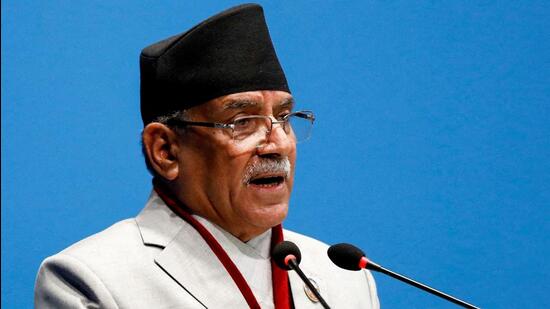
Nepal's Prime Minister Pushpa Kamal Dahal, also known as Prachanda, is slated to be in India during May31-June 3. (REUTERS File)
{{^htLoading}} {{/htLoading}}
Some understandings and agreements in the field of energy, especially an arrangement to allow Nepal to sell power to Bangladesh via India, are expected to be finalised during the visit by Dahal, also known as “Prachanda”. India and Nepal are also working on a mutual legal assistance treaty (MLAT) in criminal matters and the issue is expected to figure in the discussions, the people said.
Though both sides are yet to officially announce the visit, Dahal is expected to be in India during May 31-June 3. In addition to holding talks with his Indian counterpart Narendra Modi and meeting President Droupadi Murmu in New Delhi on June 1, Dahal is expected to visit Indore in Madhya Pradesh to study the city’s waste management system and cleanliness initiatives, the people said.
{{^htLoading}} {{/htLoading}}
{{^usCountry}}
Nepal and Bangladesh have pressed India to allow transit power trade in recent years. Bangladesh Prime Minister Sheikh Hasina raised the issue of importing power from Nepal and Bhutan through India during her visit to New Delhi last September. The matter also figured during Nepal foreign minister Narayan Prakash Saud’s visit to Dhaka in mid-May, when he urged Bangladeshi companies to invest in his country’s hydropower sector.
{{/usCountry}}
{{#usCountry}}
Nepal and Bangladesh have pressed India to allow transit power trade in recent years. Bangladesh Prime Minister Sheikh Hasina raised the issue of importing power from Nepal and Bhutan through India during her visit to New Delhi last September. The matter also figured during Nepal foreign minister Narayan Prakash Saud’s visit to Dhaka in mid-May, when he urged Bangladeshi companies to invest in his country’s hydropower sector.
{{/usCountry}}
“India and Nepal are now close to an understanding and an agreement is expected to be finalised during the Nepalese prime minister’s visit. This will help meet a long-standing demand of Nepal, which has hydropower it wants to trade, and Bangladesh, which needs additional energy,” one of the people cited above said.
Addressing an event in Dhaka on May 13, Saud said Nepal was encouraged by India’s recent response in facilitating energy cooperation. “We are making progressive strides towards the import of power from Nepal to Bangladesh. Once materialised, even if in the form of a small volume of 40-50MW...it would be a huge milestone...for sub-regional cooperation,” he said.
{{^htLoading}} {{/htLoading}}
Other agreements related to power trade and construction of transmission lines are expected to be finalised during Dahal’s visit. There could also be forward movement on cooperation in fertilisers, including the setting up of a factory in Nepal, the people said.
Ahead of Dahal’s visit, the two countries held their first round of negotiations on the MLAT in criminal matters on April 13. From the Indian side, the virtual meeting was attended by representatives of the law, home and external affairs ministries and the Central Bureau of Investigation (CBI).
The Indian side has been pushing for MLAT, which will streamline and speed up the process for seeking assistance in criminal cases, as the existing extradition treaty is now seen as archaic since it was signed on October 1953.
{{^htLoading}} {{/htLoading}}
“It is often seen that criminals from India commit crimes and then escape to the other side to avoid capture by police. India and Nepal already have great working relations when it comes to criminal matters, which can be taken forward in terms of information and intelligence-sharing about fugitives and fast-track extraditions,” a person familiar with developments said on condition of anonymity.
Several criminals and terrorists have been arrested by Indian security agencies in Nepal in the past. For instance, former Indian Mujahideen chief Yasin Bhatkal was captured from near the border in Raxaul in Nepal in 2013. Similarly, Amit Kumar, a doctor involved in a multi-crore kidney racket, was caught by the CBI from Nepal in 2018.
Rezaul Hasan Laskar is Foreign Editor with the Hindustan Times, which he joined in 2015. He began as a journalist in his hometown of Shillong in northeast India and has worked in newspapers and wire services over the years. He moved to New Delhi in 1997 and initially focused on defence, national security, Jammu and Kashmir and the northeast, while also working of foreign policy and international relations. He has been part of the media delegation accompanying PMs on foreign visits and has reported from destinations ranging from Tibet to Ukraine. Between 2007 and 2013, he was the Press Trust of India correspondent in Pakistan, one of only two Indian journalists allowed to report from the country. He extensively covered Pakistan’s domestic politics and the life of the common people, as well as the fallout of the 2008 Mumbai attacks on India-Pakistan relations and the subsequent trial in Pakistan of the suspects involved in the attack. As part of his reportage in Pakistan, he travelled the breadth of the country, from the Swat Valley to Balochistan. Reza’s first gig in journalism was writing a weekly music column, and music – especially classic rock – remains a keen interest. He is also a movie buff and a keen photographer.
Neeraj Chauhan is a senior journalist with Hindustan Times and an investigative reporter specialising in national security, terrorism, organised crime, narcotics, corruption, financial crime and complex investigations. With over 21 years of experience across Hindustan Times, The Times of India, The Indian Express and The Pioneer, he has built deep expertise in India’s internal security and law-enforcement landscape. Neeraj has extensively covered India’s principal investigative, intelligence and security agencies, including the NIA, CBI, ED, IB, R&AW, MHA and other central security forces. His work has included deeply reported investigations into terrorism, terror financing, cross-border crime, narcotics trafficking, cybercrime, financial fraud and political and corporate corruption. He has reported on some of the most significant terror attacks and security developments in India over the past two decades, including the Delhi serial blasts, the 26/11 Mumbai attacks, the 2019 Pulwama terror attack and the recent Pahalgam attack. His reporting has also chronicled the rise and decline of the Indian Mujahideen, the activities and subsequent crackdown on the Popular Front of India (PFI), Islamist extremist networks, the conflict in Jammu and Kashmir, insurgencies in the Northeast and Maoist violence. Some of Neeraj’s major breaking stories are in Aryan Khan drug case, Sushant Singh Rajput suicide, interception of a 3,000-kg Afghan heroin consignment worth about ₹21,000 crore at Mundra port, Sri Lanka easter bombings, Aarushi-Hemraj murders in Noida, 2G scam, coal block allocation scam, AgustWestland VVIP chopper deal and major bank frauds and extradition cases involving Mehul Choksi, Nirav Modi and Vijay Mallya. His reporting is marked by an ability to cultivate sources, analyse confidential and complex documents, and follow investigations over several years—from the initial breakthrough to chargesheets, trials and international legal proceedings. He specialises in making complicated security and investigative developments accessible while examining their wider implications for governance and public policy. A Chevening South Asia Journalism Programme Fellow at the University of Westminster, Neeraj also spent time at the Financial Times as part of the fellowship. He was also a Robert Bosch Media Ambassadors India-Germany Fellow, studying at the University of Tübingen and working with Der Tagesspiegel in Berlin. He has previously taught investigative journalism and crime reporting as a guest faculty member at the Times School of Journalism. Over more than two decades, Neeraj has established himself as an authoritative voice on India’s national security and investigative landscape, with his reporting closely followed by officials, investigators, lawyers, policymakers and readers seeking insight into some of the country’s most complex and consequential developments.
Get real-time updates on CJP Delhi Protest LIVE , breaking headlines, and top India News, breaking headlines, and real-time updates from across the nation. Stay informed on politics, government policies, crime, Today Weather, and major developments on Hindustan Times
Get real-time updates on CJP Delhi Protest LIVE , breaking headlines, and top India News, breaking headlines, and real-time updates from across the nation. Stay informed on politics, government policies, crime, Today Weather, and major developments on Hindustan Times
Home/India News/Power trade, cooperation in legal matters on agenda for Nepal PM’s visit
{{^htLoading}}
Advertisement
{{/htLoading}}
SHARE THIS ARTICLE ON
{{#usCountry}}{{/usCountry}}
Notifications
Get breaking alerts directly from the newsroom
Notifications are on!You'll be notified when news breaks