
 E-Paper



NGRI survey yields valuable info to aid SLBC tunnel project: Officials
NGRI's VTEM survey in Telangana reveals crucial geological data for the Srisailam tunnel project, enhancing safety and construction protocols post-accident.

 Prefer HTon Google


The National Geophysical Research Institute’s (NGRI) Versatile Time-Domain Electromagnetic (VTEM) survey in Telangana’s Nallamalla forest range, where the Srisailam Left Bank Canal (SLBC) tunnel is under construction, has yielded vital information on the geographical fault lines in the area, people aware of the matter said on Monday.
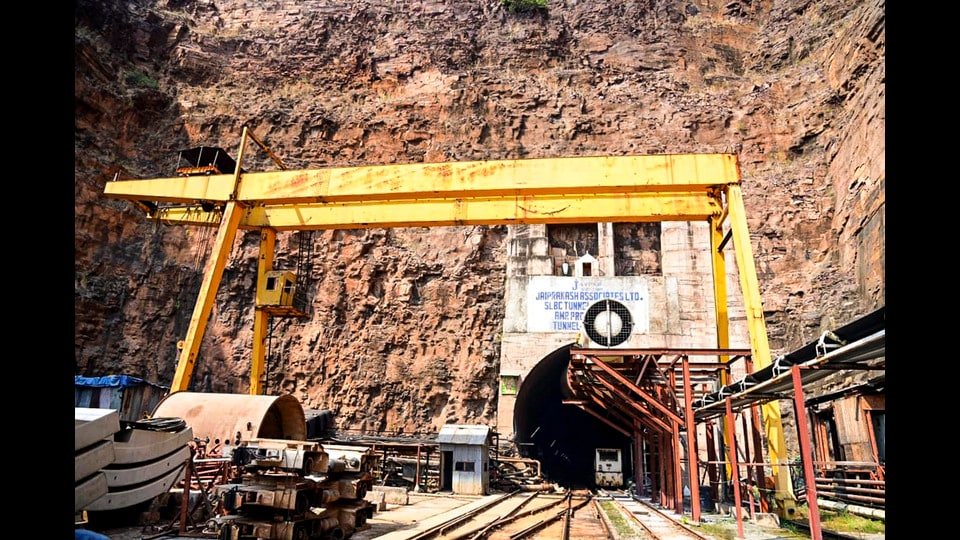
Scientists with NGRI on Sunday presented the survey reports to state irrigation minister, N Uttam Kumar Reddy, at a high-level review meeting held to discuss resumption of construction work on the tunnel, which was abandoned after it collapsed on February 22, 2025, killing eight people, including two project engineers.
“The results are encouraging, providing valuable geological data about the shear zones present in the tunnel area. The report would help the engineers identify any potentially adverse geological zones in advance and assess the required tunnel support systems,” an official familiar with the matter said.
The airborne VTEM survey, developed by Canadian firm, Geotech, was launched on November 3, 2025,by chief minister A Revanth Reddy at Mannevaripalli village in Achampet block. The technology uses a dipole transmitter and receiver combination to measure secondary magnetic fields generated by conductive material in the earth to map geophysical features. A large transmitter loop suspended 100–150 feet beneath a helicopter emits electromagnetic pulses into the ground, while sensors record reflections that reveal variations in rock structure, water flow and mineral composition. The technology can map subsurface geological formations up to a depth of 1,000 metres.
“The combination of aerial precision and scientific analysis will give a complete picture of subsurface conditions and guarantee the safety of future tunnelling,” NDMC scientists reportedly told the irrigation minister.
Reddy called for round-the-clock operations on the SLBC tunnel project with a focused approach to safety protocol and immediate mobilization and deployment of machinery.
“He instructed that the remaining tunnel works be executed using scientific methodologies based on advanced tunnelling techniques and observational methods, ensuring continuous monitoring and adherence to international best safety practices,” an official statement from the minister’s office said.
Reddy also announced the creation of an exclusive SLBC division headed by a chief engineer to expedite the tunnel construction. He directed that an independent supervision consultant (ISC) be appointed to assist the chief engineer in ensuring safety, quality, and design compliance throughout construction.
“Dedicated planning teams will monitor daily and weekly progress, while tunnel safety supervisors from Singareni Collieries Company Limited (SCCL) will be deployed at site. The minister also ordered the establishment of specialized geotechnical and geological teams to perform daily assessments of ground behaviour and tunnel stability, enabling real-time decision-making and risk mitigation,” the statement said
The tunnel project, worth a sum of ₹4,600 crore, aims to divert Krishna River water from the Srisailam reservoir to provide irrigation to 400,000 acres in the erstwhile combined Nalgonda district besides providing drinking water to 516 villages en route.
At the time of the accident last year, a 20.5 kilometre stretch was completed from Devarakonda and another 14 kilometre was completed from the inlet end at Domalapenta.


