A packed room at the Bombay Bar Association (BBA)’s meeting called to protest against the Emergency, tales of renowned criminal lawyer Ram Jethmalani’s ‘ghoda-gaadi (horse carriage)’ in pre-independence Karachi, carving out the state of Maharashtra from the larger Bombay state in 1960, and the spontaneous reaction of the judges of the Bombay high court who rose early from proceedings after receiving the news of Jayprakash Narayan’s death in 1979 – senior advocate Nitin Thakker, 79, is the keeper of the storied history of one of the oldest high courts in the country and the events that shaped the young nation’s “city of dreams”.
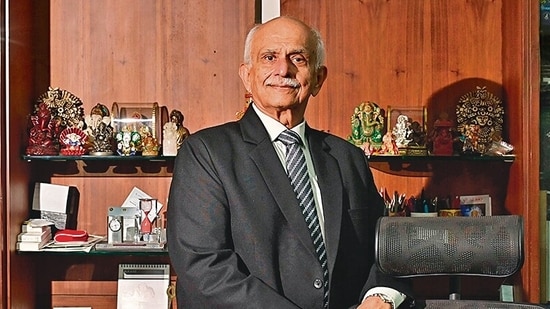
An archetypal SoBo (South Bombay) boy, the two-time president of BBA, Thakker’s first fee as a young lawyer in 1969 was three gold mohurs or ₹45.
Donning the black gown since 1968, Thakker has been both on the electric tram that ceased operations in 1964, and also the underground Metro Line 3 inaugurated in 2025.
Deep Dive
What significant historical events shaped Nitin Thakker's early life and legal career?
Why does Nitin Thakker believe political leaders in his youth had a cleaner image compared to today?
How has social media changed the relationship between the bar and the bench according to Nitin Thakker?
Also Read | Indra Mohan Pandey: ‘Panditji just passed by us... I could see him clearly’
With humble beginnings in Kalbadevi, once a hotspot for cloth trade and home to a large Gujarati community, Thakker is now a resident of the upscale Altamount Road. His father, Gordhanbhai Thakker, a lawyer and later a judge, worked closely with freedom fighter Bhulabhai Desai. His mother Sarlaben Thakker too distributed information pamphlets about the movement.
Thakker was born on a day ahead of the June 3 declaration of 1947 that announced the end of British rule in India and the partition of the country into India and Pakistan. Patriotism was perhaps his first inheritance.
{{/usCountry}}Thakker was born on a day ahead of the June 3 declaration of 1947 that announced the end of British rule in India and the partition of the country into India and Pakistan. Patriotism was perhaps his first inheritance.
{{/usCountry}}His first courtroom visit was at age 11 when his father, then a sessions court judge, presided over a criminal trial. It did not leave a lasting impression. “I visited the court during my school holidays. I was perhaps too young to decide anything,” said Thakker. He studied in the St. Xavier’s Boys Academy’s Gujarati-medium school.
Also read | Pushpa Singh: Only a few of us champions are left, the rest are out
He treasured a memory of his principal, a Spanish priest who spoke Gujarati and had the novel idea to raise funds for a new school building in the early 1960s. “They had a screening of (the film) Mughal-e-Azam and we, the children from Gujarati-medium, were asked to sell tickets,” Thakker reminisced.
One of his early childhood memories was watching the funeral procession of then deputy prime minister Vallabhbhai Patel in 1950 as it passed his balcony. He remembered making a dash as a school boy to the SNDT university after hearing of Prime Minister Jawaharlal Nehru’s arrival. “We just got a glimpse of him when he came out of the gate. In those days, the PM didn’t have the kind of security they have now. Political leaders were far more approachable and they had a clean image,” said Thakker.
During those days, even if decisions were made in Delhi, their effects were immediately felt in the Bombay HC and BBA that counted Dr. B R Ambedkar, M K Gandhi, Nani Palkhivala, and Fali Nariman among its erstwhile members.
During the 1964 food shortage when PM Lal Bahadur Shastri gave a call to avoid cooking grains for one meal to reduce India’s foodgrain dependency, Thakker’s home followed it to a tee. “My mother stopped cooking grains on Mondays. We decided we would only eat vegetables,” said Thakker.
In 1966, he graduated from the Sydenham College of Commerce and then studied law at the Government Law College, the alma mater of some of the finest legal minds in the country. “My father was firm that he will not mentor me. I did a nine-month internship at Kanga and Company, and then joined the chambers of senior advocate Anil Divan.”
Also Read | Lt Gen Arvind Mahajan (Retd): ‘We were hailed as the generation of New India’
In 1975, during the Emergency that Thakker describes as a “blot on our democracy”, BBA passed a resolution to abstain from court as a mark of protest. Thakker was present in Room No. 57 of the HC. “Hardly any lawyers participated in the general body meeting or debates we held before that. But that day was chock-a-block. There weren’t enough chairs. We were all standing with all the doors open because there was no AC…The resolution was passed with an overwhelming majority,” said Thakker.
Then in 1990, BBA passed a resolution showing “complete lack of confidence” against four sitting judges of the HC amid allegations of corruption. “I was part of that resolution. I remember the debate going on in the bar association in the general body meeting. We were urging the then chief justice not to allot any work to these four judges.”
Over the years, the relationship between the bar and bench has evolved but social media is the game-changer, he said. “Social media has not just changed courts or the judiciary but it has brought every person under scrutiny,” said Thakker. He also added that it may have made judges more guarded because sometimes video clips of observations are taken out of context.
AI too raises concerns of client privacy but Thakker said that the age of AI has certainly arrived. “AI is here to stay. BBA was the first bar association in the country to come up with AI guidelines for advocates in July 2025.”
While a new HC building is taking shape in Bandra, the old early English-Gothic building in Fort holds the sentiments of far too many, Thakker agreed. “Everybody loves this building. But in the interest of litigants and the administration of justice, I must say, this building has outlived its utility.”
Thakker said that neither of his two children picked law as a career but 11 years after their wedding in 1969, his wife Nalinee too studied law. A grandfather of three college students, he said, his entire family’s affection is mostly concentrated on Atom, their seven-year-old goldendoodle.