The Karnataka high court on Thursday restrained students from wearing hijab or any other religious attire to schools and colleges until it finally decides a clutch of petitions questioning the ban on hijab, imposed by the state government through an executive order on February 5.
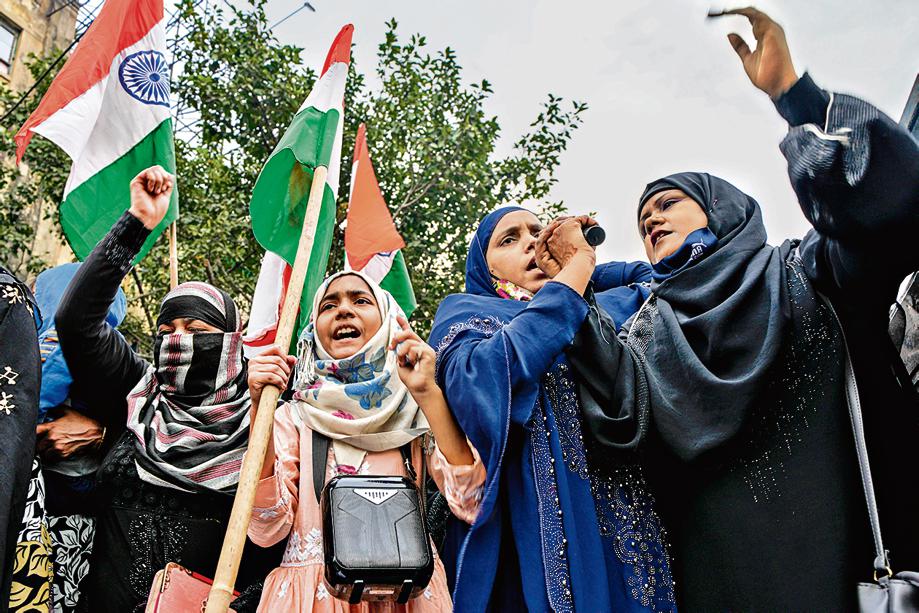
A bench, led by chief justice (CJ) Ritu Raj Awasthi, emphasised that it would give precedence to reopening of educational institutions in the state while prohibiting all kinds of religious attire in schools and colleges for the time being.
“For the time being, we will pass an interim order. Let the institutions reopen with a stipulation that no student would be allowed to wear any religious attire. We are going to restrain everyone from wearing a headscarf or a saffron gear,” said the bench, which also included justices Krishna S Dixit and JM Khazi, adding the court would continue hearing the case on Monday next week.
“Let peace and tranquility return to the state first. You are before the court. So, have faith in us. We are concerned most about the state and reopening of schools and colleges. We will restrain everyone from adopting any particular attire. This is matter of a few days,” added the bench, saying the interim order would be released soon. The detailed order of the high court was not released on Thursday.
{{/usCountry}}“Let peace and tranquility return to the state first. You are before the court. So, have faith in us. We are concerned most about the state and reopening of schools and colleges. We will restrain everyone from adopting any particular attire. This is matter of a few days,” added the bench, saying the interim order would be released soon. The detailed order of the high court was not released on Thursday.
{{/usCountry}}Following an order by Karnataka chief minister Basavaraj Bommai on Tuesday, all schools and colleges in the state are shut until Friday as a measure to contain the rapidly deteriorating situation amid the hijab controversy. The CM’s order came after a week-long protests over the ban on hijab, followed by students from the majority Hindu community turning up to schools and colleges donning saffron shawls to assert their faith, forcing a clash of religious beliefs.
The full bench of the high court is hearing the case after the single-judge bench on Wednesday referred the matter to a larger bench in view of the “enormous public importance of the questions involved” and issues of “constitutional guarantees to the religious minorities.”
Meanwhile, the row over hijab also reached the Supreme Court on Thursday morning. A petition for transferring the cases from the Karnataka high court to the Supreme Court was mentioned by senior advocate Kapil Sibal before Chief Justice of India NV Ramana. But the CJI refused to give a date for an urgent hearing while pointing out that the high court was already seized of the matter.
Before the high court, senior advocates Sanjay Hegde and Devadatt Kamat, who represented students from colleges in Udupi, opposed the prohibitory interim order, arguing that faith cannot be suspended even for a few days and that the restraint of such a nature cannot be passed without reaching the prime facie findings.
But the bench retorted: “You people should not insist for wearing all these religious things which are not conducive. If you want us to decide these issues, you will have to cooperate.”
Also Read | ‘Hijab row a deliberate attempt to tinker with the country’s social fabric’
Kamat, on his part, replied: “What your lordships are saying will amount to a suspension of Article 25 (right to practice and profess religion) as far as students are concerned. We are asked to choose between food and water. We are being asked to choose between education and conscience.”
The bench, however, remained unmoved: “This (interim order) is only for a few days. And we are not asking for your permission to pass the order.”
The high court’s interim order followed a submission by state’s advocate general Prabhuling Navadgi, who urged the bench to make an interim arrangement to enable schools and colleges in Karnataka reopen from Monday. “After hijab, we now have students wearing saffron shawls in colleges. We are saying that nobody should be allowed to press for any particular attire in educational institutions and follow the government’s circular as well as institutions’ dress code,” Navadagi submitted.
Even as his arguments were opposed by Hegde and Kamat, the bench said that an interim order has to be passed since the issues involved would require long deliberation on whether hijab is an essential religious practice for Muslim women and thus, constitutionally protected.
“The first concern of everyone should be that educational institutions should reopen and they start imparting education. Other issues are before the court and will be decided in due course. But education should not suffer,” remarked the bench.
It added: “There should not be any dispute on this from any side that education of students must start without any disturbance. Things had very recently started becoming a bit normal after the pandemic and then this happened. It is not a good situation.”
Hegde and Kamat tried to persuade the court that they are also supporting the state’s law officer on reopening of schools and colleges and that students would also wear uniforms but at the same time, they should be allowed to wear hijab until the issues are finally decided.
While Hegde emphasised on religious freedom and right to education allegedly getting trampled upon by a ban on hijab, Kamat sought to convince the court that the government order of February declaring wearing hijab is not an essential religious practice in Islam is beyond the authority of the state.
The bench, however, asked counsel: “You will have to tell us what is wrong with this government order if they have tried to balance different constitutional rights. If they have tried to balance the rights of educational institutions and other rights, what is wrong about it? All educational institutions also have to follow some rules.
Earlier on Thursday, CJ Awasthi, while hearing a separate petition for mandating a dress code in temples, expressed his dismay at the controversies brewing in the state.
“It is quite shocking that some are going after hijab and others are going after dhoti. Is it one country or is it divided by religion?”, the CJ asked.
Justice Awasthi further observed: “We are a secular country. There is an effort to divide the country by religion. The talk must not be restricted to fundamental rights alone, it is also important to talk about fundamental duties of citizens, what the citizens should give back to their country.”
Also Read | Muslim women in Prayagraj stage protest against restrictions on ‘hijab’ in Karnataka
Meanwhile, in the Supreme Court, senior advocate Sibal sought an urgent hearing, alleging girls are getting stoned for wearing hijab and schools and colleges are shut in Karnataka following several clashes between students and others.
But the CJI refrained from entertaining the request. “We cannot do anything, Mr Sibal. Why should we jump in? Let the high court decide first. Today, the matter is listed before a three-judge bench in the high court,” the judge said.
Sibal, who was appearing for a girl student from a college in Udupi, replied that he is requesting the top court to transfer the cases from the Karnataka high court to itself since the issue involves larger questions of law and that it may have to be referred to a nine-judge bench.
The CJI, however, retorted: “Let the high court examine this first. It is too early for us to interfere. Wait for a day or two. They may pass some interim orders. The problem is the high court will not touch the matter if we order listing it.”
To this, Sibal said that the issue has become pan-India and protests are happening in several parts of the country.
“We are not saying anything on merit. The high court is hearing it. Let the high court hear it. They referred the issue to a larger bench and they are hearing it today. You have filed a petition asking for transfer. It doesn’t look nice. We will see,” responded the CJI, refraining from specifying any fixed date of hearing.
Sibal was appearing for Fathima Bushra, who is a student of Government PU College in Udupi. The plea seeks a declaration that the government’s order dated February 5 prohibiting hijab in educational institutions was unconstitutional and in breach of fundamental rights of the petitioner and others practising Islam.
The Campus Front of India (CFI), a student organisation which backed the students wearing the hijab, on Thursday said that it was not satisfied with the decision of the high court.
“We are not satisfied with the decision (of the court). We will wait till Monday and then contemplate our next course of action,” Ataullah Punjalkatte, the state president of the CFI, told HT.
Meanwhile, right wing organisations said they will abide by the court’s decision.
Prakash Kukkehalli of the Hindu Jagarana Vedike told HT that he is hopeful that students would return to colleges without wearing religious attire, and will focus on their education. “Due to 4-5 students, several lakh students from across the state have been disturbed... For now at least, let them go back to schools and colleges by respecting the HC judgement,” he said.
With just over a year to go for the Karnataka elections, the ban on hijab is perceived by a section as the BJP government’s right-wing push ahead of polls. The state government, however, maintains that compliance with uniform code is a must and that educational institutions have the autonomy to decide on their uniform codes. Karnataka state primary and high school education minister BC Nagesh recently said that the students wearing hijab in Udupi’s Kundapura were allowed to enter college premises as a “courtesy”.
Opposition political parties, on the other hand, have accused that the ruling BJP has been trying to divide and poison students for political gain and deflect attention away from corruption and inefficiency.