
 E-Paper



‘Not essential’: Karnataka high court upholds hijab ban
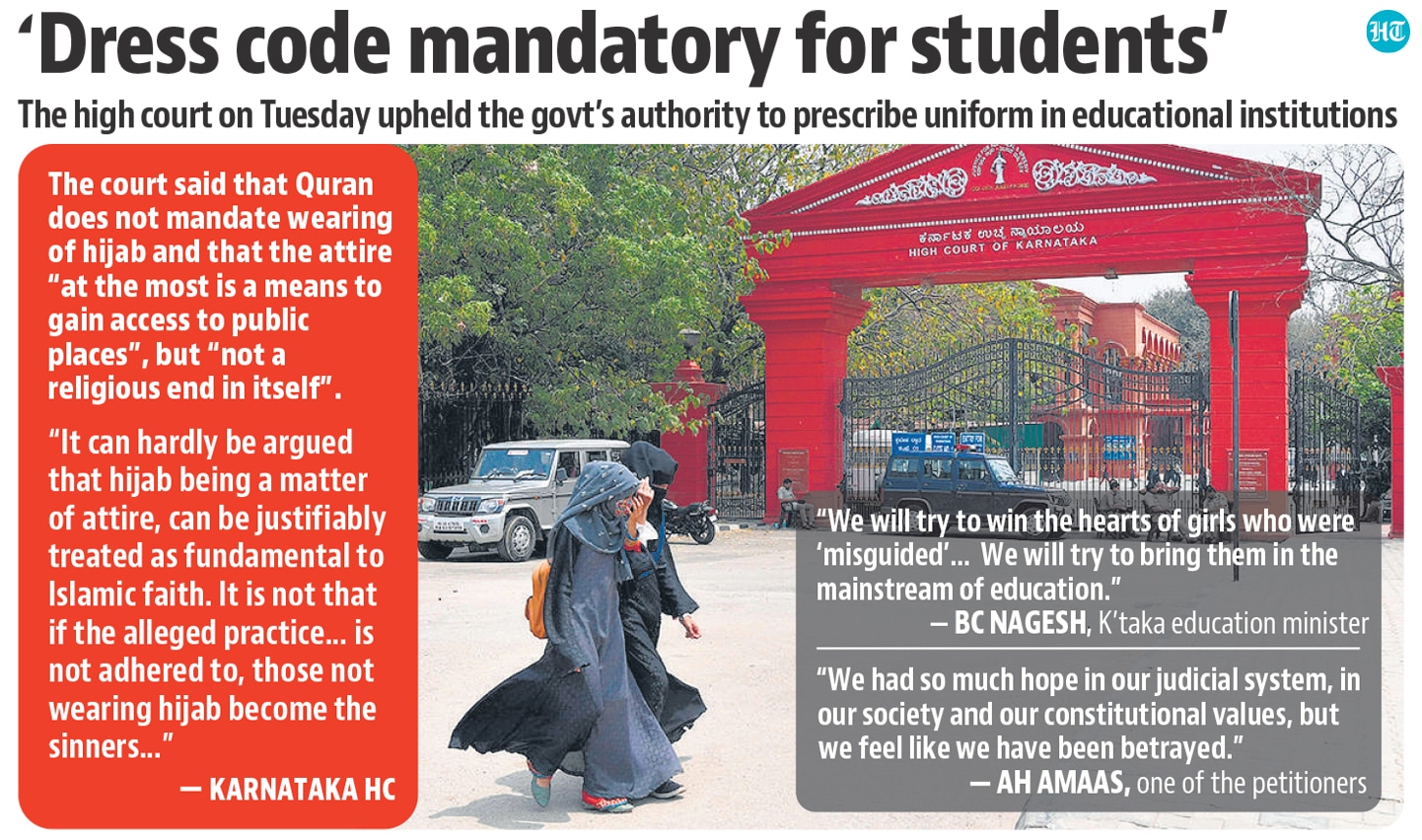
In its 129-page judgment, a full bench headed by chief justice Ritu Raj Awasthi held that Quran does not mandate wearing of hijab for Muslim women and that the attire “at the most is a means to gain access to public places” and a “measure of social security”, but “not a religious end in itself”.

 Prefer HTon Google


Wearing of hijab by Muslim women does not form a part of essential religious practice in Islam, ruled the Karnataka high court on Tuesday, affirming the ban on hijab imposed by the state government in schools and colleges through a February 5 executive order which led to massive protests and counter-protests across the state and in several other cities across the country.
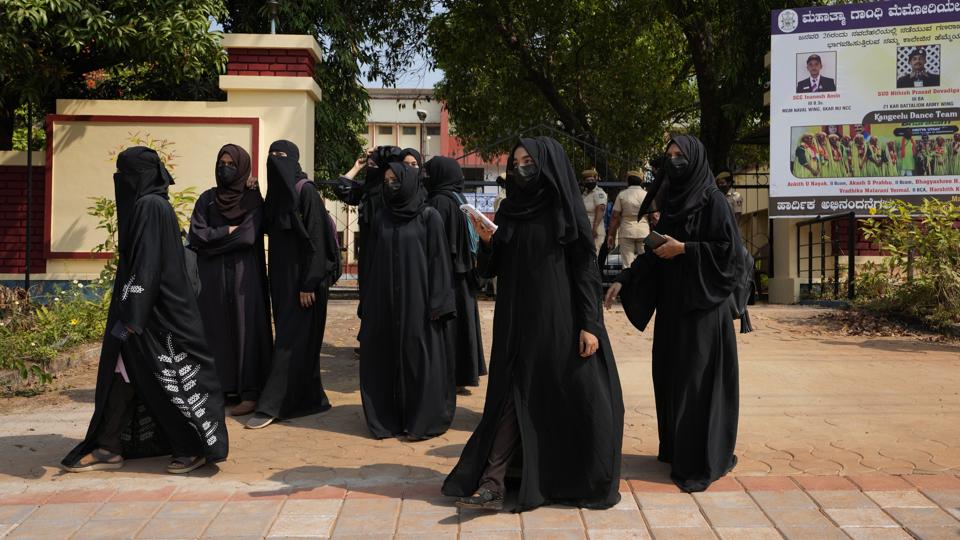
The high court also favoured a “speedy and effective” investigation into stoking up of the hijab controversy in Karnataka, suspecting some “unseen hands at work to engineer social unrest and disharmony in the state”.
In its 129-page judgment, a full bench headed by chief justice Ritu Raj Awasthi held that Quran does not mandate wearing of hijab for Muslim women and that the attire “at the most is a means to gain access to public places” and a “measure of social security”, but “not a religious end in itself”.
This is the first ruling by a constitutional court in India on whether hijab constitutes an essential religious practice in Islam, entitled to protection under the Indian Constitution, subject to least measures of interference by the State.
Also Read | Decoding the Karnataka high court ruling on hijab
“It can hardly be argued that hijab being a matter of attire, can be justifiably treated as fundamental to Islamic faith. It is not that if the alleged practice of wearing hijab is not adhered to, those not wearing hijab become the sinners, Islam loses its glory and it ceases to be a religion,” said the bench, which also comprised justices Krishna S Dixit and JM Khazi, while dismissing a clutch of petitions filed by some girl students and others pressing wearing of hijab as their religious right protected under the Constitution.
The high court asserted that the petitioners have “miserably failed” to meet the threshold requirement proof as to whether wearing hijab is an inviolable religious practice in Islam and therefore, “what is not religiously made obligatory cannot be made a quintessential aspect of the religion through public agitations or by the passionate arguments in courts.”
It relied on ‘The Holy Quran: Text, Translation and Commentary’, written by Indian-British barrister and Muslim scholar Abdullah Yusuf Ali, to hold that wearing hijab has been only recommendatory, if at all it is and that it was recommended as a measure of social security for women and to facilitate their safe access to public domain.
The high court also upheld the state government’s authority to prescribe uniform in educational institutions under the Karnataka Education Act while declaring that “adherence to dress code is a mandatory for students”.
Hours later, one of the petitioners, Niba Naaz, filed an appeal in the Supreme Court challenging the high court verdict. Naaz’s petition, filed through advocate Anas Tanwir, argued that that the high court has erred in creating a dichotomy of freedom of religion and freedom of conscience wherein the court has inferred that those who follow a religion cannot have the right to conscience.
The verdict drew mixed reactions, with the chief minister Basavaraj Bommai-led Bharatiya Janata Party government hailing the order, and petitioners expressing their reservations on its far-reaching impact of the order.
“If I have to explain this in a simple fashion, the Quran and the Hadees, which share the lifestyle of Prophet Mohammed… if we combine the two, we can understand Islam. In the Quran we are given orders that any adult (woman) who has crossed puberty, she has to Purdah against those who she may marry. In this her father, her brother, or children of her siblings don’t count. This is clear cut like the five-time Namaaz we follow,” Abdul Lateef Madani, a Muslim scholar and cleric in Udupi said.
In its judgment, the bench highlighted that any insistence on wearing of purdah, veil, or headgear in any community may in fact hinder the process of emancipation of women in general and Muslim women in particular, since such practice would militate against the constitutional spirit of equal opportunity of public participation and positive secularism.
Speaking specifically about educational institutions, it held: “Prescription of school dress code to the exclusion of hijab, bhagwa, or any other apparel symbolic of religion can be a step forward in the direction of emancipation and more particularly, to the access to education. It hardly needs to be stated that this does not rob off the autonomy of women or their right to education inasmuch as they can wear any apparel of their choice outside the classroom.”
It underlined that the school regulations prescribing dress code for all the students as one homogenous class serve “constitutional secularism” and that the prescription of school uniform is only a reasonable restriction that is constitutionally permissible.
It pointed out that educational institutions are “qualified public places” that are structured predominantly for imparting educational instructions to the students, assuming authority to repel the assertion of individual rights to the detriment of their general discipline and decorum.
Rejecting the petitioners’ arguments that prescription of dress code offends students’ fundamental right to expression or their autonomy and their freedom of conscience, the high court said that there is absolutely no scope for complaint of manifest arbitrariness or discrimination when the dress code is equally applicable to all the students, regardless of religion, language, gender or the like.
“An extreme argument that the students should be free to choose their attire in the school individually, if countenanced, would only breed indiscipline that may eventually degenerate into chaos in the campus and later, in the society at large... School uniforms promote harmony and spirit of common brotherhood transcending religious or sectional diversities,” said the bench.
The high court also expressed its “dismay” at the hijab controversy breaking out in December last year with protests starting from the Pre-University College at Udupi after some girls were allegedly denied entry for violating the dress code.
“We notice that all was well with the dress code since 2004... We are dismayed as to how all of a sudden that too in the middle of the academic term the issue of hijab is generated and blown out of proportion by the powers that be. The way, hijab imbroglio unfolded gives scope for the argument that some ‘unseen hands’ are at work to engineer social unrest and disharmony. We expect a speedy and effective investigation into the matter and culprits being brought to book, brooking no delay,” said the court in its judgment.
While the petitioners questioned the timing of the state government’s order on the premise of political considerations, the high court declined to comment on it. “Whether a particular decision should be taken at a particular time, is a matter left to the executive wisdom, and courts cannot run a race of opinions with the Executive, more particularly when policy content and considerations that shaped the decision are not judicially assessable. The doctrine of separation of powers expects the organs of the State to show due deference to each other’s opinions,” it maintained.
Welcoming the order, chief minister Bommai said, “Everyone should abide by the High Court order in the interest of the students.”
“This is about the future of our children and their education. There is nothing more important than education for our children. So, we all should abide by the Court order in the interest of the children,” he said.
The state government stands vindicated, Karnataka health minister K Sudhakar said. “Schools are equivalent to temples. There is no discrimination based on caste or religion. Uniform is a small route to support oneness and equality. So, students must focus on learning and equipping themselves for a bright tomorrow and discourage those who misuse students for such narrow political ends,” he added.
Reacting after the verdict, the Congress said it was more concerned about the education of the students. “My greatest concern in the hijab controversy is education, and law and order. The Karnataka High Court has given a judgment but the responsibility for education, law and order and communal harmony is still with the government of Karnataka,” DK Shivakumar, the state Congress president, said on Twitter.
Other political leaders, however, called the court decision “deeply disappointing”. “Karnataka HC’s decision to uphold the Hijab ban is deeply disappointing. On one hand we talk about empowering women yet we are denying them the right to a simple choice. Its isn’t just about religion but the freedom to choose,” Mehbooba Mufti, the former chief minister of the erstwhile state of Jammu and Kashmir, tweeted.
The three-judge bench was constituted on February 9 after a single judge referred the matter to a larger bench in view of the “enormous public importance of the questions involved” and issues of “constitutional guarantees to the religious minorities.”
The full bench was seized of a batch of petitions by some girl students, seeking permission to wear the hijab in educational institutions where a uniform has been prescribed. The girls were allegedly denied entry into a PU College for girls in Udupi in December last for violating the dress code.
On January 1, six girl students attended a press meet held by the Campus Front of India (CFI) protesting against denial of entry into classrooms as they were wearing the hijab. This was followed by students from the majority Hindu community turning up to schools and colleges donning saffron shawls to assert their faith, forcing a clash of religious beliefs.
As the issue of hijab versus saffron scarves spread to several educational institutions in many parts of Karnataka, and sparked protests in other states including Tamil Nadu, Maharashtra and Andhra Pradesh, the state government announced a holiday from February 9 to February 15 in all the pre-university colleges and from February 9 to February 16 in degree and diploma colleges.
On February 10, the high court ordered reopening of educational institutions in the state while restraining students from wearing hijab or any other religious attire to schools and colleges until it finally decided a clutch of petitions questioning the ban on hijab.
The petitioners were represented in the high court through senior advocates Sanjay Hegde, Devadatt Kamat, Ravivarma Kumar and Yusuf Muchchala. Karnataka’s advocate general Prabhuling K Navadgi argued for the state government before the bench.
Expressing disappointment over the court order, one of the petitioners reiterated that they will not attend classes without the headscarf.
“Why we went to the High Court is because we wanted the Hijab and sit in class. We had a lot of hopes that we will get justice in High Court but unfortunately did not get it. We will not go to class without the Hijab,” Aliya Asadi, the 17-year-old petitioner from Government Girls Pre-University College in Udupi said.
“The court has said that the Hijab is not part of essential religious practices. This is something that should be decided by Islamic scholars. We had gone to court over individual rights. We did not anticipate this judgement. Our struggle will continue and we will make a decision on how to move forward, including appealing in the Supreme Court,” Ashwan Sadiq, national general secretary of the Campus Front of India (CFI) said.
The verdict was welcomed by right wing groups.
“We have said it from the beginning that we will follow whatever order the court delivers. They (Hijab-wearing students) have to leave such mentality and come back to classes. If they want education, they have to come. If they think that the propaganda filled by a few is more important, then what can we do? They can always appeal in the Supreme Court and we have no problem with it,” Prakash Kukkehalli, the Mangaluru divisional secretary of the Hindu Jagrana Vedike, said.



