E-Paper



Number Theory: 2023 will be the warmest year, but will it also breach 1.5°C threshold?
The 1.5-degree threshold is among the key objectives of the Paris Agreement, and considered crucial to prevent irreversible damages because of global warming

 Prefer HTon Google


That 2023 will be the warmest recorded year is almost a given. The more interesting question, as far as the climate crisis is concerned, is whether the planet will also breach the 1.5-degree warming compared to the pre-industrial average barrier in 2023. The 1.5-degree threshold is among the key objectives of the Paris Agreement, and considered crucial for preventing irreversible damages because of global warming. An HT analysis of various long-term datasets shows that while the 1.5-degree barrier could be breached in at least one as differences in the way global warming is measured lead to varying estimates of global warming in 2023.
To be sure, climate crisis mitigation goals talk about preventing such warming over a sustained period rather than just a year, and a single year breach, while significant, does not herald a permanent shift.
Here are four charts which explain the situation in detail.
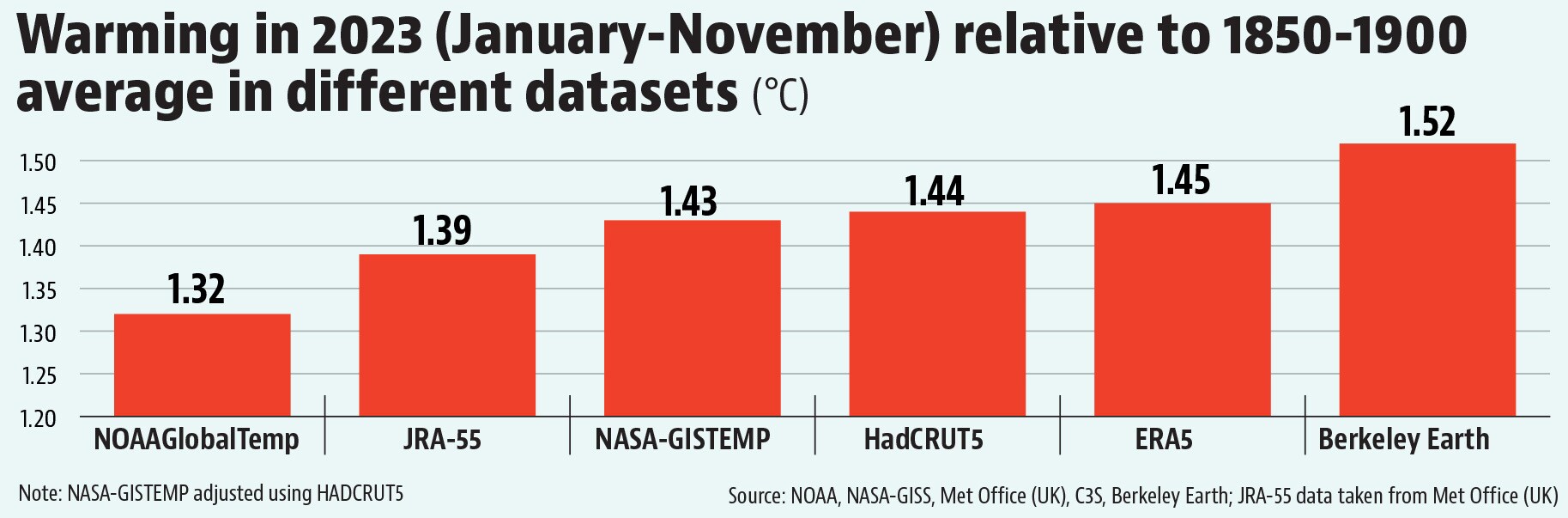
 Is 2023 warming likely to be over 1.5 °C?This depends on whom you ask. Berkeley Earth, a US-based non-profit that publishes its own temperature records, is almost certain that 2023 warming (relative to the 1850-1900 pre-industrial baseline) will be more than 1.5°C. UK’s Met Office expects warming to reach 1.5°C only in 2024, which everyone expects to be warmer than 2023. For the year up to November, the warming in six most prominent long-term temperature datasets ranges from around 1.32 degree Celsius in United States National Oceanic and Atmospheric Administration (NOAA) dataset to around 1.52 degree Celsius in the Berkeley Earth dataset. Clearly, there is not going to be a consensus on whether 2023 breached the 1.5°C threshold even when the final reading is taken.
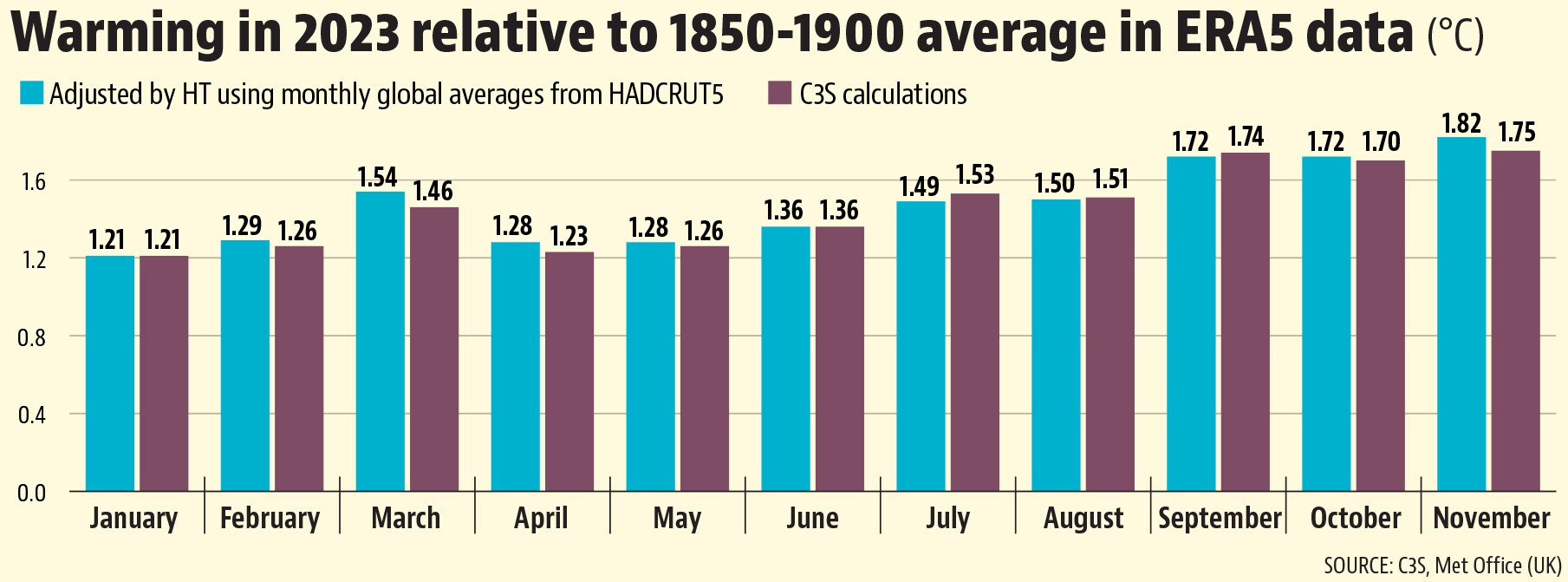
- What explains the disagreement on the level of warming in 2023?The difference is not because there is a disagreement about present-day temperatures. The biggest reason is that everybody’s estimates vary a lot for the 1850-1900 average against which global warming is generally measured. Calculating this average requires approximations because actual observations are few. The differences between such approximations change the final result. Depending on the approximation, the same data for 2023 can show different levels of warming. For example, ERA5 data starts only in 1979. Therefore, the Copernicus Climate Change Service (C3S), which publishes ERA5 data, uses a mathematical function to find warming relative to the 1850-1900 average. A different method can show a slightly different level of warming. To illustrate this, HT adjusted ERA5 data using HADCRUT5 data, a common method among scientists. This shows that the HT’s and C3S’s warming differs by at most 0.07 degrees for any month in 2023. This is a small number but can add up to making 2023 warming more than or less warm than 1.5°C.
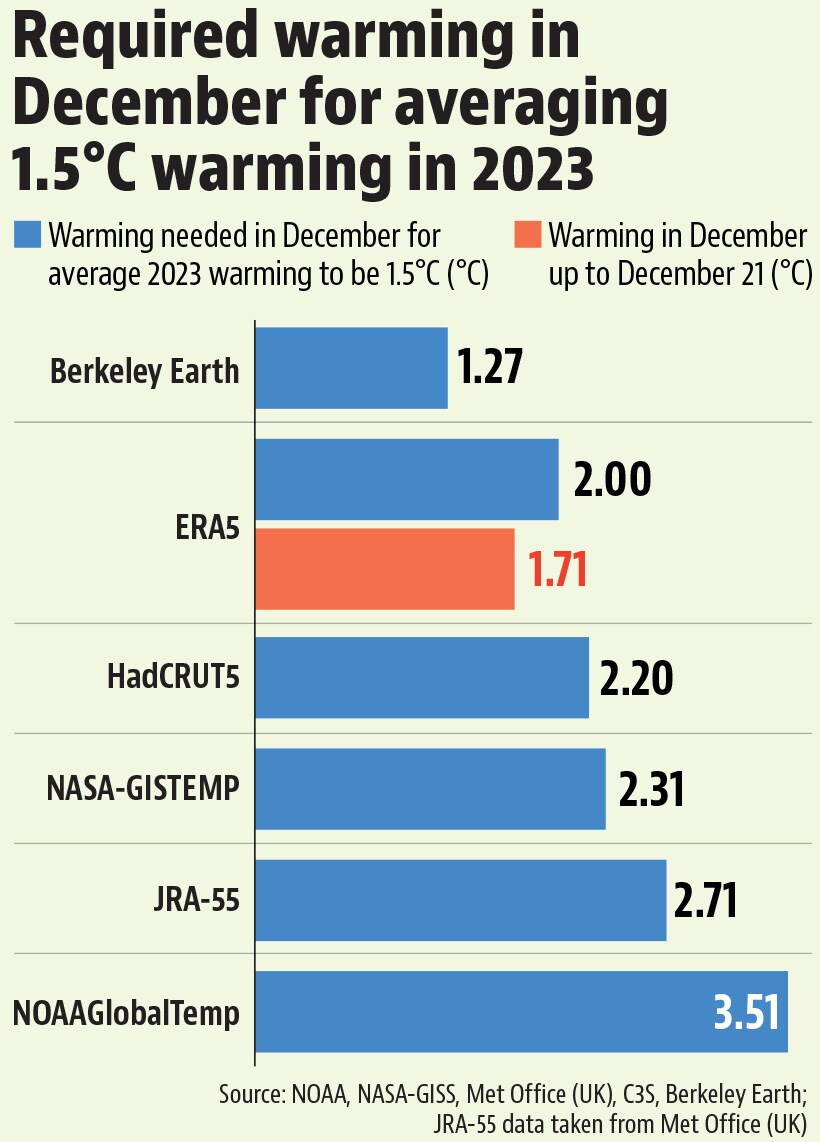
- How much warming is needed in December for 2023 average to reach 1.5 degrees?This number also varies because everyone’s estimates of warming vary up to November. The required warming in December is the least (1.27°C) in the Berkeley Earth data and the most (3.51 °C) in the NOAA dataset. Will December warming cross these thresholds? Not all datasets publish daily temperature data. Daily December data from the ERA5 dataset can help us make an informed guess. December 2023, up to the 21st, is 1.71°C warmer than the pre-industrial average in ERA5 data, compared to 1.45°C warming in the year up to November. Since ERA5 needs a 2°C warming in December to average 1.5°C warming in 2023, it unlikely to breach that threshold. However, ERA5 numbers show two more things. While the warming in December is more than in the year up to November, it is unlikely to push December warming to levels in the higher spectrum of the 1.27-to-3.5-degree range for the 1.5-degree threshold to be breached. This makes it more likely that only Berkeley Earth’s dataset will breach the 1.5°C threshold this year.
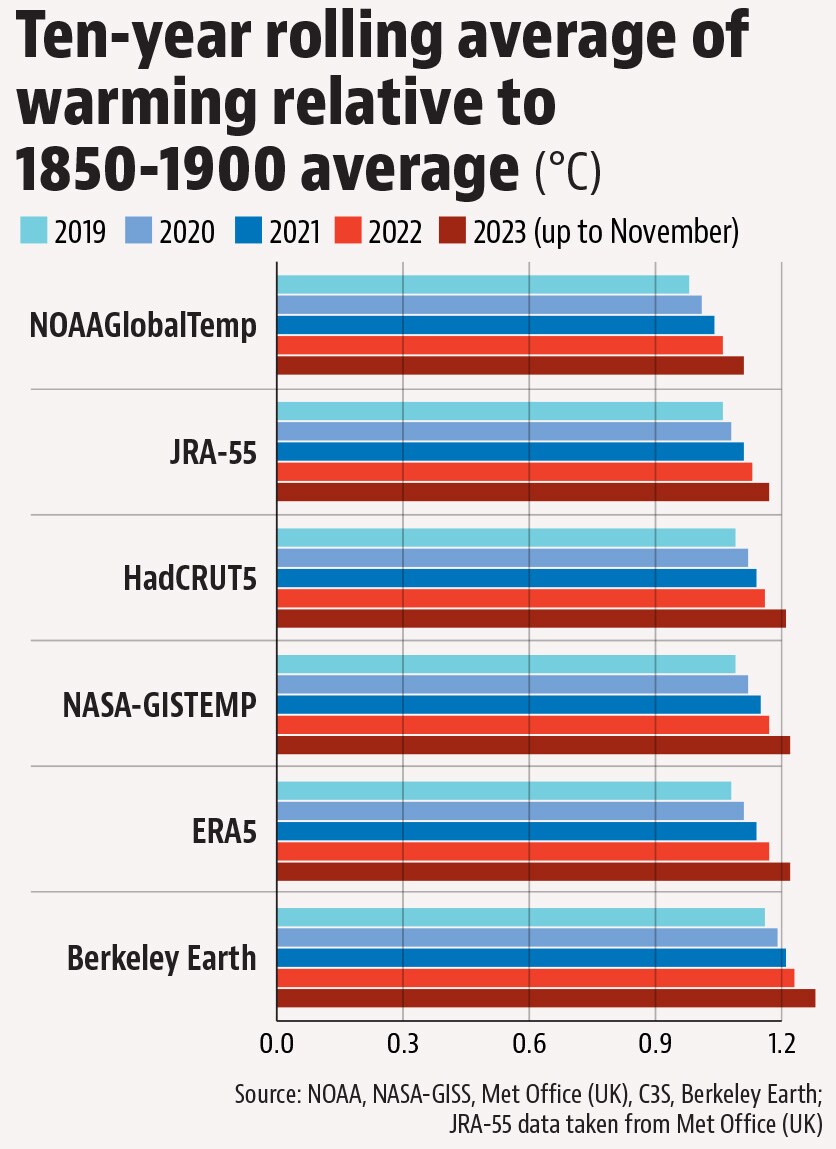
- So, 2023 may not breach 1.5 °C goal, but it will make a big jump towards itTo be sure, the Berkeley Earth data breaching the 1.5°C threshold will not mean we have failed to meet our biggest goal from the Paris Agreement at the end of 2023. These goals are meant for the world’s temperature aggregated for a long time period. The Earth’s long-term warming, by any measure, is not going to reach 1.5°C at the end of 2023. This is simply because 2023 will, at worst, be the first year to breach the 1.5°C threshold. Using the average warming up to November, the past 10 years’ average warming reaches the 1.22 degrees figure in the NASA dataset and 1.18 degrees in the HADCRUT5 dataset. Nonetheless, even these numbers are a big jump from the 10-year average up to last year (1.18 and 1.16 respectively for NASA and HADCRUT5). This is because 2023 (up to November) is 0.09 to 0.12 degrees warmer than 2016, the warmest year on Earth before this year. In comparison, 2016 and 2020 (the warmest two years before this year) were either tied together or separated by just 0.02 degrees in most datasets.