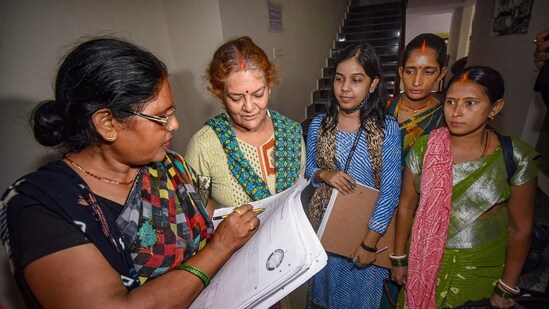
The publication of subcaste-wise population numbers from the Bihar caste survey has given a big boost to the demand for proportionate reservations across the country. While national Opposition parties including the Congress have raised this demand, Prime Minister Narendra Modi, while speaking in a rally in Chhattisgarh, accused the Opposition of playing divisive politics. Whether or not this demand will hurt the BJP or help the Opposition is a question best left to the future. It is, however, a
Patna: Enumerator staff collect information from residents for a caste-based census in Bihar after Patna High Court rejected a petition against the survey, in Patna. (PTI)
Economics of India's caste-wise inequality
Non-SC/ST/OBCs are the richest social group in India
The 2019 All India Debt and Investment Survey (AIDIS) gives information about the total value of assets of broad social groups in India. An HT analysis of unit level data shows that the average value of total assets of a non-SC/ST/OBC household was ₹32,82,842 which is 1.8-3.3 times the average assets of SC, ST or OBC households. To be sure, asset value might be a reflection of inherited wealth as well, and therefore does not tell us the current state of inequality in the labour market. A comparison of monthly per capita expenditure (MPCE) levels for different social groups can help resolve this. Unit level data from the latest Periodic Labour Force Survey (PLFS) shows that non-SC/ST/OBCs have a much bigger share in higher MPCE brackets than their share in population while the opposite is true for the SC/ST/OBC population. This advantage increases with rising MPCE levels. To be sure, it needs to be kept in mind that samples such as PLFS do not include the really rich in India.
Advantage of non-SC/ST/OBCs is seen in their representation in high-income jobs
Regular wage/salaried jobs have the best income levels in India. An HT analysis of the latest PLFS data shows that not only do non-SC/ST/OBC workers have a higher relative share in salaried jobs, their advantage increases with salaries. Relative share here throughout the rest of the analysis is the share of the group in that work status relative to the share among all workers.
Inequality in government jobs is lower for SC/ST groups
PLFS data allows a separate classification of government jobs. The analysis shows that the relative share for SCs and STs in government salaried jobs is higher than overall salaried jobs. For OBCs, the relative share in government salaried jobs is lower than overall salaried jobs. And for non-SC/ST/OBC workers, too, the advantage in government salaried jobs is lower than the advantage in overall salaried jobs. So, reservation has had a bigger equalising effect for SC/ST workers than for OBCs – a possible a reflection of the fact that SC/ST groups get proportionate reservations and OBC do not.
Share of government job holders is lower among younger workers across social groups
The data above shows that the demand for proportionate reservations for OBCs could have potential traction given that OBCs have not gained as much from reservations as SC/ST workers have. However, it needs to be kept mind that the share of government salaried job holders has been falling among young workers across all social groups – possibly because the overall pool of government jobs has been losing its importance in the economy. How these factors will play out politically remains to be seen.
Abhishek Jha is Assistant Editor-Data at Hindustan Times. He uses statistical programming to generate newsworthy insights from large datasets. He is part of the team that produces Number Theory, a daily data story feature of the paper’s print edition. Since March 2024, he has been writing Weather Bee, a weekly column for the Hindustan Times website. He is a chemical engineer by training, who specialises in stories related to weather, climate, and the environment. Jha has been at HT since 2018, where he offers data-driven perspective and analysis on politics, environment, weather, climate, economy and society. His work includes data coverage of elections in India and abroad, including the 2019 and 2024 Lok Sabha elections; the disasters and extreme weather resulting from changing climate, such as floods, droughts, heat waves, cold waves, and dwindling snow cap in the Himalayas; the factors that drive poor air quality in northern India; the changing patterns of land use; the Covid-19 pandemic and its impact on labour market conditions; the changing pattern of consumer spending seen in the new consumer spending surveys; and social norms seen in the surveys such as the National Family Health Survey.
Roshan Kishore is the Data and Political Economy Editor at Hindustan Times. He heads the newsroom's data journalism team, which produces Number Theory, a daily data-driven feature for the print edition and the HT app. Number Theory uses data analysis and story-telling based on it to add value to the newsroom’s daily coverage by putting stories in a larger context on a range of issues, including politics, macroeconomy, markets, global affairs and climate. Under his leadership HT’s data journalism work has established itself as a niche product in Indian journalism and pushed the boundaries of marrying academic rigour with news sense and speed. Along with writing and editing data stories, he has also been writing a weekly political economy column called Terms of Trade for HT Premium. A trained economist with an MPhil degree from Jawaharlal Nehru University, Kishore has also been a visiting fellow at the Centre for Advanced Studies of India (CASI) at the University of Pennsylvania. Along with his journalistic work, his writings have also appeared in journals such as the Economic and Political Weekly and working papers for CASI and UNESCAP.
Get the latest India News, breaking headlines and real-time updates from across the country. Stay informed about politics, government policies, crime, weather major national developments and Karnataka Bandh LIVE.
Get the latest India News, breaking headlines and real-time updates from across the country. Stay informed about politics, government policies, crime, weather major national developments and Karnataka Bandh LIVE.
Home/India News/Number Theory: Economics of India's caste-wise inequality
{{^htLoading}}
Advertisement
{{/htLoading}}
SHARE THIS ARTICLE ON
{{#usCountry}}{{/usCountry}}
Notifications
Get breaking alerts directly from the newsroom
Notifications are on!You'll be notified when news breaks