E-Paper



Number Theory: Monsoon has ground to cover in its last 2 weeks
Most of India's reservoirs will remain dry even after its main rainy season
Updated on: Sep 18, 2023, 07:51:27 IST


Share via


Copy link

Rain over large parts of India since September’s second week is a relief after the country experienced its driest August in recorded history. While kharif crop sowing was nearly complete in early August, last week’s rain could help in preserving its output. It should also help in bringing down temperatures after the warmest August in recorded history. However, the amount of rain India needs in the next two weeks of the monsoon season – it ends officially on September 30 – is still quite high if the year is to not record a deficit. This suggests that unless IMD forecasts for this month are very wrong, large parts of India and most of its reservoirs will remain dry after its main rainy season. Here are four charts that explain this.

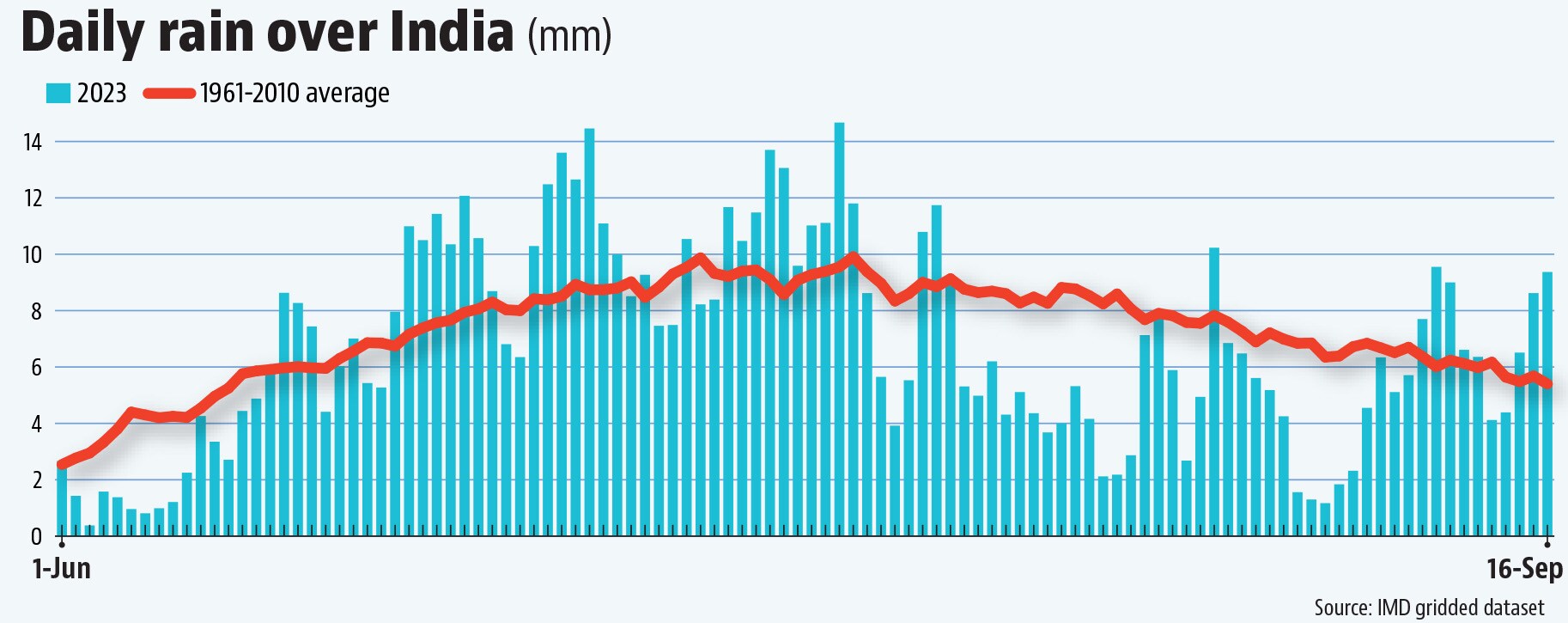
 Before last week, daily rain had a deficit almost continuously for over a monthThe amount of precipitation recorded overall has been more than the 1961-2010 average, a benchmark for rain, on almost all days starting September 7, according to India Meteorological Department’s (IMD) gridded dataset. While such a daily surplus is not needed every day in the usual course of things, it is significant because of the prolonged gap after which this happened. There was a deficit continuously on every day for the two-week period from August 24 to September 6. In the 34-day period from August 4 to September 6, there were only two days of surplus rain: August 19 and August 23. To be sure, as the accompanying chart shows, recording a surplus in September takes much less rain than in August, which is India’s second-wettest month. For example, India received 6.61 mm rain on September 10, an 8% surplus for the day. A similar amount of rain (6.85 mm) on August 24 was a 10% deficit for that day.
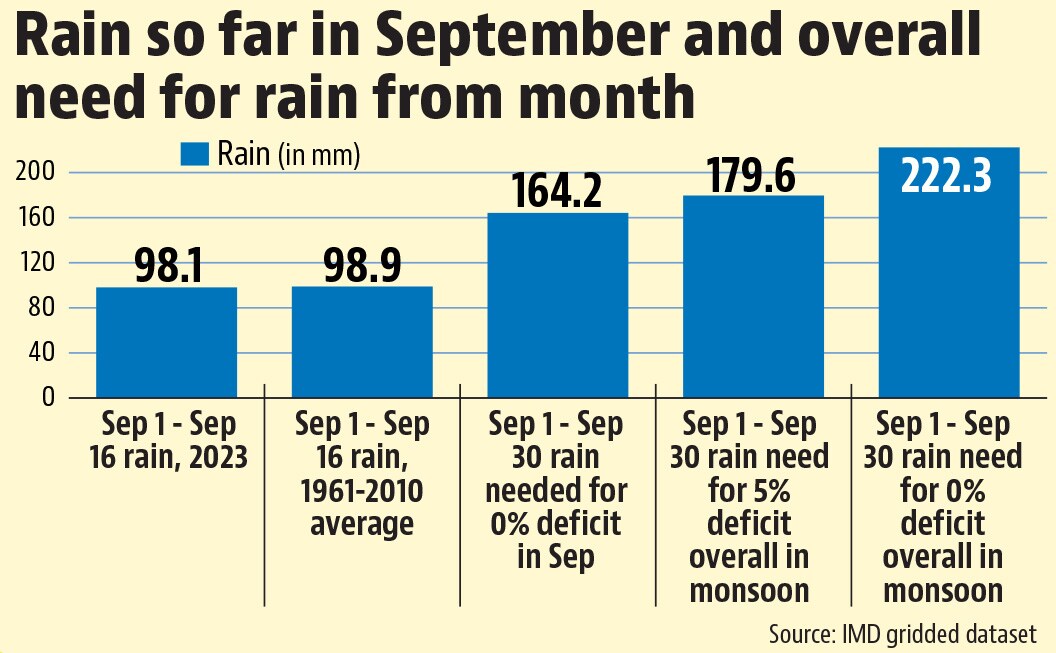
- Therefore, September rain will have to defy IMD forecasts for a monsoon without deficitThe example given above suggests that September will have to record a large surplus to fix the deficit accumulated through August. How much of a surplus does September need? The 1961-2010 average for the June-September monsoon season is 853.7 mm. India has received 729.5 mm rain from 1 June to September 16, which leaves a requirement of 124.2 mm in the remaining two weeks of the month. This translates to an overall surplus of 35% for September compared to the 1961-2010 average or a total of 222.3 mm rain in the month. 222.3 mm rain would make this September the tenth wettest since 1901, when it is only the 67th wettest so far. Even for an overall 5% deficit this monsoon, September will have to record a 9% surplus. In comparison, the IMD has forecast a maximum of 183 mm rain in the month. This means that IMD forecast for September will have to be way off mark for no deficit in 2023 monsoon.
- September surplus is not expected over all the 37% of India that is dryTo be sure, if 222.3 mm rain does fall in September, it will not be the first time this monsoon that IMD forecast for a month has been off the mark. IMD had forecast a maximum of 297 mm rain in July. July rain was 16 mm more than that. The degree by which September forecast needs to go wrong is much bigger: 39 mm. Moreover, a more recent forecast for the next two weeks shows surplus rains giving parts of Bihar, Uttar Pradesh, north-western states, and peninsular India without surplus rain. Since forecasts tend to be more accurate when made closer to the date, one can expect that the deficits of these regions will remain largely as they are. This is a problem because large parts of north-western, western, and peninsular India are also under big deficits. While 36% of India’s total area has a deficit of 20% or more (called “deficient” rain officially), this area is 76% in Kerala, 47% in Maharashtra, and 46% in Haryana, and 39% in Punjab and Andhra Pradesh. Around a third of Karnataka and Tamil Nadu is also under similar deficits. The surplus rain forecast in central and eastern India will also have a lot of ground to cover: 51%-77% of the area of West Bengal, Jharkhand, Bihar, and Uttar Pradesh is also “deficient”.
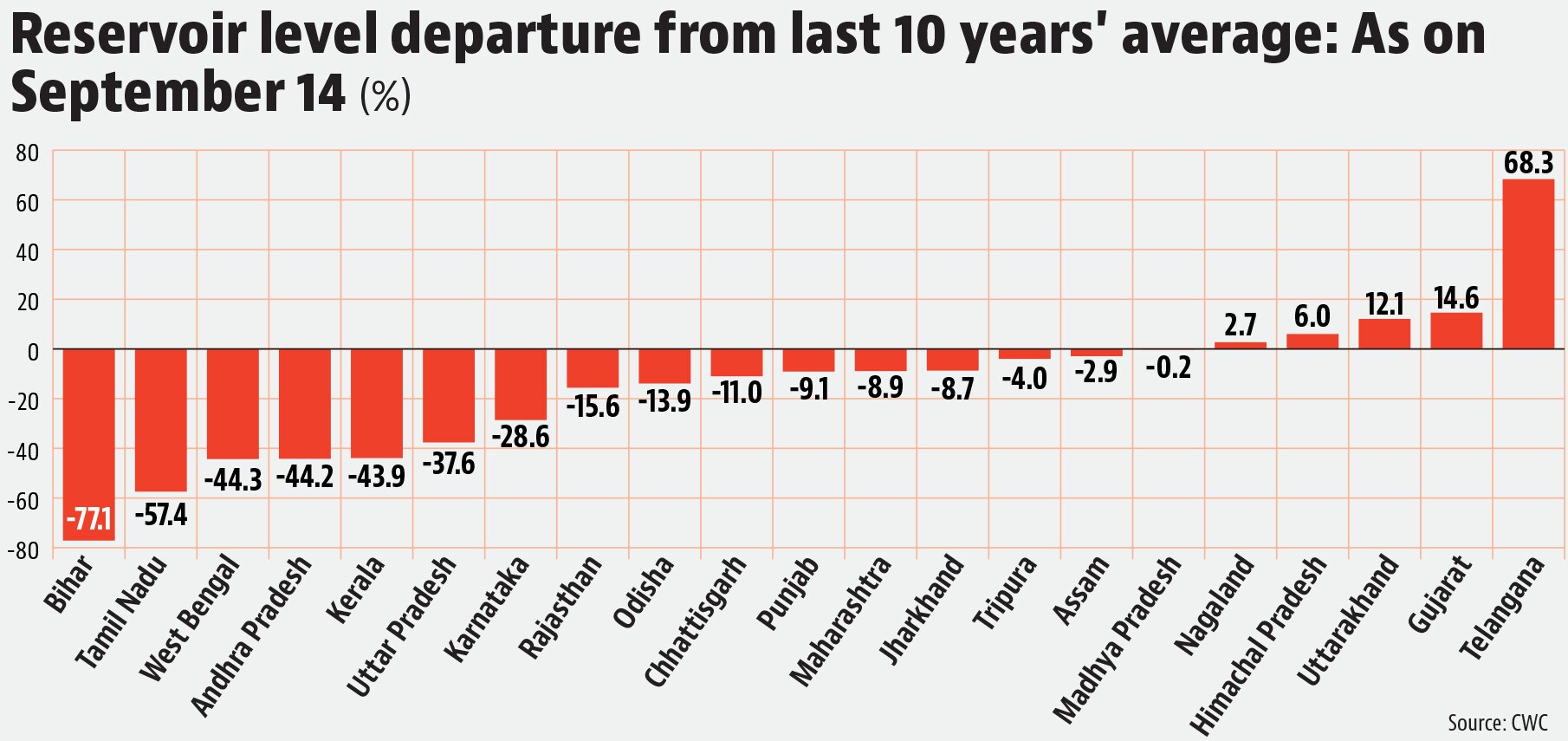
- This has left reservoirs dry for the winter crop cycleAs the discussion above suggests, some parts of India – including important crop-producing states – are likely to end up with a dry monsoon. While the impact of the dry monsoon so far on the kharif crops will likely only be known when its output is measured (there was correction in sowing after July rains), it has created at least one pressure point for the winter crop cycle. Among the 21 states for which the Central Water Commission (CWC) publishes reservoir data, all but five (Uttarakhand, Himachal Pradesh, Gujarat, Telangana, and Nagaland) have a deficit.