Bhubaneswar: This year’s Padma awardees from Odisha represent a range of achievements. From a 61-year-old sculptor who created the National Police Memorial to a 72-year-old neurosurgeon who led the team behind the country’s first successful craniopagus separation in 2017, to an 80-year-old writer celebrated for her exploration of human relationships and emotions, and a 63-year-old Odissi dancer who brought the classical dance form to global prominence—these individuals embody the spirit of Odisha’s rich cultural heritage.
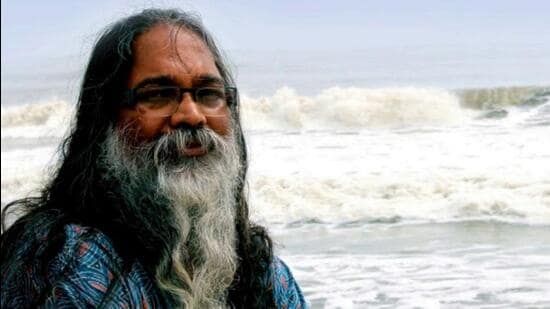
Sculptor Adwaita Charan Garanayak, 61, currently the director general of the National Gallery of Modern Arts, is one of four Padmashri nominees from Odisha.
Known for his iconic sculptures, Garanayak’s works include the 28-foot-long monolithic black granite statue of Netaji Subhas Chandra Bose at India Gate and the 30-foot-tall black granite monolith at Delhi’s Chanakyapuri, the National Police Memorial, which honours the 34,844 police personnel who have died in the line of duty since August 15, 1947.
Born in Dhenkanal district, Odisha, Garanayak studied fine arts at prestigious institutions, including the historic Slade School of Fine Arts in London in 1995. He designed the central memorial structure at the National Police Memorial in New Delhi.
Garanayak, known for his work with black granite, is part of a new generation of sculptors who move beyond academic realism, exploring new materials and techniques while staying connected to Indian artistic traditions. Notable projects include the Mahatma Gandhi Dandi March statue at Rajghat and the sculpture park at KIIT Campus, Bhubaneswar.
In 2023, Garanayak was invited by the consul general of India in Osaka-Kobe to create three sculptures over six months, which were installed in different locations. “Stones are the oldest members of our planet. Every stone has its own vibration and is connected with the magnetic field. That is why in temples, people hug and kiss the stone idols of deities. They are attracted to the stones, or if you see stones worn in rings, they connect with divine power,” said Garanayak.
{{/usCountry}}In 2023, Garanayak was invited by the consul general of India in Osaka-Kobe to create three sculptures over six months, which were installed in different locations. “Stones are the oldest members of our planet. Every stone has its own vibration and is connected with the magnetic field. That is why in temples, people hug and kiss the stone idols of deities. They are attracted to the stones, or if you see stones worn in rings, they connect with divine power,” said Garanayak.
{{/usCountry}}Ashok Kumar Mahapatra, 72, who served as the chief of the Neuroscience Centre at the All India Institute of Medical Sciences (AIIMS), New Delhi, until 2017, is currently the vice chancellor of Siksha O Anusandhan University in Bhubaneswar.
With significant contributions to neurosurgery and medical education, he led India’s first successful craniopagus separation in 2017. Mahapatra and a team of 125 medical professionals separated 27-month-old twins, Jaga and Balia, who were conjoined at the skull and shared brain tissue, nerves, and major blood vessels. The 16-hour, two-stage surgery included vein grafting to ensure proper blood flow to Balia’s brain, as the twins shared a single vein.
The surgery was later included in the Limca Book of Records. Mahapatra also specialises in skull base surgery, addressing complex conditions requiring advanced techniques and precision.
He is a fellow of the National Academy of Sciences and has received numerous lifetime achievement awards. In 2010, he founded the Neurological Surgeon Society of India, which has played a crucial role in advancing neurological surgery in the country. He also served as the first director of AIIMS Bhubaneswar in 2012.
Padmashri awardee, Odissi dancer Durga Charan Ranbir, 61, is known for popularising Odissi dance worldwide, travelling extensively with his disciples to conduct workshops and performances across various countries.
Born in the remote village of Kamaguru in Khurda district, Odisha, Ranbir developed a passion for dance and music from an early age. Despite his zamindar father’s aversion to the arts, Ranbir would often skip classes to attend cultural programs in his village. After completing his matriculation, he studied at Utkal Sangeeta Mahavidyalaya in Bhubaneswar, training under renowned Odissi gurus Deba Prasad Das and Pankaj Charan Das.
In Bhubaneswar, he founded his own institution, Nrutyayan, where he trains students and promotes the Deba Prasad Gharana style of Odissi. His significant contributions to Odissi have earned him several prestigious awards, including the Orissa Sangeet Natak Akademi Award, the Veda Vyas Award from Bhanja Kala Kendra, and the Orissa Samman from the Orissa Press Academy.
Pratibha Satpathy, 80, is a prominent poet in Odia literature, known for her contributions and literary achievements. Born in Satyabhamapur village in Cuttack, Satpathy inherited a passion for literature from her grandfather, the renowned Odia lexicographer Gopal Chandra Praharaj.
She wrote her first poem at the age of 12 and has never looked back. Even today, she edits the quarterly poetry magazine Udbhasa, which promotes Odia poetry. Many of her poems explore the sensitive emotions of women and themes of life, nature, and human relationships.
Satpathy has received numerous awards, including the Jhankar Award, Orissa Sahitya Akademi Award, Kendra Sahitya Akademi Award, Sahitya Bharati Samman, and the Sarala Award. Some of her poetry collections include Nimishe Akshara, Sabari, Adha Adha Nakshyatra, and Tanmaya Dhuli.