Washington: In a message to major global powers, particularly in the West, finance minister (FM) Nirmala Sitharaman has said that advanced nations must take responsibility for the global spillover of their “political and economic policy decisions”.
She highlighted how “extreme policies” have led to “extreme market responses” and claimed that nations that had nothing to do with these policies are facing its consequences.
On the first day of her visit to Washington DC — Sitharaman is in the US to attend the annual meetings of the International Monetary Fund and World Bank — the FM said that these advanced nations must put in place safety nets rather than “impose sanctions on nations” that were merely fulfilling their obligations to people.
The FM also told the West that promises “made in good times” on climate finance and energy transition must be redeemed.
Also Read | Sitharaman, Yellen discuss global economy, G20, energy
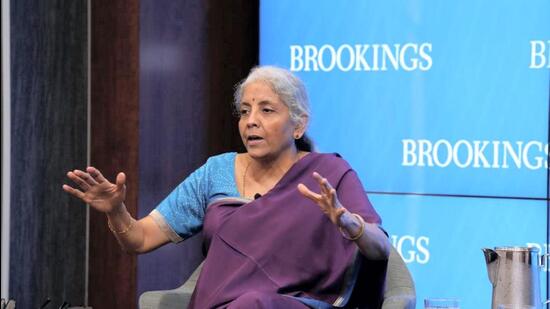
Soon after her arrival in the US capital on Tuesday, Sitharaman engaged in a public conversation with economist Eswar Prasad at the Brookings Institution in DC. The comments on the responsibility of advanced economies were a part of her written speech distributed at the event but were not delivered in person. She dived straight into the interaction with the moderator and audience.
{{/usCountry}}Soon after her arrival in the US capital on Tuesday, Sitharaman engaged in a public conversation with economist Eswar Prasad at the Brookings Institution in DC. The comments on the responsibility of advanced economies were a part of her written speech distributed at the event but were not delivered in person. She dived straight into the interaction with the moderator and audience.
{{/usCountry}}In her written remarks, Sitharaman said that no economy, including the Indian economy, has been exempt from the impact of swirling global currents. “After the unprecedented shock of the pandemic came the conflict in Europe with its implication for energy, fertiliser and food prices”. She added that in its wake, synchronised global monetary policy was tightening. “So naturally, growth projections have been revised lower for many countries, including India.” This “triple shock” had made growth and inflation a “double-edged sword”, she said.
On Tuesday, in its latest world economic outlook, the Fund slashed India’s growth projection to 6.8% in 2022-2023, days after World Bank slashed it to 6.5%.
The FM said that she was aware that growth forecasts were being lowered but expressed confidence that India will grow at 7%. “We expect India’s growth rate to be around 7.0% this financial year. More importantly, I am confident of India’s relative and absolute growth performance in the rest of the decade.”
In the final section of her written remarks, while highlighting India’s own commitment to multilateralism, Sitharaman laid out the broader context of the Covid pandemic, consequences of the conflict in Europe, and the global tightening of financial conditions and volatility “as inflation has proven to be anything but transient”.
In 2021, as the Joe Biden administration was infusing liquidity into the economy, and critics were warning it of possible inflationary consequences, Sitharaman’s American counterpart, Treasury Secretary Janet Yellen, termed inflation “transitory”.
Indian economic policymakers have claimed that their pandemic policy framework — which relied on direct food assistance to the poor, easing credit, and was far less fiscally expansive — had proved to be the better model.
The FM said, “Unprecedented quantitative easing and fiscal expansion is making way for quantitative tightening and fiscal retrenchment. Extreme policies beget extreme market reactions. In turn, systematic vulnerabilities built up and hidden during good times stand exposed. But, the consequences are faced by nations that had nothing to do with such policies”.
This is among the clearest Indian critiques so far on the implications of fiscal expansionary policies, subsequent inflation, and the hike in interest rates by the Federal Reserve. The rise in rates to quell inflation has slowed growth and created recessionary conditions.
Sitharaman then added in her written remarks that international cooperation was needed more than ever. But in the near term, she said, “Advanced economies must take responsibility for the global spillover of their political and economic policy decisions and put in place safety nets rather than impose sanctions on nations who are merely fulfilling their moral and democratic obligations for their people.”
The FM did not elaborate, but Western policy approaches have collided with what India sees as meeting its obligations to citizens on a range of issues — from food procurement and security and subsidies to energy purchases and pricing.
Sitharaman also reminded the West of its climate-related obligations. “In the medium-term, promises made in good times to provide finances to developing countries for dealing with climate change, energy transition and deliver on their commitments to net-zero must be redeemed.”
She added that as India prepared to take over the G-20 presidency, it was ready to do whatever was needed to “facilitate dialogue, discussions and decision on these critical issues”.