
 E-Paper



Oppn: Vande Mataram debate an attempt to divert attention from pressing issues
Congress chief Kharge criticised the NDA's focus on Vande Mataram in Parliament, calling it a distraction from pressing economic and security issues.


NEW DELHI: Congress chief Mallikarjun Kharge on Tuesday hit back at the National Democratic Alliance over the Vande Mataram discussion in Parliament, describing it as a tactic to divert attention from the economic challenges the country is grappling with, pressing foreign policy issues, and internal security matters.
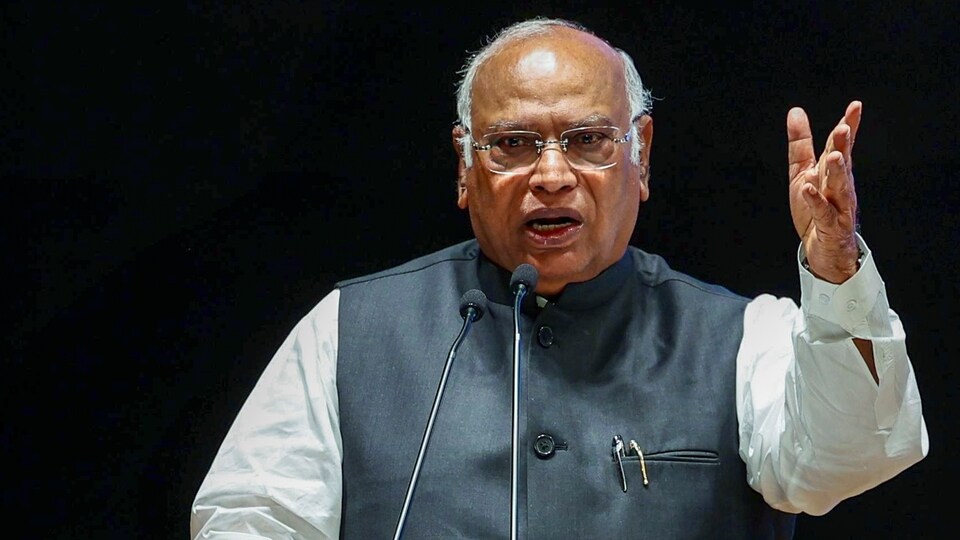
“The political debate over the national song Vande Mataram is merely a diversionary tactic when the country faces economic challenges. True patriotism seeks solutions to problems like the falling value of the rupee and the hardships faced by the common people, rather than mere symbolism and speeches,” he said in the Rajya Sabha during a discussion on the 150th anniversary of the national song.
Even when the country is grappling with a raft of problems relating to economy, unemployment, and social issues, the Prime Minister is only interested in election campaigning, the Congress leader alleged.
His comments came a day after Prime Minister Narendra Modi opened the debate and said Vande Mataram will remain an inspiration to create a self-reliant and prosperous India. Modi blamed India’s first PM Jawaharlal Nehru for removing stanzas from the song, composed in the 1870s by Bankim Chandra Chatterjee, and said this was done under pressure and to appease the Muslim League: “Under pressure, the Congress divided Vande Mataram, and that’s why the Congress also had to buckle under pressure and partitioned India.
But Kharge hit back.
“He (Modi) initiated the debate on Vande Mataram with the West Bengal elections in mind. Do not be under the misconception that attacking Gurudev Rabindranath Tagore is a way to divert attention from real issues. The objective of this House should be to focus on the pressing issues facing the country. Because the true tribute to Mother India will be when this Parliament debates public issues and their solutions,” Kharge said.
He also disputed the PM’s reference to Nehru’s letter to Subhas Chandra Bose, saying Modi misled the House.
“On, October 20, Nehru wrote to Subhas Bose. In that letter Nehru supported Jinnah’s point of view and said, coming in the background of Ananda Math, Vande Mataram can irritate Muslims. I want to read Nehru’s quote: “I read the background of Vande Mataram. I think this background can instigate the Muslims.” On 26 October, a Congress Working Committee (meeting) was held in Bankim Chandra Chatterjee’s Bengal to review the utility of Vande Mataram. The entire country opposed this proposal. But unfortunately, on Oct 26, the Congress compromised on Vande Mataram. The decision to remove lines from Vande Mataram was done as an act of social harmony,” Modi had said in the Lok Sabha on Monday.
But Kharge said that the truth was that on October 16, 1937, Bose wrote to Rabindranath Tagore asking him what stance the Congress should take on Vande Mataram. The next day, on October 17, Bose wrote to Nehru and suggested that the latter should meet Tagore personally on this issue, he said.
“On October 25, 1937, Nehru met Tagore and wrote a letter on October 26, which I quote: ‘In offering my own opinion about it, I am reminded that the privilege of originally setting its first stanza to the tune was mine …..to me, the spirit of tenderness and devotion expressed in its first portion, the emphasis it gave to beautiful and beneficent aspects of our motherland made a special appeal, so much so that I found no difficulty in disassociating it with the rest of the poem. The first two stanzas are such that it is impossible for anyone to take objection to… remember we are thinking in terms of a national song for all India’,” Kharge said.
The Congress Working Committee (CWC) unanimously passed a resolution on the song and prominent leaders who agreed to this resolution were Mahatma Gandhi, Maulana Azad, Nehru, Bose, Dr. Rajendra Prasad, Sardar Patel and others, Kharge said.
“This resolution clearly states that: ‘The committee wish to point out that the modern evolution of the use of the song as part of national life is of infinitely greater importance …...therefore the committee recommends that wherever Vande Mataram is sung at national gatherings only the first two stanzas should be sung, with perfect freedom to the organisers to sing any other song of an unobjectionable character’,” Kharge said.


