
 E-Paper



Pakistan new breeding ground of locusts, say experts
Locusts entered Rajasthan from Pakistan in April, and then drifted into other parts of western India.

 Prefer HTon Google


Pakistan has become a new breeding ground of desert locusts, entering Rajasthan from adjoining areas in Pakistan, said BR Kadwa, deputy director of the agriculture department.
“Swarms of locusts are entering Rajasthan from adjoining areas in Pak every 2-3 days since a month. Pakistan has become the new breeding ground of the locusts and hence we are seeing the repeated attacks of locusts in the state. Four swarms have entered Jaipur recently,” Kadwa told news agency ANI.
He further said that fortunately, Rabi crop has been harvested and Kharif sowing season is yet to arrive.
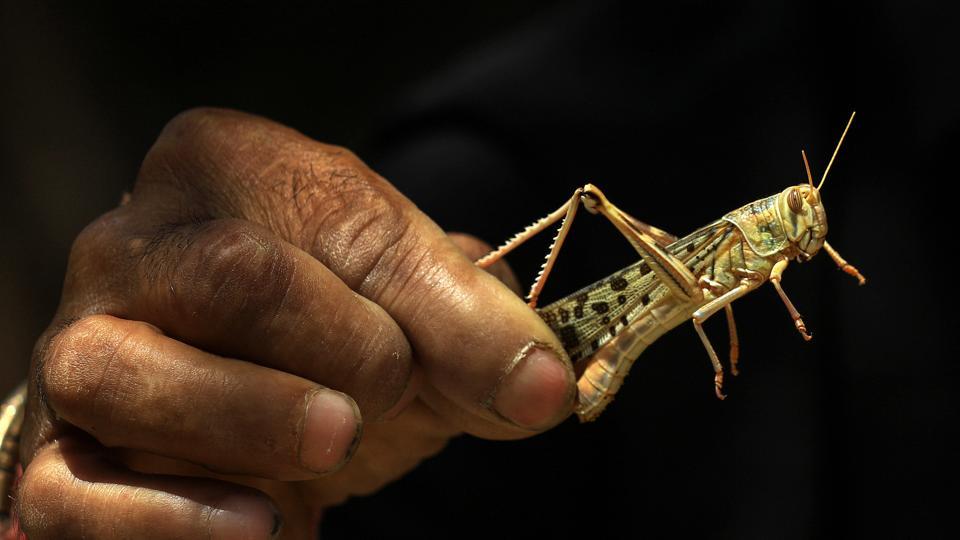
The desert locust is one of about a dozen species of short-horned grasshoppers.
This swarm originated in the Horn of Africa, where excess rains triggered a breeding boom. According to Indian experts, the swarm entering India now had another round of breeding in Baluchistan, Iran and Pakistan.
Locusts entered Rajasthan from Pakistan in April, and then drifted into other parts of western India. They are currently active in Rajasthan, Gujarat, Maharashtra, Uttar Pradesh and Madhya Pradesh. Rajasthan is currently the worst-affected state, according to the Union Environment ministry.
Adult desert locust swarms can fly up to 150 km a day with the wind and adult insects can consume roughly their own weight in fresh food per day. A single square kilometre swarm can eat as much food in a day as 35,000 people.
They feed on nearly all green vegetation - leaves, flowers, bark, stems, fruit, and seeds - and crops including millet, rice, maize, sorghum, sugarcane, barley, cotton, fruit trees, date palm, vegetables, rangeland grasses, acacia, pines and banana.
Desert locusts change their behaviour from acting as individuals to becoming part of a group, forming dense and mobile hordes. Swarms can be several hundred square kilometres and extremely dense, with up to 80 million adults in each square kilometre.
The last major infestation was in 2003-2005 when more than 12 million hectares were treated in west and northwest Africa, costing hundreds of millions of dollars, including food aid.


