
 E-Paper



Parts of Delhi in deep red as Air Quality Index nears 400 mark
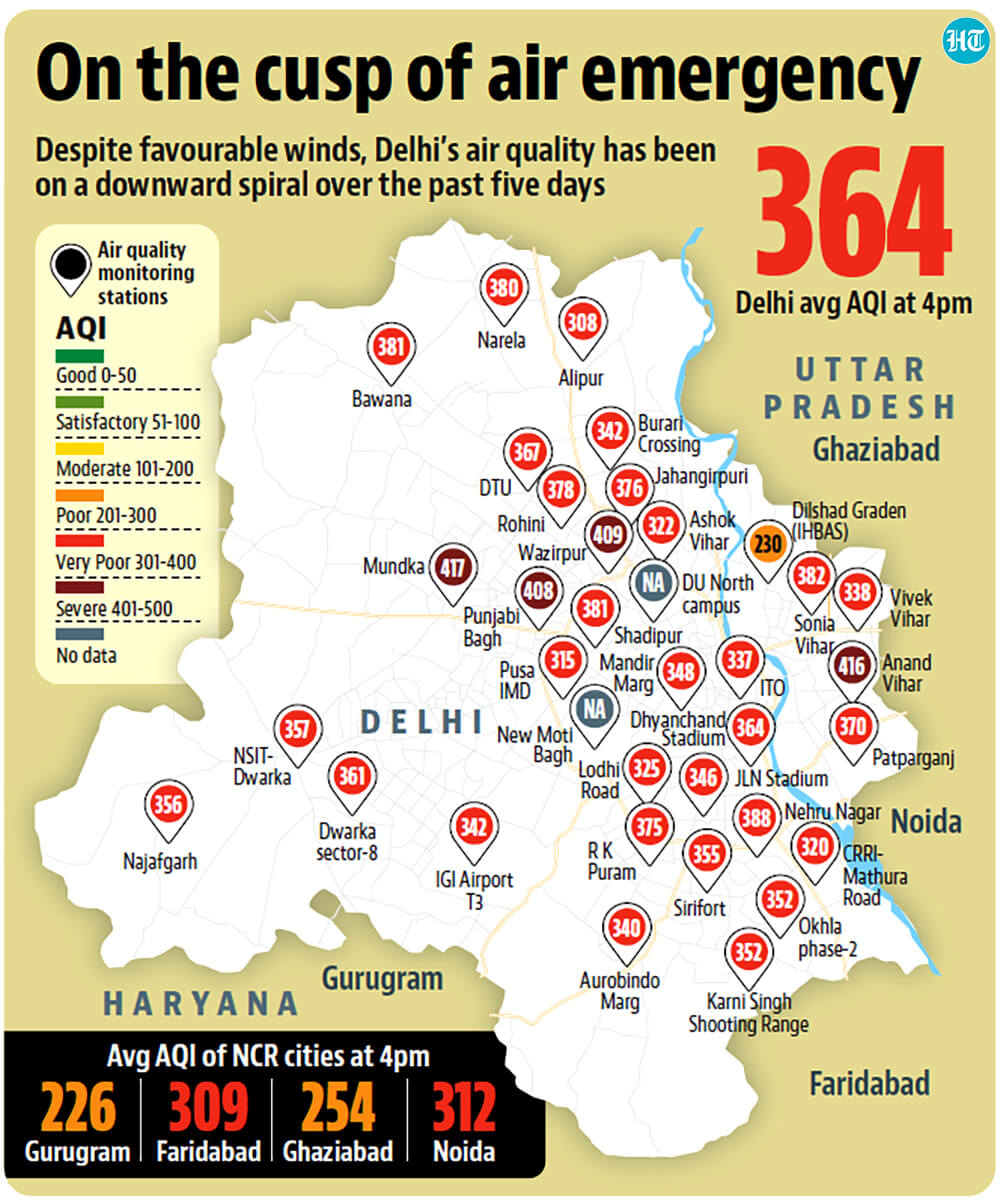
Delhi’s overall AQI worsened to 364, according to the CPCB bulletin, a reading in the upper reaches of “very poor”, and the worst yet this season.


Another year, another winter of sepia skies, another cycle of itchy throats, burning eyes, flaring allergies and choked lungs. For yet another winter, Delhi is staring at the brink of a public health emergency, with the air quality index (AQI) on Wednesday evening edging closer to the dreaded, deep red “severe” zone.
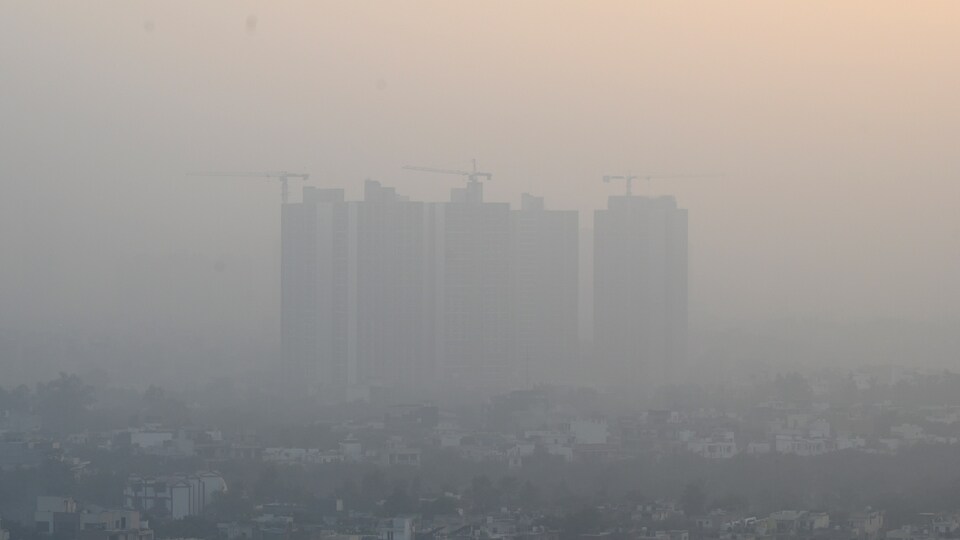
Delhi’s overall AQI worsened to 364, according to the Central Pollution Control Board’s (CPCB) 4pm bulletin, a reading in the upper reaches of “very poor”, and the worst yet this season. But at least four areas slipped into “severe” — Mundka with an AQI of 417, Anand Vihar (416), Wazirpur (409) and Punjabi Bagh (408). Bawana and Rohini reported brief spells of severe air as well in the afternoon.
This spike comes in the face of a spate of policies and mitigation programmes — some scientific and many unscientific — by multiple agencies that are again appearing to fall well short of controlling the levels of toxicity that subsume the city’s air from early November.
Experts warned that the readings will only get worse over the next few weeks, and make the inevitable plunge into the most hazardous level on the CPCB’s scale since the present haze draping Delhi is largely down to local pollutants concentrating in the air because of still winds and dipping temperatures. The role of raging fires in neighbouring states is still low because of a favourable wind direction.
According to the Union ministry of earth sciences’ Decision Support System (DSS), around 13% of Delhi’s PM2.5 (ultra-fine particulate pollutants) levels on Wednesday was due to smoke from farm fires, 11.4% from the city’s own transport sector, and 10.4% from neighbouring Gautam Budh Nagar. To be sure, these numbers are only estimates, and DSS does not measure pollutants in real-time.
The DSS estimate for Tuesday said 14.3% of Delhi’s PM2.5 concentration was from Gautam Budh Nagar, around 11.8% from vehicles in Delhi, around 8% from Ghaziabad, and only around 7.2% from stubble burning.
While data from authorities in Punjab and Haryana suggest that farm fires in the two agrarian states have increased over the past week, they are not yet at levels they tend to hit this time of year. Punjab and Haryana reported a combined 1,556 farm fires on Tuesday, nearly triple the number a week ago (442), but still lower than 1,769 on October 31 last year and 3,137 in 2021. To be sure, year-on-year data on stubble fires is not always comparable due to differences in cropping and harvest patterns.
The wind plays a crucial role here since a southeasterly current — like the one the Capital is experiencing right now — takes most of the farm smoke towards Rajasthan and across the border, while a northwesterly current brings it towards the city. The worst affected cities in India on Wednesday were Hanumangarh in Rajasthan (with an AQI of 414) and Fatehabad in Haryana (413), and four others in the belt had an AQI reading poorer than Delhi’s.
To be sure, India’s pollution norms are less stringent than global thresholds. For instance, the Indian safe standard for PM2.5 is 60µg/m³, while the World Health Organization’s (WHO) standard is a fourth of that at 15 µg/m³. Similarly, India’s PM10 standard is 100µg/m³ and the WHO’s is 45µg/m³. Delhi’s PM2.5 levels peaked at 173.3µg/m and PM10 at 327.8µg/m on Wednesday.
The air in Delhi continued to worsen despite no discernible change in meteorological conditions over the past 48 hours, said Kuldeep Srivastava of the India Meteorological Department (IMD). “Wind speeds continued to remain low, even during the day. They were calm at night and averaged just around 2-4 km/hr during the day, which meant the visibility did not go over 2,000 metres,” he said.
Experts said the air hazard underlined authorities’ inability to control a situation that repeats itself with near clockwork precision every year. A host of policies and mitigation measures are in effect in Delhi now, for instance, including the Graded Response Action (Grap) imposed by the Commission for Air Quality Management (CAQM), the Delhi government’s winter pollution action plan and the “Red Light On, Gaadi Off” campaign.
As every year, the residents of the city bear the costs for this failure and pay with their health.
Bad air disproportionately affects elderly people, children and those with pre-existing conditions or impaired immunity. In fact, pollution levels as high as Delhi is experiencing right now also threatens healthy adults. Doctors and researchers have said polluted air can cause bronchitis, asthma, anaemia and acute respiratory infections, apart from nausea.
A 2018 study by WHO revealed that when pregnant women are exposed to polluted air, they are more likely to give birth prematurely, and have small, low birth-weight children. Air pollution also impacts neurodevelopment and cognitive ability and can trigger asthma, and childhood cancer. Children who have been exposed to high levels of air pollution are likely to be at greater risk for chronic diseases such as cardiovascular disease later in life, according to WHO.
With the increasing proportions of dust and smoke in the air, health care facilities and doctors across the Capital have reported an upsurge in the number of patients with severe coughs, allergies and respiratory illnesses.
“We are increasingly seeing patients who are coming in with viral infections and are taking a week to over 10 days to recover. Such a cough usually subsides in two or three days, but are worsened by the air pollution. Patients are requiring nebulisers and inhalers to get some respite from prolonged and more severe cough and chest congestion,” said Dr Neetu Jain, senior consultant (pulmonology critical care and sleep medicine) at Delhi’s PSRI Hospital.
Dr Anant Mohan, a leading pulmonologist, and the head of the department of pulmonary, critical care and sleep medicine at the All India Institute of Medical Sciences (AIIMS) said the pollution impairs the entire body’s functioning.
“Pollution is a silent epidemic. The more exposure people have to high levels of particulate matter and toxic chemicals, the more share of population will fall ill. Our superficial understanding might only be that pollution would cause breathing distress, but it also disrupts the functioning of vital organs, including the brain and heart,” Dr Mohan said.
According to the weather forecast by IMD, Delhi’s sky will remain clear for the next few days, with some fog likely on Thursday and Friday. The temperature — the minimum was 16.2°C on Wednesday, a degree lower than Tuesday — is expected to dip over the next few days too, said weather officials.


