The Supreme Court has directed its five-member high-powered enquiry committee (HPEC) to begin its probe into the July protests by examining the use of pellet guns, targeted violence and harassment of female protesters, injuries sustained by police personnel and destruction of property, while making clear that broader constitutional questions arising from the July protests led by the Cockroach Janta Party (CJP) will be decided by the court itself.
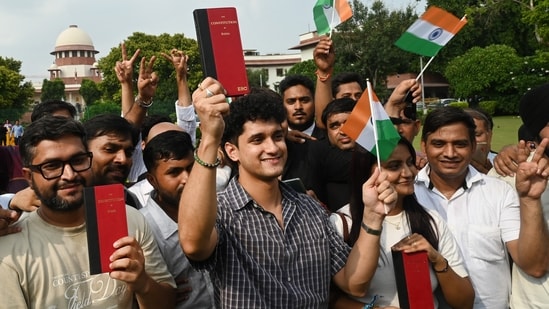
In a detailed order issued after the September 10 hearing, a bench comprising Chief Justice of India Surya Kant and justices Joymalya Bagchi and V Mohana also directed the committee to ensure protection and confidentiality for vulnerable witnesses, including keeping their identities undisclosed, and said a separate online portal could be created to enable them to submit evidence and documents.
Priority list of key issues
The court’s latest directions give the HPEC a specific priority list as it begins its inquiry into the competing allegations surrounding the July 20 protests. The committee has been asked, “in the first instance”, to examine four sets of issues — use of pellet guns; targeted violence and harassment of female protesters; injuries sustained by police personnel; and excessive violence and destruction of property “occasioned on either side”.
The order is a significant sharpening of the mandate given to the HPEC by the court on August 18. While the committee will examine the factual allegations and assist the court, the Supreme Court reiterated that wider constitutional questions arising from the controversy, including the use of facial recognition by law enforcement agencies, would remain for its own consideration “at the appropriate stage”.
{{/usCountry}}The order is a significant sharpening of the mandate given to the HPEC by the court on August 18. While the committee will examine the factual allegations and assist the court, the Supreme Court reiterated that wider constitutional questions arising from the controversy, including the use of facial recognition by law enforcement agencies, would remain for its own consideration “at the appropriate stage”.
{{/usCountry}}Also Read I Abhijeet Dipke 'resigns as MP CM' after Balaghat heckling, sparks row over 'misuse of letterhead'
The court also rejected a plea by some petitioners for reconstitution of the HPEC, expressing “some measure of disquiet” over what it called “conjecture and preconceived notions” against the committee even before it had commenced its inquiry.
The HPEC, the bench said, had been constituted to assist the Supreme Court “with the highest standards of fairness and transparency and with a dispassionate approach” and was not meant to espouse the cause of either side.
The order also emphasised the protection of vulnerable witnesses in view of allegations of threats and intimidation surrounding the protests.
Intimidation and Swantantra Bhardwaj's arrest
In a separate direction, the bench ordered Delhi Police to assess the threat perception of a 14-year-old female protester and provide protection to her and her family. It also directed the police to expeditiously investigate allegations that anti-social elements had threatened or harassed the girl and her family and submit a status report before the next hearing. The order recorded allegations that threats had been made to the life of the child and her family and that no action had been taken by Delhi Police against those allegedly responsible.
The Supreme Court had already expressed concern during last week’s hearing over the treatment of the minor, saying allegations of intimidation of a child could not simply await the outcome of the HPEC inquiry if those accused were free to threaten or browbeat the victim and her family.
The intervention came amid a criminal case against right-wing influencer Swatantra Bhardwaj, who was recently detained after allegedly claiming in an interview that he had “cracked the skull” of the father of a student activist – the minor referred to by the bench on Thursday, during an earlier CJP protest. Delhi Police subsequently invoked provisions of the SC/ST (Prevention of Atrocities) Act and criminal intimidation in the case relating to the alleged assault on the 38-year-old man.
A separate Pocso case was also registered against Bhardwaj following allegations by the student that she was subjected to rape threats, abuse and circulation of morphed images after she complained about the alleged assault on her father.
The latest order goes further in creating a framework for witnesses appearing before the committee. It said statements and evidence submitted by vulnerable witnesses must be kept strictly confidential and their identities protected. The HPEC may create a separate online portal to facilitate the submission of documents and evidence by such witnesses and other stakeholders.
The court also appointed senior advocate Dr Monika Gusain, along with advocate-on-record C Solomon, as amici curiae to assist the Supreme Court as representatives of the HPEC and to act as an “independent arbiter” between the parties.
The court further asked the HPEC to appoint a member secretary at the earliest to provide logistical and secretarial support and directed the committee to submit its first report to the Supreme Court “at the earliest”.
HPEC formed to examine and recommend
The directions come against the backdrop of the Supreme Court’s August 18 decision to constitute the HPEC headed by former Supreme Court judge Justice R Subhash Reddy to independently examine the competing allegations arising from the protests.
The committee was tasked with examining allegations of excessive police force as well as violence against security personnel and damage to public property. The court subsequently clarified on September 10 that the HPEC could examine allegations and make recommendations but could not order registration of FIRs, since the power to direct a criminal investigation remained with the Supreme Court.
The clarification followed the court’s September 1 decision to use its extraordinary powers under Article 142 to bring criminal proceedings arising from the protests to an end. FIRs registered between July 20 and 25 in connection with the protests were ordered not to be pursued or investigated, and the court directed that no fresh FIRs be registered in relation to those incidents.
The HPEC’s fact-finding exercise will therefore proceed within a framework in which the Supreme Court has retained control over any decision to order criminal investigation while asking the committee to focus first on the allegations it considers most pressing.
The matter will next come up on October 9.
Also Read I Noida government schools open or close? Official clarifies after CJP's Saurav Das makes big claim
The July 20 march to Parliament by protesting students came weeks after the agitation against leaks in the NEET test paper that necessitated a retest began; the protests, catalysed and headed by the Cockroach Janata Party, also demanded the resignation of then education minister Dharmendra Pradhan.
The government eventually gave in to the demands; Pradhan resigned on July 25. The government also set up a committee headed by Infosys chairman Nandan Nilekani to reform the test process and launched efforts to strengthen the test conducting agency NTA.