
 E-Paper



In Japan, PM Modi, US President Biden to focus on Ukraine, bilateral ties
It is understood that the Biden-Modi conversation largely revolved around the world after the Ukraine crisis and the geopolitical and economic implications of the war.

 Prefer HTon Google


There will be three legs of Prime Minister Narendra Modi’s engagements with United States (US) President Joe Biden in Tokyo — in the bilateral format; under the Quad umbrella; and as part of the launch of the Indo-Pacific Economic Framework (IPEF).
All three elements speak of the strengths as well as challenges in the India-US relationship.
First, the bilateral element.
On April 11, the two leaders met for a virtual conversation and set the stage for the 2+2 dialogue between the external and defence ministers on both sides later that day. This meeting had been held in the wake of Russia’s invasion of Ukraine and amid clear differences between Washington and Delhi, where the former wished for India to make a more assertive position against Moscow.
It is understood that the Biden-Modi conversation largely revolved around the world after the Ukraine crisis and the geopolitical and economic implications of the war. PM Modi got an opportunity to explain where India stood on the issue; how it saw developments in the Indo-Pacific as well as in neighbouring countries; and reassure the American side that India would not take any action that adversely affected core US national interests. Biden and his team shared their assessment of the churn in the international system, the impact of the war on Russia and its capabilities, and while nudging Delhi, displayed an appreciation of India’s position and constraints.
Both leaders discussed China’s behaviour in the wake of the war and reiterated their commitment to the larger bilateral relationship, its importance, and the shared worldview on the Indo-Pacific.
In Tokyo too, expect what national security advisor Jake Sullivan termed a “constructive and straightforward” conversation.
After the early weeks of turbulence on the Ukraine question, India and the US found a way to manage the differences. But this chapter isn’t over, and differences persist with the war continuing and its implications deeply felt in the rest of the world. While PM Modi — who recently got a sense of the mood in both Nordic countries and Western Europe — would be keen to understand what the US sees as the endgame in Ukraine, President Biden may well be keen to get a sense of Indian understanding of the larger situation and specific policies, including its somewhat accelerated oil imports from Russia.
For Washington, the core objective is weakening Russia and enabling Ukraine to push Moscow back to the extent possible; for Delhi, the core objective is restoring peace so that the war’s inflationary consequences are managed and there is a reprieve at home. Food security, too, will emerge as a point of discussion with PM Modi having an opportunity to share India’s concerns and decisions on securing wheat supplies at home while exporting it in a calibrated manner to countries in need.
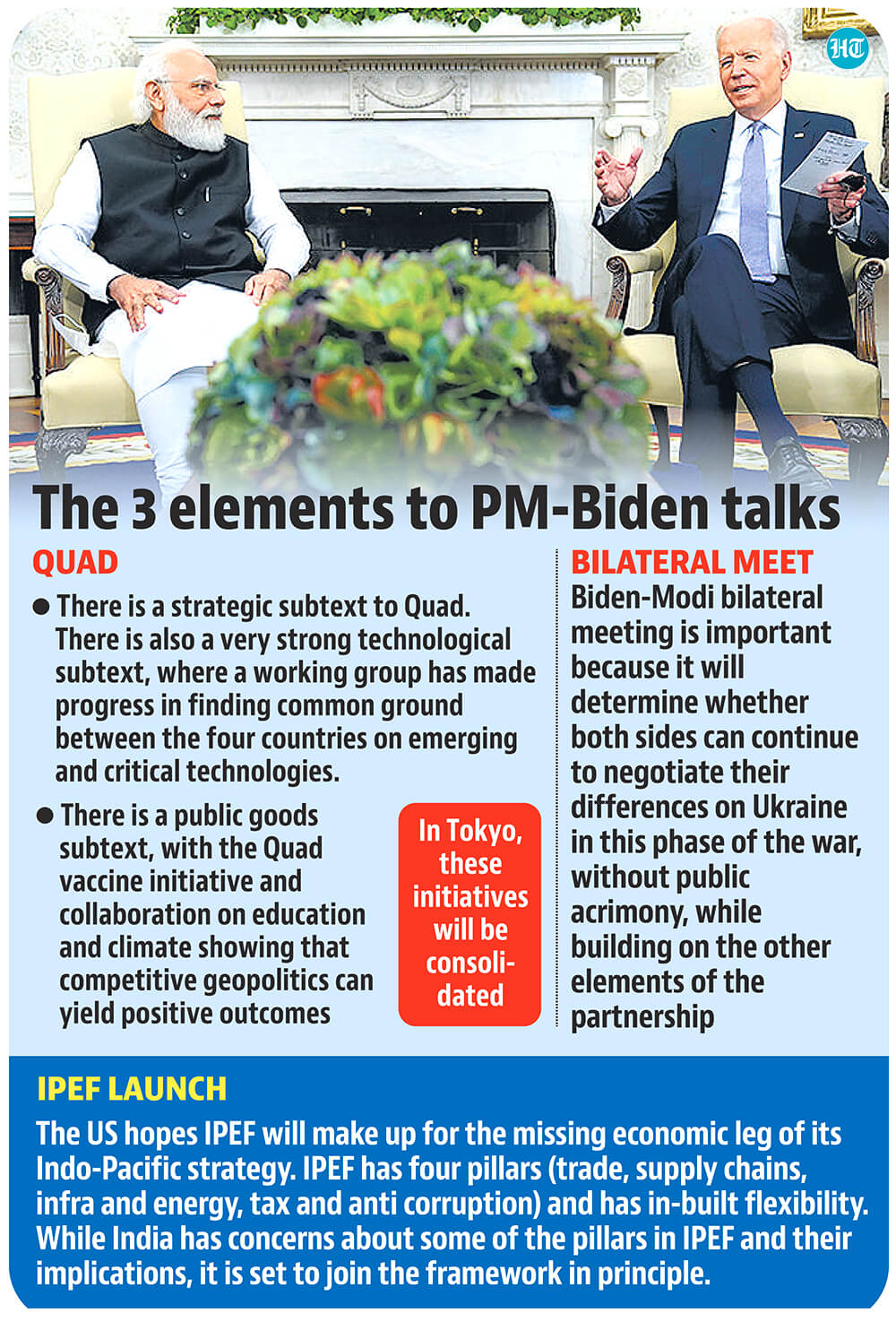
The Biden-Modi bilateral meeting is important because it will determine whether both sides can continue to negotiate their differences on Ukraine in this phase of the war, without acrimony and without public accusations and counter-accusations. It is also important because besides setting new goalposts and consolidating existing initiatives in a wide range of areas, the two will continue to discuss further areas of cooperation with the aim of bolstering Indian capabilities and deepening India-US strategic synergy.
This is where the Quad comes in.
Quad has already emerged as the big diplomatic success story of recent years. From a body that was defunct just five years ago to having four leader-level summits in the past year (two virtual, two in-person), it has both symbolic importance and real substantive content. Quad has emerged as a mechanism where all countries, some explicitly and others implicitly, can work to build a countervailing coalition to China by shaping the regional environment around it. This is not meant to create conflict as Beijing fears; it is meant to avoid conflict by ensuring deterrence and creating a balance of power in the Indo-Pacific so that China doesn’t miscalculate and overreach, a tendency it has shown in recent years.
There is a security subtext to Quad, and as Dhruva Jaishankar argued in HT on Sunday, it is perhaps time to lend the security dimension more salience especially in the maritime domain. There is a very strong technological subtext, where a working group has made progress in finding common ground between the four countries on emerging and critical technologies.
There is a public goods subtext, with the Quad vaccine initiative and collaboration on education and climate showing to countries in the region that competitive geopolitics can yield positive outcomes.
In Tokyo, these initiatives will be consolidated. The need for WHO approvals, which will help expedite the vaccine initiative, will be discussed. Green initiatives will be given a boost. While Quad members want to focus on consolidation rather than expansion in terms of formal membership, there may be an effort to create room for South Korea, which is keen to collaborate with the grouping, in specific working groups. It is also perhaps time for Quad countries to have a more substantive, even if discreet, discussion on Taiwan. For the US, Taiwan ranks high-up in the list of priorities in the Indo-Pacific; this is not the case with, say, India. While China is unlikely to mount an offensive in the near future, having clear expectations on what Quad members can and cannot do in case the situation in the Taiwan straits gets unstable will help avoid future misunderstandings.
But beyond the strategic element, the third element is set to draw attention in Tokyo — the launch of the IPEF.
The American motivation on IPEF is simple. The US has faced enormous flak for being absent from the key trading arrangements in the region. Domestic politics in the country does not allow for a mega free trade pact. A framework allows the US to send a signal of its economic commitment. It also helps bring countries together on the same page on broad principles governing four economic pillars — trade, supply chains, infrastructure and energy, taxation and anti-corruption measures.
While it has already been criticised for being a weak alternative to a free trade pact, the US administration believes that durability of the arrangement and diversity of participation is key. To achieve this, as HT reported last week, it has offered a pick and choose model to participating countries where they can opt for the pillars which they want to collaborate on — without needing to participate in all the pillars. It has also left the door open for more substantive discussion on each of the pillars for the future. In recent months, India has shown greater willingness and enthusiasm to enter into trade agreements than the US. While it has concerns about some of the pillars in IPEF and their implications especially given that market access isn’t on the table, New Delhi — in the spirit of showcasing its own commitment to the region — is likely to join the framework in principle.
Through this combination of a bilateral meeting, a Quad summit, and IPEF launch, India and the US will hope to overcome and manage persistent differences, share assessments, arrive at a common understanding on shared geopolitical concerns, ensure substantive policy outcomes which make a difference in the lives of their people, and give a signal of their shared commitment to security and prosperity in the region. As Modi meets Biden, politics, strategy and economy will dominate the conversations in Tokyo.


