New Delhi: “Easy justice, speedy justice, and justice for all” should be the hallmark of the judiciary when India completes 100 years of its independence in 2047, Prime Minister Narendra Modi said on Saturday, pitching the use of local languages in courts to strengthen people’s right to access justice.
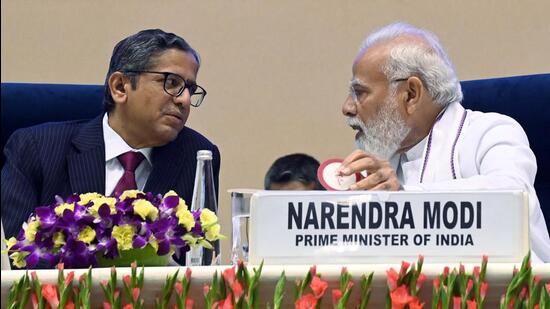
Speaking at the inaugural session of the joint conference of chief ministers of states and high court chief justices at the national capital, Modi also underlined the need to simplify laws for the general public, and said that the central government is actively examining a proposal to have two drafts of every legislation – one, that may have legal terminologies, and the other, in a much simpler form for everyone to understand.
Since good governance has its foundation in the idea of justice, Modi said, the justice delivery system must be connected with the citizens of the country and should be in a language they understand.
Modi spoke after Chief Justice of India NV Ramana’s address, in which the Supreme Court judge minced no words in criticising the executive and the legislature for engendering pendency of cases across all levels in courts.
Also Read | Inaction by executive behind pendency: CJI
{{/usCountry}}Also Read | Inaction by executive behind pendency: CJI
{{/usCountry}}In his 19-minute address, the PM, on his part, repeatedly promised all support to the judiciary, and also urged the chief ministers to render their assistance so as to ensure that hopes and aspirations of the citizenry from the justice delivery system are fulfilled.
The PM commenced his address by underlining that the confluence and balance of judiciary and legislature will prepare the roadmap for an effective and time-bound judicial system in the country. He said that 75 years of independence have continuously clarified the roles and responsibilities of both the judiciary and the executive. “Wherever it is necessary, this relation has evolved continuously to give direction to the country,” said Modi.
Terming the conference a vibrant manifestation of the beauty of the Constitution, the PM said there is a need to prioritise issues concerning the judiciary, especially when the Government of India is celebrating and commemorating 75 years of independence through an initiative -- ‘Azadi Ka Amrit Mahotsav’.
“In 2047, when the country will complete 100 years of its independence, then what kind of judicial system would we like to see in the country? How do we make our judicial system so capable that it can fulfil the aspirations of India of 2047, these questions should be our priority today... Our vision in Amrit Kaal should be of such a judicial system in which there is easy justice, speedy justice, and justice for all”, underlined Modi. The government has said that the period between 2022 and 2047 will be marked as Amrit Kaal, and that it will work towards achieving its stated ambitions for 2047 in these 25 years.
The PM took the opportunity to talk about intricacies of law, arising out of barriers of language and legal jargon. He said that there is a need to promote local languages in the courts so that people of the country feel connected with the judicial process and their faith in the system increases. “People’s right to judicial process and access to justice will get strengthened by this,” he added.
The PM said that justice delivery system should use the language of the common man. “Unless the common man understands the basis of the justice, for him/her, there is no difference between the justice (from a court) and a government order,” he said.
“In many countries, when a law is made. One version is in proper legal terminology but along with it, a parallel form of the same law is also prepared in a simplified language for the common man... we are also trying to come up with a mechanism where the same law can be passed in two different formats by the parliament and in state legislature. I have constituted a team to examine this,” said Modi.
He further praised Chief Justice of India NV Ramana for advocating the use of local languages in courts. “A large section of the population finds it difficult to understand procedures of the courts as well as their judgments. We need to simplify this system for the general public. We need to encourage regional language in courts. This will strengthen the faith of the common man in the justice delivery system.”
The Government of India, Modi said, considers the use of technology in the judicial system as an essential part of the Digital India mission. Calling attention to the success of the Digital India project that has allowed a wide majority of Indian to avail services on phone, PM Modi said that when people are getting access to everything on the phone and using the technology, they will aspire to get justice also in same way.
“Of all the digital transactions that took place in the world last year, 40% of the digital transactions took place in India,” highlighted the PM, as he appealed to the chief ministers and chief justices of high courts to take the concept of digital innovation in judiciary forward.
Courts in the country shifted to virtual hearing following the onset of the Covid-19 pandemic, making use of technology and ensuring there is no break in the justice delivery system. Starting March 2021, courts at all levels started conducting proceedings through video-conferencing, which has gradually become a norm in many constitutional courts.
On Saturday, Union law minister Kiren Rijiju said at the conference that the Supreme Court has emerged as a global leader with over two lakh virtual hearing. “The high courts and district courts together have conducted nearly 1.84 crore virtual hearings,” he added.
A week ago, at an event in Chennai, CJI Ramana said that the Supreme Court has continued hearing of cases through the virtual mode in the spirit of providing accessibility to lawyers practising across the country and it should be strengthened in future.
The Prime Minister added that the government is working hard to reduce delays in justice delivery and efforts are on to increase judicial strength and improve judicial infrastructure. He said ICT (information and communications technology) has been deployed for case management and efforts to fill the vacancies at various levels of judiciary are underway.
Modi further said that judicial reform is not merely a policy matter but involves human sensitivities, which should be kept in the centre of all the deliberations.
“Today, there are about 3.5 lakh prisoners in the country who are undertrials and are in jail. Most of these people are from poor or ordinary families. In every district there is a committee headed by the district judge, so that these cases can be reviewed and wherever possible, such prisoners may be released on bail. I would appeal to all chief ministers and chief justices of high courts to give priority to these matters on the basis of humanitarian sensibility and law,” said the PM.
Modi also highlighted the significance of mediation as a tool for settlement of pending cases in the courts, especially at the local level. “There is a tradition that is thousands of years old, of settlement of disputes through mediation in our society. Mutual consent and mutual participation, in its own way, is a distinct human concept of justice. With this thinking, the government has introduced the Mediation Bill in the parliament as umbrella legislation. With our rich legal expertise, we can become a global leader in the field of solution by mediation. We can present a model to the whole world”, he said.
On April 9, at an event in Gujarat, both President Ram Nath Kovind and the CJI brought to fore the significance of mediation as a tool of alternative dispute resolution mechanism.
On mediation, President Kovind, who has been a lawyer himself, said, “In mediation everyone is a winner,” as he said that “If any pending litigation is settled by mediation, the entire court fees deposited by the litigant party are refunded.”
The CJI, on his part, had flagged multiple benefits of adopting alternate methods of dispute resolution. “Since alternate dispute resolution (ADR) is designed around a participatory model, its adoption is going to break the existing barrier. From being an ‘outsider to the process’, citizens with their direct involvement will be ‘insiders in the process’. Online mediation has the ability to revolutionise the justice delivery system by promising simple and affordable justice for all,” justice Ramana said.