
 E-Paper



PM Narendra Modi vows to protect farmers amid trade tensions
PM Modi said India will never compromise the interests of its farmers because agriculturists of the country have made the country self-sufficient

 Prefer HTon Google


Prime Minister Narendra Modi pushed for greater self-reliance, local manufacturing of everything, from fertilisers to EV batteries, and pledged to protect farmers amid trade tensions with the US, delivering his 13th straight Independence Day address on Friday.
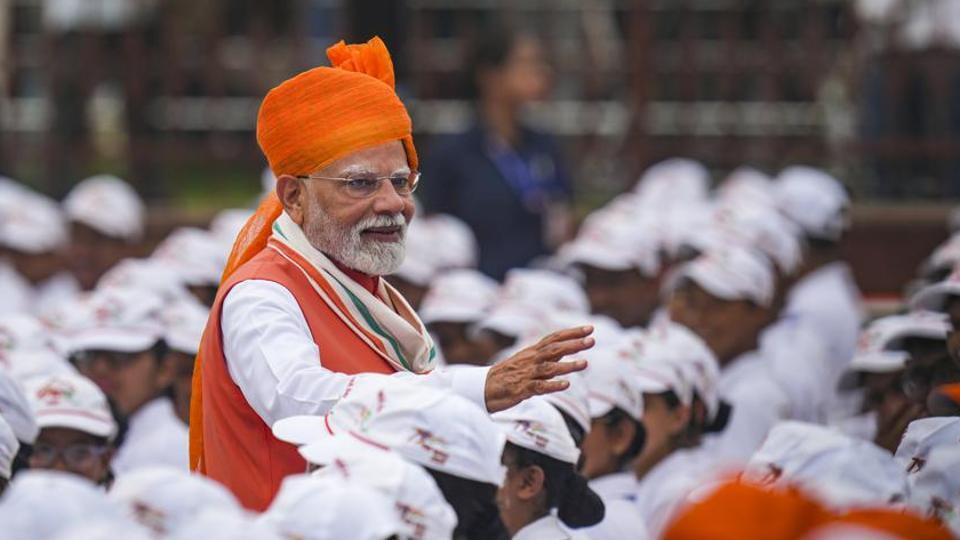
“Farmers, fishermen, cattle rearers are our top priorities”, Modi said in his customary address at the Red Fort in New Delhi, soon after hoisting the Tricolour under a cloudy, monsoon sky in New Delhi.
“Modi will stand like a wall against any policy that threatens their interests. India will never compromise when it comes to protecting the interests of our farmers,” he said.
India will never compromise the interests of its farmers because agriculturists of the country have made the country self-sufficient, Modi said in a sweeping speech, underscoring the fifth-largest economy’s stand on not opening up the farm sector during the US-India trade talks.
Also Read: Modi outlines vision centered around self-reliance, defence, pledges simpler GST
The PM said the country needed to achieve self-sufficiency in energy, critical minerals, technology and weaponry, underscoring the need to build high quality goods even as “economic selfishness rises by the day”.
Linking local production with national pride, Modi said, “The yardstick of a nation to measure its self-esteem is to see to what extent it is self-reliant,” Modi said.
“Everybody knows that after we gained freedom, feeding millions was a great challenge. It was my farmers who toiled to fill our silos with grains. Modi stands like a wall, won’t compromise on farmers.”
A large majority of Indian agriculturists are small land-owners, tending to tiny parcels of farmland.
The farm sector supports nearly half of the nation’s population and agriculture accounts for nearly 18% of India’s GDP, which explains the country’s continued protectionism.
The focus on the economy comes against the backdrop of US President Donald Trump’s decision to impose a 50% tariff rate on India, much higher than its neighbours and peers, which disadvantages exports and could hurt nearly one per cent of the nation’s gross domestic product, according to some analysts.
“The need of the hour is to take a resolve for building a strong India ... I want our traders, shopkeepers to display boards for swadeshi (India-made) products,” Modi said.
Modi said that agriculture remains the cornerstone of India’s development, with the country being no. 1 in milk, pulses and jute production, and no 2 in rice, wheat, cotton, fruits and vegetables.
Farm exports have crossed ₹4 lakh crore, reflecting the nation’s global competitiveness, he said adding, to further empower farmers, the government launched the PM Dhanya Dhanya Krishi Yojana for 100 backward farming districts, complementing ongoing support through PM-Kisan and irrigation schemes etc.
Earlier this month, Trump signed an executive order imposing an additional 25% tariff on all Indian goods entering the US, making good on his threat to penalise New Delhi’s continued purchases of Russian oil.
The additional 25%, due to take effect on August 27, puts India at par with Brazil as the two countries whose exports will face the highest levy of 50% on their goods. The duties would put Indian exporters at a significant disadvantage compared to their rivals in Bangladesh, Indonesia and Vietnam – which face tariffs of between 19% and 20% .
India has called the American actions “unfair, unjustified and unreasonable” and said it will take all actions necessary to protect its national interests,
India and the US failed to hammer out a bilateral trade pact after several rounds of negotiations, despite Trump’s hint in the middle of the talks that a “big deal” was imminent. India’s refusal to open up its farm, fishery and dairy sectors was one of the main sticking points.


