The agriculture ministry is bringing hi-tech to the Pradhan Mantri Fasal Bima Yojana (PMFBY), the National Democratic Alliance (NDA) government’s flagship crop insurance programme, and making structural changes to address systemic hurdles in its implementation.
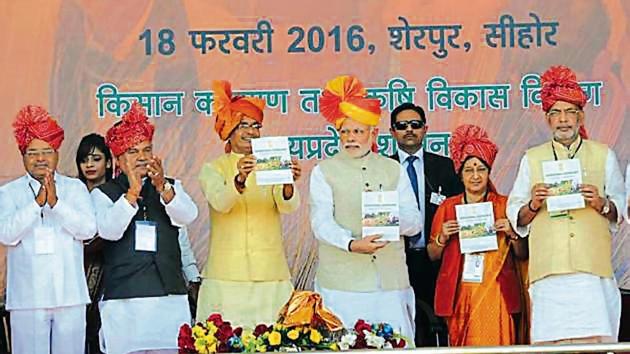
Delayed payments to farmers have marred the scheme, which was launched in 2016-17 with the promise of lower insurance premiums, higher risk coverage and faster payouts.Timely claims settlement is critical to its success .
Tussles between states and insurance companies over estimates of crop losses and computation of claims are a key bottleneck. Often, insurance companies suspect fudging of data by claimants, a senior official familiar with the matter.
For a transparent estimation of crop losses, the ministry has developed an android app and harnessed satellite technologies, such as remote sensing. A centralised web-based management information system, like the one used for the Mahatma Gandhi National Rural Employment Guarantee Scheme, is now being used to monitor agricultural activities real time.
The number of farmers who opted for insurance fell 17% to 47.9 million in 2017-18, from 57.4 million in 2016-17. Area coverage under the scheme rose to 57.1 million hectares in 2016-17, the initial year, from 52.4 million hectares in 2015-16, when a different insurance regime was in force. However, in 2017-18, the area insured fell to 47.5 million hectares. Of the total premium of ₹19,000 crore paid in the kharif (summer crop) season of 2017 , payouts have been made to the tune of ₹14,000 crore. Farmers pay between 1.5-2% of the total premium. The rest is shared 50-50 between the Centre and the states.
{{/usCountry}}The number of farmers who opted for insurance fell 17% to 47.9 million in 2017-18, from 57.4 million in 2016-17. Area coverage under the scheme rose to 57.1 million hectares in 2016-17, the initial year, from 52.4 million hectares in 2015-16, when a different insurance regime was in force. However, in 2017-18, the area insured fell to 47.5 million hectares. Of the total premium of ₹19,000 crore paid in the kharif (summer crop) season of 2017 , payouts have been made to the tune of ₹14,000 crore. Farmers pay between 1.5-2% of the total premium. The rest is shared 50-50 between the Centre and the states.
{{/usCountry}}Crop losses are estimated through so-called crop-cutting experiments, which involve cutting and weighing of crop samples. It is this step that lacked transparency, officials say, and the android app would help remove the opacity. Revenue officials are being required now to use “CCE Agri”, a Google-based android app linked to the central portal, to record yields. To skirt Internet outages in rural areas, the app can record data even offline. Cherry-picking, or the practice of insurance firms selectively bidding to insure low-risk areas, is a problem. Pointing out drawbacks in the PMFBY, a committee set up to identify ways of doubling farmers’ income. In a report titled ‘Risk Management in Agriculture,’ said last month that the “number of bidders in the drought-prone rainfed areas have been relatively lesser, resulting in premium rates as high as 25%”. The premium rates are usually between 15-20%.
To tackle this, the unit of the insured area is being widened to clusters which will include both low-risk and high-risk areas. Earlier, bidding was done at the district level. “This change will lead to more competitive bidding,” said Ashish Kumar Bhutani, a joint secretary in the agriculture ministry. Remote sensing is also being used to analyse area profiles and eliminate discrepancies between the area insured and the area sown. “States have been notifying only select crops. This means risk cover is not available for all crops. To increase area coverage it is important to notify as many crops as possible,” said Satish Giri, an expert who analysed the scheme recently.