
 E-Paper



PMO holds high-level meet on Joshimath land subsidence; Experts conduct study
The meeting came after Prime Minister Narendra Modi expressed concern over the Joshimath land subsidence issue and reviewed the situation with Uttarakhand chief minister Pushkar Singh Dhami

 Prefer HTon Google


The Prime Minister’s Office (PMO) has held a high-level review meeting on the land subsidence activities in Uttarakhand’s Joshimath and a team of central agencies and experts are assisting the state government to prepare short, medium and long-term remedial measures to deal with the situation, officials said on Sunday.
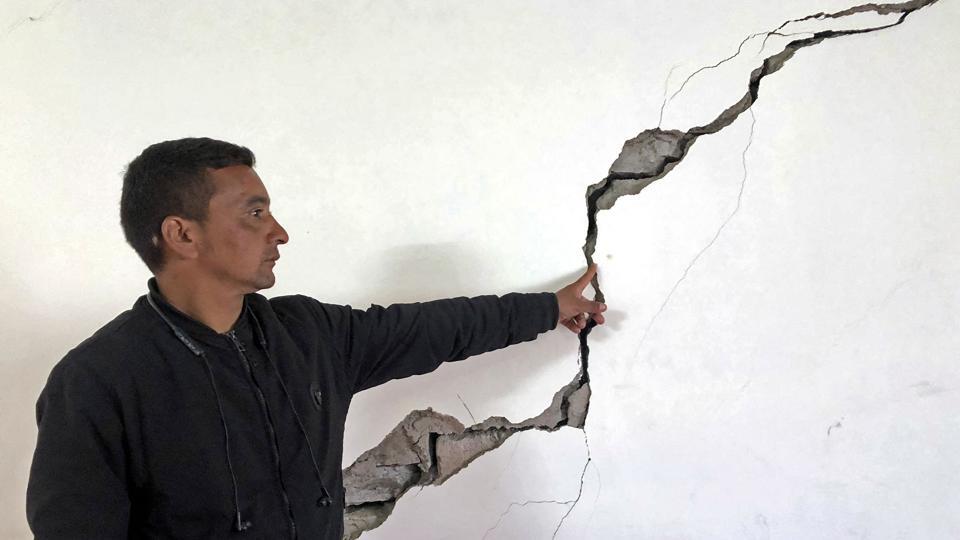
The meeting came after Prime Minister Narendra Modi expressed concern over the issue and reviewed the situation with chief minister Pushkar Singh Dhami.
The Uttarakhand government has declared Joshimath’s all nine municipal wards as ‘disaster affected’ and ‘unsafe for living’ under the Disaster Management Act in view of the growing threat from land subsidence that has resulted in cracks in over 600 houses in the city and has started the evacuation of the people from these areas.
According to a release from the PMO, principal secretary to the Prime Minister, Dr P K Mishra, who held the meeting on Sunday, stressed that the immediate priority for the state should be the safety of the people living in the affected area.
The meeting was attended by the cabinet secretary, home secretary, and other senior officials of the central government. Besides, members of the National Disaster Management Authority (NDMA), chief secretary and director general of police (DGP) of Uttarakhand, district magistrate (DM) of Joshimath, and experts from IIT Roorkee, National Institute of Disaster Management, Geological Survey of India and Wadia Institute of Himalayan Geology also attended the review through video conferencing.
The release said that the Uttarakhand chief secretary informed the meeting that the state and district officials with the support of central experts have assessed the situation on the ground.
The team of experts and central agencies surveying the area has made many short-term and long-term remedial measures including conducting a study on the carrying capacity and a detailed geotechnical investigation of the area, officials said.
The team comprises Garhwal commissioner Sushil Kumar, Disaster Management secretary Ranjit Kumar Sinha, Disaster Management executive officer Piyush Rautela, National Disaster Response Force (NDRF) deputy commandant Rohitas Mishra, landslide expert and scientist Shantanu Sarkar and Dr BK Maheshwari from IIT Roorkee.
Ranjit Kumar Sinha said following the survey, many recommendations have been made, which primarily include involving prestigious institutions to conduct studies on different aspects of the emerging situation in Joshimath.
Sinha said National Institute of Hydrology will be asked to check the water seepage in Joshimath. “There will be a technical study of the carrying capacity of Joshimath town by IIT Roorkee also”, he said adding that there will be a detailed geotechnical investigation of the geological terrain in Joshimath area. “Also, there will be real-time monitoring of seismic activities for which seismic sensor will be set up here.”
Kalachand Sen, director Wadia Institute of Himalayan Geology, said that given the geological vulnerability of Joshimath town, which is located in the earlier landslide area, developmental and construction activities should be totally stopped in the most susceptible areas of the town.
“We should also go into the root causes of the sinking phenomenon through a detailed study. Also, there should be a seismic microzonation study of Joshimath town. There should be proper drainage and sewerage system so that there is no water percolation,” he said.
Piyoosh Rautela, executive director Uttarakhand State Disaster Management Authority (USDMA) said that the main recommendations of the study conducted by USDMA in August last year have also been made to the government.


