E-Paper



Pradhan downplays H-1B visa fee increase, praises India’s higher education
He said India’s institutions are producing talent of global standards, and the country must not be swayed by geopolitical developments

 Prefer HTon Google


Union education minister Dharmendra Pradhan on Monday sought to allay concerns over $100,000 annual application fee on the American H-1B visa programme, expressing confidence in India’s higher education ecosystem and the global standing of Indian students amid such “geopolitical shocks.”
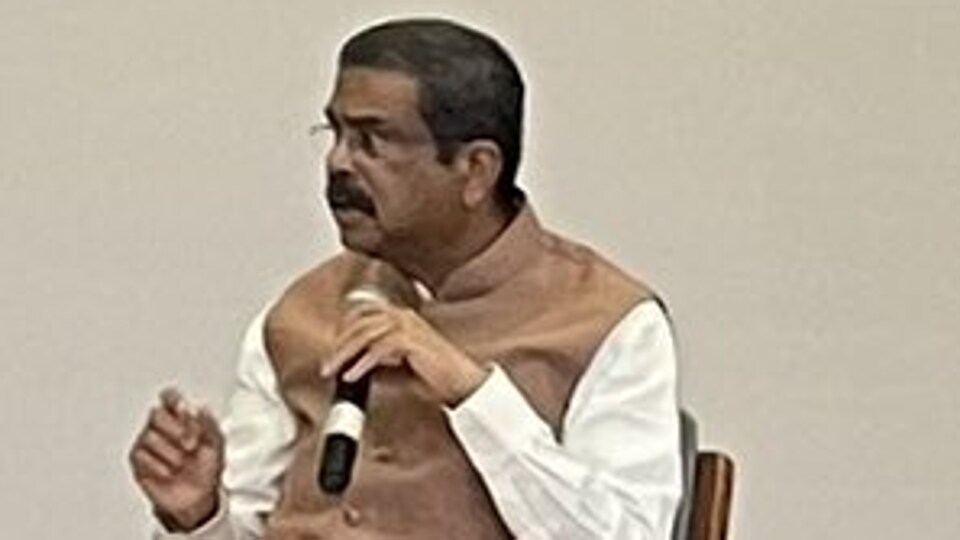
He said Indian institutions produce talent of global standards, and the country must not be swayed by geopolitical developments. “There are 50 million students in Indian higher education, out of which only one million go overseas. Our institutions in different parts of the country are of national importance. “
He said the Indian Lunar Exploration Chandrayaan Programme put India on a higher pedestal of scientific capability, and none of its developers were Indian Institute of Technology (IIT) or National Institute of Technology (NIT) graduates.
He was responding to a question on concerns over the H-1B fee increase at an event The Hindu organised in New Delhi. “I will not be aggressive on this issue, but I am confident that our IITians, our NITians, IIMians, and state university students are doing excellently in the global economy. You will find our Indian community with a lot of knowledge capacity in any global hot spot of economy across the world,” he said when asked what his advice would be to students amid concerns over the H-1B visa issue.
President Donald Trump last week announced $100,000 annual application fee on the H-1B visa programme, effectively shutting the door on skilled Indian employees. The US awards 85,000 H-1B visas annually on a lottery system. India accounts for around three-quarters of the recipients. Large American technology firms rely on Indian workers.
Pradhan termed “such geopolitical” challenges as “shock” and “not a new thing.” He expressed faith in Indian academics and institutions. “We have to live in a geopolitical scenario. It is not a new thing. These shocks come up every two to three decades. It is there today. It will be there tomorrow. But as a responsible, progressive, and self-respect-driven country, we have faith in our academics and institutions. From here, we can create global standards, and it is a reality today.”
Pradhan highlighted India’s expanding global academic footprint with the IIT Delhi campus in Abu Dhabi (UAE), the IIT Madras in Zanzibar (Tanzania), and the Indian Institute of Management Ahmedabad setting up a campus in Dubai. “Many countries with developed and emerging economies are interested in opening IITs.”
Pradhan lauded the National Education Policy 2020, saying it is “rooted in Indian ethos and is futuristic as well.” He said policy aims to benefit Indian and global students, emphasising mother-tongue instruction, skill-based learning, and multidisciplinary education to ensure accessible and high-quality education.
Pradhan defended the University Grants Commission (UGC) draft regulations, 2025, amid criticism over centralising vice-chancellor appointments. He accused some states of trying to “dilute the governor’s authority” in higher education.
The UGC draft regulations issued on January 6 propose a three-member committee for appointing vice-chancellors, chaired by the governor’s nominee and including members from the UGC and the university. Critics say this undermines state governments’ autonomy in such appointments. Over 1,500 suggestions on the draft are under consideration.
Pradhan said his party is democratic, not of families, when asked about speculation about his chances of becoming the next Bharatiya Janata Party chief. “Leadership will decide on the appropriate time.”