
 E-Paper



New bill paves the way for Punjab govt to pick DGP
The Punjab assembly has passed a bill to remove the Supreme Court-mandated process for appointing the Director General of Police (DGP) and replace it with a seven-member committee to shortlist eligible officers. The bill has been put forward by the Bhagwant Mann-led government, despite the fact that the validity of the original provision is still pending final adjudication. The 2006 Prakash Singh Case aimed to provide police reforms, including fixed tenures for DGPs and separate law and order from investigation. The bill will need to be approved by the governor before becoming law.

 Prefer HTon Google


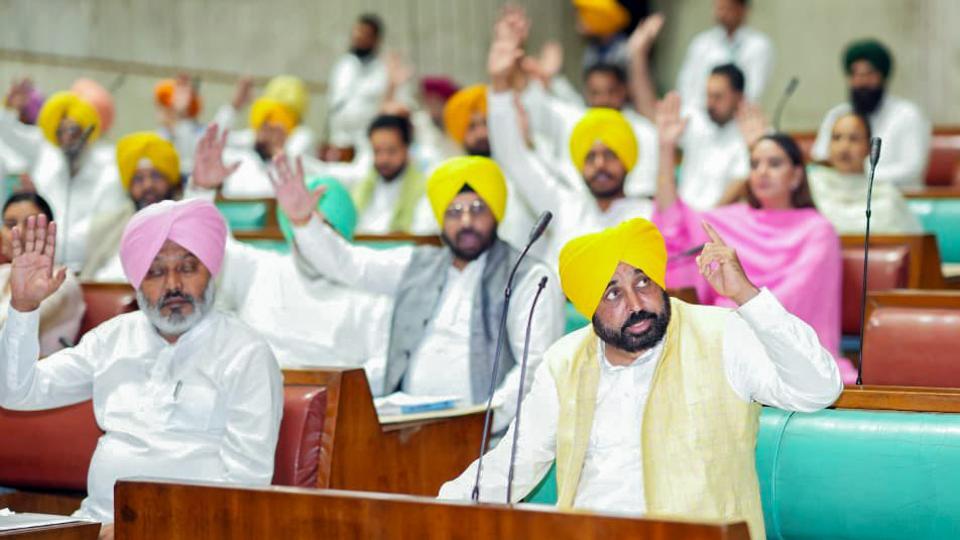
The Punjab assembly on Tuesday passed the Punjab Police Amendment Bill, 2023 which seeks to do away with the Supreme Court-mandated procedure to appoint the Director General of Police (DGP) following an empanelment by the Union Public service commission (UPSC).
As per the Bill, a seven-member committee, to be headed by a former chief justice or a retired judge of the Punjab & Haryana high court, will shortlist three senior-most officers from a pool of eligible officers for the post of DGP, and the state will then pick one from that list.
The other members of the committee comprise the state chief secretary, a nominee of UPSC, a nominee of Punjab Public Service Commission, the administrative secretary of home department, a nominee of Union ministry of home affairs, and a retired DGP of Punjab Police.
“The provisions of this section (Section 6 that lays down the new procedure) shall prevail notwithstanding anything contained in any judgement, order or decree of any court,” stated the proposed law, adding that the state is exclusively empowered to make laws on public order and police that fall in the State List under the Seventh Schedule of the Constitution.
The Bill further said: “It is necessary to put in place a proper mechanism for selection/appointment and removal of DGP which takes into consideration the peculiar challenges faced by the states of Punjab by virtue of being a border state. In order to achieve this objective, it is proposed to amend Section 6 of the Punjab Police Act, 2007.”
The Bill will have to be put up before the governor for his assent before it can become a law and be implemented.
The Bhagwant Mann-led government has come up with the 2023 law even as the validity of the original provision under the 2007 Act on the procedure to appoint the DGP is pending final adjudication, besides the fact that in July 2018, the Supreme Court ordered that any law framed by a state government in contravention of court orders will remain suspended. In 2019, the apex court rejected an application by the Punjab government to bypass the requirement of the empanelment by UPSC.
In the landmark Prakash Singh Case on police reforms, the Supreme Court had in 2006 issued a slew of directions to insulate the state police forces from pulls and pressures of political executives. The set of seven directions in its September 2006 verdict aimed at propelling police reform by providing for fixed tenure for DGPs, separating law and order from investigation, and constitution of bodies such as state security commission, police establishment board and police complaint authority for warding off unwarranted influence on the police while keeping the personnel accountable for their actions.
In July 2018, the top court chronicled the steps for appointment of regular DGPs. The court said that it would be mandatory for the states to prepare a list of senior police officers at least three months prior to the retirement of the incumbent and send it to UPSC. UPSC would then prepare a panel and intimate the states, which in turn would immediately appoint one of the persons from that list. The empanelment committee in UPSC consists of representatives of UPSC, the central government, and the state government concerned.
“None of the states shall ever conceive of the idea of appointing any person on the post of Director General of Police on acting basis for there is no concept of acting Director General of Police as per the decision in Prakash Singh’s Case,” added the July 2018 order.
Notably, the 2018 also order made it clear that “any legislation/rule framed by any of the states or the central government running counter” to its directions shall remain in abeyance to the extent of breach.
In January 2019, the Supreme Court dismissed applications moved by five states - Punjab, West Bengal, Haryana, Bihar and Kerala — for modification of its order issued in 2018 on the selection and appointment of DGPs. The court reiterated its direction to the states for selecting their police chiefs from a list of officers empanelled by UPSC.
Shooting down the Punjab government’s endeavour, the top court in its January 2019 order held that the procedure laid down in 2018 “are wholesome and if the same are implemented, it will sub-serve public interest until such time that the matter is heard finally.” A 2013 petition challenging constitutional validity of laws and executive orders passed by several states, including Punjab, to reportedly circumvent the empanelment process of UPSC is currently pending before the top court.
The latest move by the Aam Aadmi Party government in Punjab to take the appointment of DGP out of the purview of UPSC has come up at a time when the state has been continuing with an acting DGP for the last more than 11 months. 1992-batch IPS Gaurav Yadav is holding the charge as acting DGP after the Mann government decided to remove 1987-batch IPS VK Bhawra, who was appointed as DGP following the procedure laid down by the apex court. Bhawra, who was appointed by the Charanjit Singh Channi government, was removed within six months of his appointment.
The Bill says that in case of vacancy for the post of DGP, the state government may give the additional charge to any officer of an equivalent rank. In the wake of categorical disapproval of the Supreme Court against the appointment of acting DGPs, the provision to not have a regular DGP, and give the additional charge to any other officer, may also be contentious.


