
 E-Paper



Putin visit reflected India’s freedom of choice: Jaishankar
The minister’s remark comes against the backdrop of pressure from the US to reduce purchases of Russian oil and military hardware

 Prefer HTon Google


New Delhi: Russian President Vladimir Putin’s visit to India for a bilateral summit this week reflected India’s freedom of choice and policy of strategic autonomy, external affairs minister S Jaishankar said on Saturday against the backdrop of pressure from the US to reduce purchases of Russian oil and military hardware.
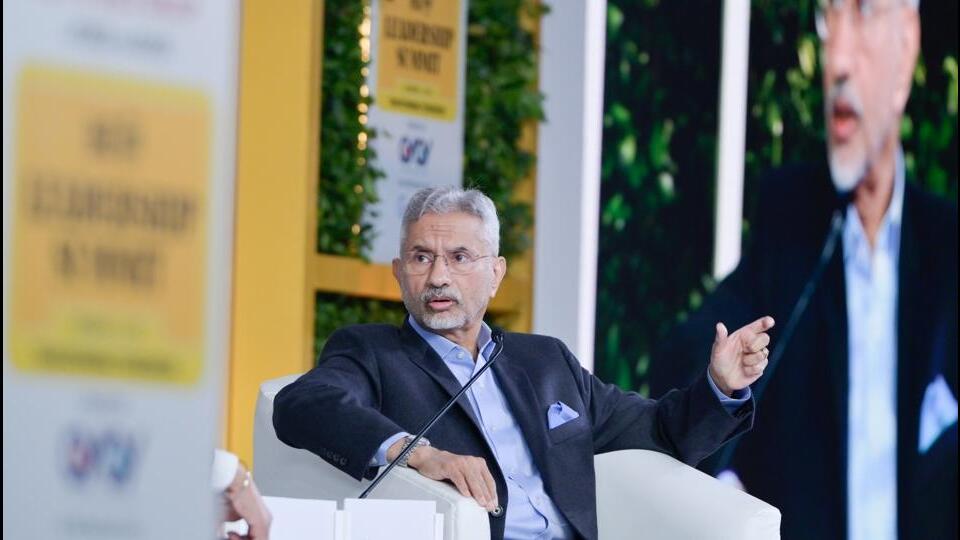
The summit between Prime Minister Narendra Modi and Putin resulted in a five-year economic programme to diversify and balance trade, a mobility agreement and measures to deepen the energy partnership. Jaishankar, speaking at the 23rd Hindustan Times Leadership Summit, said that India-Russia ties have been among the steadiest big power relationships in a world that has seen a lot of ups and downs in the past eight decades.
Asked if Putin’s visit complicated dealings with the US, Jaishankar said India has relations with all major countries and it isn’t reasonable for any country to “expect to have a veto” on how New Delhi develops its relationships. “I think we’ve always made it very clear that we have multiple relationships. We have a freedom of choice. We talk about what is called strategic autonomy and that continues and I cannot imagine why anybody would have reason to expect the contrary,” he said.
Jaishankar, who began his conversation with a quip about following the session featuring British star Hugh Grant while pointing out that foreign policy is currently more exciting than any movie, said Putin’s visit focused on “reimagining” the India-Russia relationship because economic ties hadn’t kept pace with defence and strategic collaboration.
“They [Russia] visualised the West and China as their primary economic partners. We visualised perhaps the same. The economic side of the relationship had somehow not kept pace. This visit, in many ways, was about reimagining the relationship,” he said, while pointing to overwhelming popular support for relations with Moscow.
“It was about building dimensions and facets which it lacked or didn’t have in enough measure,” Jaishankar said, listing a mobility agreement that will allow Indians to find work opportunities in Russia, and an agreement for a joint venture in fertilisers, as among the key outcomes of the summit.
India, the world’s second biggest fertiliser importer, has had to contend with unstable sources, he said in an oblique reference to China. “We had an agreement to create an important joint venture in fertilisers. In a way, you can say it’s food security,” he said, noting that Putin had come with a large business delegation to drum up trade and investment.
In the context of protracted negotiations between India and the US on a trade deal that has become crucial to bilateral ties, Jaishankar said New Delhi is prepared to find common ground with the trade-oriented US administration on “reasonable terms” but without compromising on national interests.
The India-US relationship is grappling with a set of complex issues, and the two sides are negotiating hard to find “a landing point for our respective trade interests” because the bilateral trade deal has implications for farmers and small businesses, Jaishankar said.
“I think clearly right now trade is the most important issue. It’s clearly very central to the thinking in Washington, much more than it was to earlier administrations, which is something we have recognised and we are prepared to meet, but we are prepared to meet it on reasonable terms,” he said in response to a question about the increasingly transactional nature of ties with the US.
“For those who think diplomacy is about pleasing somebody else, I’m sorry, that’s not my view of diplomacy. To me, it is about defending our national interests,” he said. “We believe there can be a landing point for our respective trade interests. Obviously, that is something which will be negotiated hard because it has an implication for livelihoods in this country.”
India has to be “extremely judicious” about its negotiating position with a country such as the US, Jaishankar said, while noting that President Donald Trump is radically different from his predecessors. The two sides, he said, have to engage and work through the issues affecting the relationship. While saying he was optimistic about concluding a trade deal with the US, Jaishankar noted that he remained hopeful that “things can turn around”.
He added, “It can happen. There’s no lack of communication…We have to see when the call is taken [and] on what terms. So if you ask me could it happen soon, my answer would be sure, very possible.”
When Jaishankar was asked if India should have indulged Trump’s ego in the context of the US President’s repeated claims about brokering a ceasefire during the conflict between India and Pakistan in May, he replied: “It is about saying what are things which my country and my people believe in. I’m not going to give a version out there which does a disservice to my armed forces and my people.”
New Delhi has maintained that talks between senior military officials of India and Pakistan led to the cessation of hostilities after four days of intense conflict in May that followed military strikes on terrorist infrastructure in Pakistan and Pakistan Occupied Kashmir. The Indian side has also dismissed Trump’s claims of brokering a truce, saying there is no room for mediation by a third party in dealing with Pakistan.
In the context of India-China relations, Jaishankar said the border areas have been stable since the two sides reached an understanding in October 2024 on the last set of “friction points” on the Line of Actual Control (LAC) and patrolling by troops has resumed and is taking place smoothly.
“The key point we made – that peace and tranquillity in the border areas is a prerequisite for good relations – is being maintained and built upon. But it’s not like that was the only issue in the relationship. There were many other issues, some of which predated [the clash in] Galwan [Valley]. There are issues about trade, investment, competition, subsidies, fairness [and] transparency…We are trying to work our way through some of it,” he said.
Some issues – such as resumption of direct flights – have been resolved while others “would be a little bit more complicated”, he pointed out.
Against the backdrop of Pakistan Army chief Field Marshal Asim Munir consolidating power in recent weeks, Jaishankar noted that the military has “overtly, covertly, [or] in a hybrid manner” been in control in Pakistan. Pointing to the world community’s “transactional” style of dealing with Pakistan, he said: “There are good terrorists and bad terrorists. There are good military rulers and apparently not so good ones. I think for us, the reality of the Pakistan Army has always been [there] and much of our problems actually emanate from them.”
These problems include the Pakistan Army’s support for terrorism, including training camps, and a policy of “almost ideological hostility towards India” backed by the military, he said. “At the end of the day, look at the state of Pakistan. See the differentials and the capabilities and frankly the reputation on either side. We should not get over obsessed and hyphenate ourselves with them.”
Turning to Bangladesh, Jaishankar noted that the interim government led by Muhammad Yunus had reservations about the conduct of elections under the former Awami League government. “At the end of the day, if the entire issue was about fair elections, then it makes sense that the elections are held. As far as we are concerned, we wish Bangladesh well…Any democratic country likes to see the will of the people ascertained through a democratic process,” he said, adding that the outcome of the polls planned for February will lead to a “balanced and mature view about the relationship and things would improve”.
Jaishankar responded to a question on whether former Bangladesh premier Sheikh Hasina, who fled Dhaka after the collapse of her government and moved to India, could stay in the country as long as she wants, he replied: “That’s a different issue, isn’t it? She came here in a certain circumstance and I think that circumstance clearly sort of is a factor in what happens to her. But again, that is something which she has to make up her mind.”


