New Delhi: While Leader of Opposition in Lok Sabha Rahul Gandhi has urged Prime Minister Narendra Modi and the Centre to declare the Kerala's Wayanad landslides – that killed over 400 people – a national disaster, a 2013 reply in Parliament by a Congress-led UPA government minister shows that no concept of “national disaster” exists under the rules of the central government.
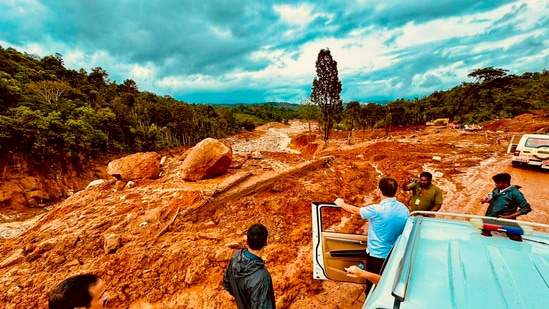
On Saturday, PM Narendra Modi will visit Wayanad to evaluate the ongoing relief and rehabilitation operations and engage with survivors of the recent landslides in the region.
On Sunday, the Bharatiya Janata Party responded to demands from various quarters, including Congress leader Rahul Gandhi, who was elected to the Lok Sabha from Wayanad in 2019 and 2024, to declare the devastating landslides a national disaster, saying that such a concept doesn't exist under central government guidelines, a policy unchanged since the UPA government's tenure.
Follow LIVE Updates on PM Modi's Wayanad visit
A 2013 Parliament document accessed by HT shows then minister of state for home, Mullappally Ramachandran, stated that “there is no provision to declare a natural disaster as a national disaster”.
"The concept of a 'national disaster' does not exist under the Central government's guidelines, a fact that has been the case since the UPA government's tenure. This was explicitly stated by the then Union Home Minister, Mullappally Ramachandran, in a response to a question in the Lok Sabha on August 6, 2013," said Muraleedharan, who is also a former Union Minister.
{{/usCountry}}"The concept of a 'national disaster' does not exist under the Central government's guidelines, a fact that has been the case since the UPA government's tenure. This was explicitly stated by the then Union Home Minister, Mullappally Ramachandran, in a response to a question in the Lok Sabha on August 6, 2013," said Muraleedharan, who is also a former Union Minister.
{{/usCountry}}He also stated that state governments concerned are primarily responsible for undertaking necessary recue and relief measures in the wake of natural disasters.
The priority is immediate relief and response assistance in the context of a natural calamity. As such there is no fixed prescribed norms, he had said.
However, for calamity of a “severe nature”, additional assistance is also considered from the National Disaster Response Fund (NDRF) after following the established procedure, the reply stated.
At least 400 people died and many remain unaccounted for after landslides hit Mundakki, Chooralmala and Vellarimala villages in district Wayanad on July 30 in what is seen as one of the biggest natural disasters to have impacted the southern state.
Centre's rescue and relief efforts in Wayanad
- The Modi government took stock of the situation and immediately sprung into action through deployment of more than 1,200 rescuers of NDRF, Army, Air Force, Navy, Fire services, Civil Defence, among others for rescue and relief operation at the incident site, official sources said.
- More than 100 ambulances along with doctors and other medical staff were deployed for medical support and treatment.
- The Indian Army erected a 190-foot Bailey bridge in Wayanad, which has been crucial in facilitating the movement of heavy machinery and ambulances. The construction of this bridge was completed in just 71 hours, significantly enhancing the rescue operations by allowing heavy vehicles and machinery to be mobilised to rescue around 200 people who were stranded due to damage of the bridge.
- An inter-ministerial central team (IMCT) has been constituted by the central movernment to visit the affected areas of the state.