On a rainy day in November more than a century ago, two Christian missionaries from Europe arrived in Sivagiri in present-day Kerala to meet Sree Narayana Guru. "You must embrace Christianity," said one missionary. "What is your age?" asked Narayana Guru. "Thirty," replied the other. "I was a Christian even before you were born," pat came the reply.
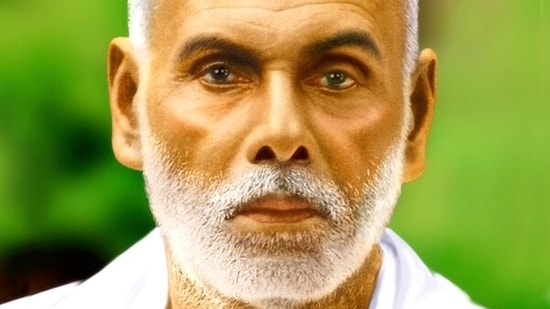
Narayana Guru, whose universal and humanitarian outlook shook up caste hierarchy in late 19th century Travancore, Kochi, and Malabar, revelled in his wit and wisdom even while negotiating the most treacherous topics. Thanks to a massive digitisation project undertaken by the Indian Institute of Technology (IIT), Bombay, and Sree Narayana Guru College of Commerce, Chembur, many unheard stories about the Indian philosopher and thinker may just be unfolding.
Launched in April this year, the project, called Narayana Guru Digital Research Resource Platform, has so far digitised 160,000 pages of documents on Narayana Guru's life and work dating back to more than a century, including the original Dharmam Malayalam magazine published from Sivagiri in which Narayana Guru's curious conversation with the Christian missionaries in 1928 is published. Rare books, diaries, and magazines perishing in private collections have yielded hitherto unknown facets of his personality.
The two-year project has been only scratching the surface in its first few months. Nearly a third of the 160,000 pages digitised was found in the first month itself in a private collection in Varkala, near Sivagiri where Narayana Guru came to live at the beginning of 20th century.
{{/usCountry}}The two-year project has been only scratching the surface in its first few months. Nearly a third of the 160,000 pages digitised was found in the first month itself in a private collection in Varkala, near Sivagiri where Narayana Guru came to live at the beginning of 20th century.
{{/usCountry}}"It is a barefoot digitisation," says the project's principal investigator Siby K George, a philosophy professor at IIT-Bombay, about the meagre means and high ambitions of the task. "The aim is to create a repository of literature around Narayana Guru and make it available to the public and researchers as open-source online material," he adds.
"Narayana Guru's movement was a milestone in modern Indian history. In the late 19th century and early 20th century, he brought a modern sense of justice to the society. He said each human being is different, equitable distribution of resources is necessary and there should be no discrimination based on caste," explains George.
The archive hunters of the project, who began by pouring over thousands of documents at the home of G Priyadharshan, an 87-year-old former teacher in Varkala, in May this year, found reports about court cases against Narayana Guru, old magazines and books containing writings about his activities and even a published copy of his will.
"There are rare documents available in the collections of individuals and institutions," says Gautam Das, the project's co-principal investigator. "The scanning is done on the site, lasting for sometimes a month," he adds. The data processing is done by Informatics Publishing Limited, a Bengaluru-based information management company. The archival materials collected and scanned so far are from as early as 1904.
"Some materials are very brittle and won't be able to go through another scan," says Girija K P, project coordinator and consultant, about the documents that may soon be lost forever. "These old and rare documents are a huge treasure," she adds. Among the documents are newspapers like Mithavadi, published from Malabar, and Dharmam in Sivagiri. "Every issue of Mithavadi had a news report on Narayana Guru. It didn't allow even a small news to fall through," says Priyadharshan.
The project team spent a month scanning tens of thousands of pages at Priyadharshan's home, another month at the Brahma Vidyalaya Library of Sivagiri Madom founded by Narayana Guru, and 23 days at Narayana Gurukulam, also in Sivagiri set up by his disciple Nataraja Guru in the 1930s.
In the coming months, the project team will be heading to other parts of Kerala searching for invaluable documents. One of the destinations will be the Kumaran Asan National Institute of Culture near Thiruvananthapuram, which houses the diaries of iconic Malayalam poet and social reformer who was a contemporary of Narayana Guru. Asan's diaries will be among the rare writings on Narayana Guru in English. "Asan wrote his diaries in English," says Das.
Funded by the Mumbai-based Sree Narayana Mandira Samiti, the project is expected to see more private collectors of documents on Narayana Guru, especially rare publications like Dharmam, Navajeevan and Pratibha magazine edited by Asan, coming forward to help the digitisation. Funds for web hosting and related expertise will be another support the project will be looking for because of the abundance of archival material.
"We need to scientifically build on yesterday's facts," says Anish Damodaran, co-founder of the Mandira Samiti-supported Backwaters Collective formed a decade ago by prominent thinkers like social theorist Ashis Nandy and historian Vinay Lal. "Access, however, is a major roadblock," says Damodaran. The digitisation of works on Narayana Guru will be one of the steps to address the lack of access to material for reimagining knowledge.