
 E-Paper



RBI hits pause, interest rates to stay low for a long time
While MPC’s primary mandate is to balance growth and inflation, RBI expressed satisfaction on things such as India’s external account for rupee’s exchange rate.

 Prefer HTon Google


New Delhi : The Monetary Policy Committee (MPC) of the Reserve Bank of India maintained status quo on interest rates and policy stance in its first meeting of the year and also the first after the Union Budget, bringing to an end the current rate reduction cycle that began a year ago. The move comes even as India’s economy is expected to do better than previously expected in 2025-26, and with the announcement of trade deals with the EU and the US, the country’s two biggest trading partners.
As a result, the policy rate continues to be at 5.25% and the policy stance neutral. While the rate was kept unchanged unanimously, one external MPC member dissented on the decision to maintain a neutral policy stance.
The MPC resolution has deemed its decision “appropriate” and also said that its future actions “will be guided by the evolving macroeconomic conditions and the outlook based on data from the new (inflation and GDP) series in charting the future course of monetary policy”. The National Statistical Office (NSO) will release the data for new inflation and GDP series on February 12 and 27.
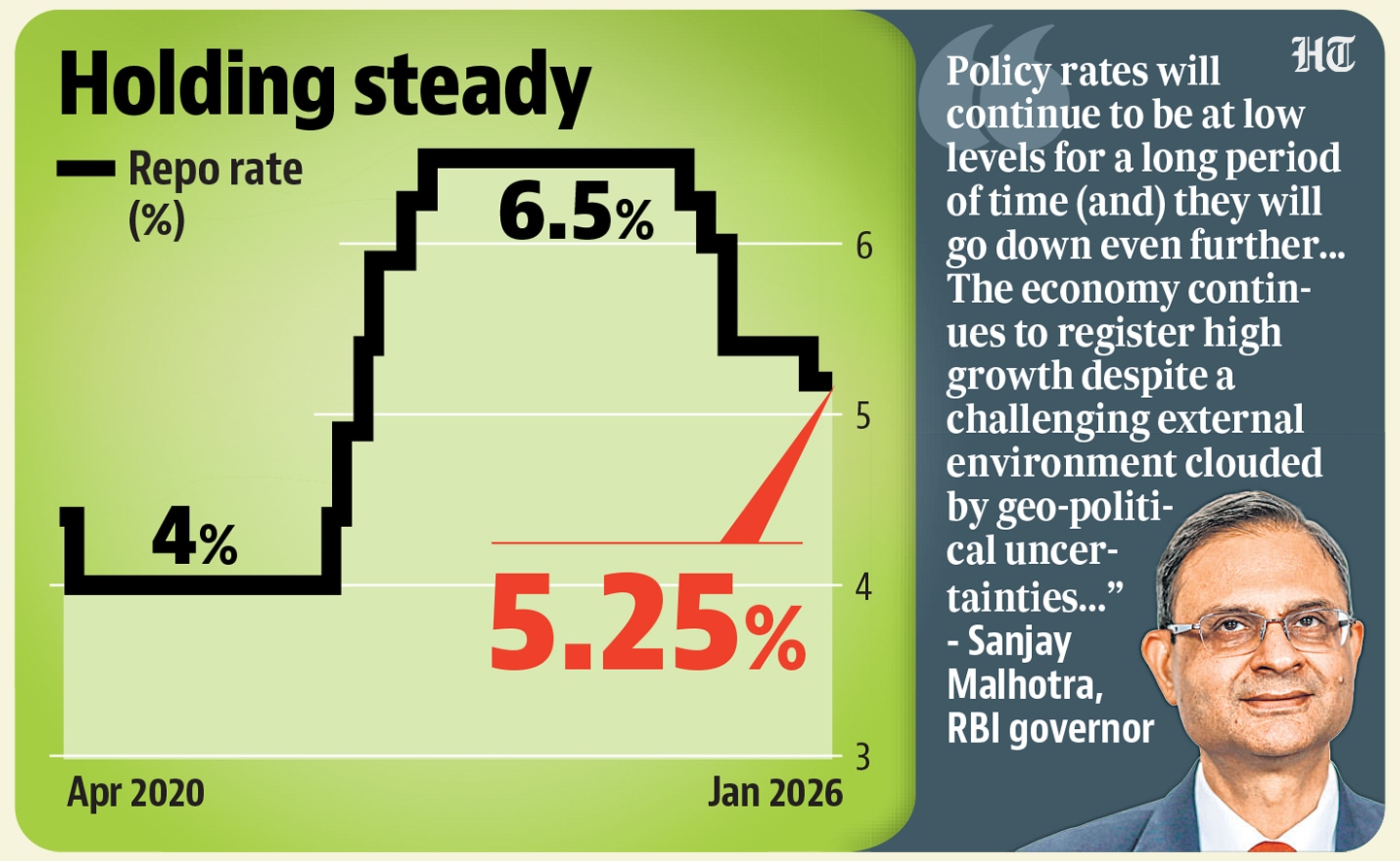
Analysts have found the MPC’s decisions on expected lines and do not see any rate cuts in the near term unless economic growth underperforms vis-à-vis current expectations. To be sure, RBI has already reduced interest rates by a cumulative 125 basis points – one basis point is one hundredth of a percentage point – in its current easing cycle which started in February 2025.
Also read: RBI keeps repo rate unchanged: What homebuyers should know before buying a ₹1 crore home
RBI Governor Sanjay Malhotra, however, described the situation in a different way where there is no risk of rate hikes either. “Policy rates will continue to be at low levels for a long period of time (and) they will go down even further,” he said in a post-monetary policy press conference, suggesting that the monetary policy will step in to support growth if needed.
“After a long season of rate cuts, we believe RBI has pivoted to steady policy rates for the foreseeable future. Today’s decision may have also been triggered by the recently announced budget which marked the end of aggressive fiscal consolidation, and announcements of trade deals with the EU and the US, which could become growth supportive over time…We believe RBI will not be looking to impart a growth stimulus over the foreseeable future (unless there is a growth shock)”, HSBC Chief India economist Pranjul Bhandari said.
Also read: White House releases India-US joint statement for ‘interim’ trade agreement
In terms of its growth and inflation forecasts, RBI has made marginal tweaks to its December 2025 forecasts. GDP growth in the quarters ending June 2026 and September 2026 is now expected to be 6.9% and 7%, respectively, slightly higher than the 6.7% and 6.8% forecasts made in the MPC’s December resolution. Inflation projections for quarters ending March 2026, June 2026 and September 2026 now stand at 3.2%, 4% and 4.2%, respectively, compared to December 2025 projections of 2.9%, 3.9% and 4%. The MPC resolution says that full-year forecasts for 2026-27 will only be issued in the April meeting after the release of the new GDP and inflation series by the NSO.
“The signing of an FTA with EU and a framework agreement with US in sight, the tone of the statement is more sanguine on growth… RBI seems to be still very comfortable with the broader inflation outlook as the increase is only because of adverse base effects and higher precious metal prices,” Citibank Chief India Economist Samiran Chakraborty said.
MPC’s overall tone on the economic environment seems to reflect what the Economic Survey said last week. Domestic economic activity continues to show resilience and promise but the external economic environment continues to be volatile and a matter of concern.
“Looking ahead, sustained buoyancy in services sector, GST rationalisation, healthy rabi prospects, monetary easing and benign inflation environment should support private consumption. Investment activity, supported by high capacity utilisation, conducive financial conditions, healthy balance sheets of financial institutions and corporates, robust credit growth and Government’s continued thrust on capital expenditure, is expected to maintain its momentum. Moreover, robust domestic demand is likely to attract fresh investments by the private sector. While services exports are expected to remain strong, merchandise exports will get a boost from the prospective trade deal with the US. The landmark comprehensive trade pact with the EU coupled with trade deals with New Zealand and Oman should help diversify exports and strengthen the external sector... Headwinds from geopolitical tensions, uncertain global trade environment, volatility in global financial markets and international commodity prices continue to pose downside risks to the outlook”, the MPC resolution says.
While MPC’s primary mandate is to balance growth and inflation, RBI also expressed satisfaction on things such as India’s external account for rupee’s exchange rate.
“ RBI sounded comfortable on the external sector outlook...underlining that the FX reserves continue to be more than 11 months of import cover...Both the Dec and the Feb statement do not have any reference to INR. There is no reference to the persistent BoP deficit too. In the post-policy press conference, Governor mentioned they “don’t see speculative elements in the FX market right now”, suggesting comfort around vols and level of INR”, Chakraborty said.


