
 E-Paper



Sam Pitroda recalls calligraphist Prem Bihari and how Constitution’s manuscript came into being
While the Constitution was adopted by the Constituent Assembly of India on 26 November 1949, it became effective on 26 January 1950.


As the country celebrated the 73rd Republic Day, telecom inventor and author Sam Pitroda shared a tweet on Prem Bihari Narain Raizada, a calligraphy artist of Delhi, who had written the entire Constitution of India by hand.
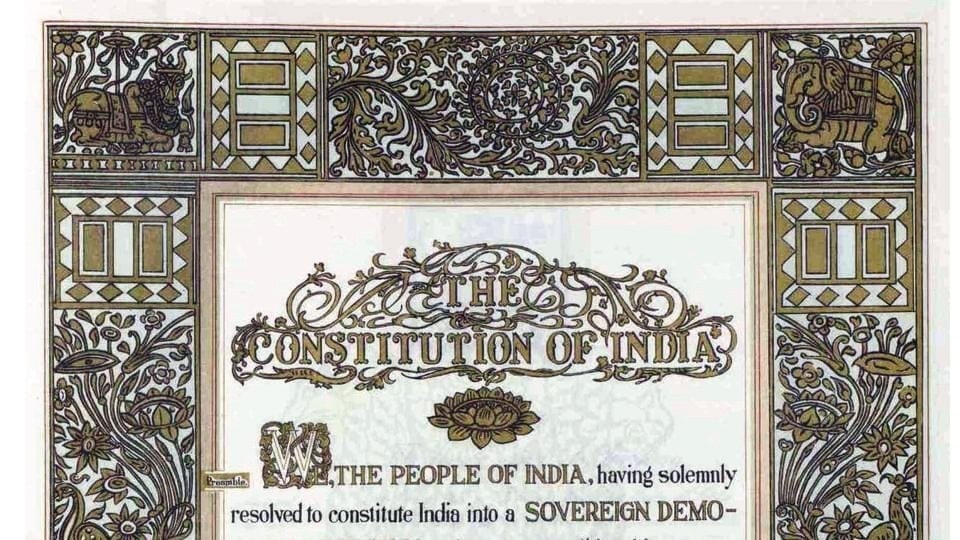
Born on December 16, 1901, in the family of a renowned calligraphy writer, Raizada was taught the art from an early age. All through his childhood he learnt calligraphy from his grandfather, who was a scholar of Persian and English and handwriting researcher.
After graduating from Delhi's St'. Stephen's College, Raizada started practising calligraphy and gradually became known for his beautiful handwriting, read the tweet shared by Pitroda, known as the advisor of the late Prime Minister Rajiv Gandhi.
His name also reached the then Prime Minister of India Jawaharlal Nehru's ears who later summoned him when the Constitution of India was ready for printing.
Nehru wanted the entire Constitution to be scribed in handwritten calligraphy in italic and not in a print format.
The tweet then talks about the exchange that took place between Raizada and Nehru. When Nehru had asked Raizada what fee he would charge for hand writing the entire Constitution, the latter said "not a single penny". However, he had one wish. He wanted to write his name on every page of the constitution while, on the last page, he wanted to have his grandfather Ram Prasad Saxena' name mentioned along with his name. Nehru accepted and the rest is history.
The tweet also mentions other noteworthy details about the Indian constitution and subsequent visit by Raizada along with the then President of India, Rajendra Prasad, to Santiniketan before embarking on his six-month journey to hand write the document, hailed as the supreme law of India.
During their visit to Santiniketan on November 29, 1949, they met renowned painter Nandalal Basu to decide the layout of the Constitution.
They decided what part of the leaf Raizada would write on, while Basu and his students would use the blank parts of the leaf to decorate with paintings.
The spaces on pages left by Raizada would make way for impeccable imagery showcasing Mohenjo-daro seals, Indian mythologies – Ramayana, Mahabharata, life of Gautam Buddha and the Mughal empire among other things.
To complete his task, Raizada needed 432 pen holders, all of which were brought from England and Czechoslovakia. He wrote the constitution in a room in the Constitution Hall of India. He died on February 17, 1986.
The Indian Constitution, the world's longest written one, lays down the framework that demarcates fundamental political code, structure, procedures, powers, and duties of government institutions and sets out fundamental rights, directive principles, and the duties of citizens.
While the Constitution was adopted by the Constituent Assembly of India on 26 November 1949, it became effective on 26 January 1950. The day is now celebrated across the country as the Republic Day.


