
 E-Paper



Saving Great Indian Bustard must be balanced with energy needs: SC
The Union government also conveyed to the court the practical difficulties and the enormous cost involved in implementing the decision

 Prefer HTon Google


The Supreme Court on Friday said that it is conscious of government’s commitment to generate solar power while implementing steps to preserve the Great Indian Bustard (GIB) and gave three weeks to the Centre to propose a way forward to balance the twin issues.
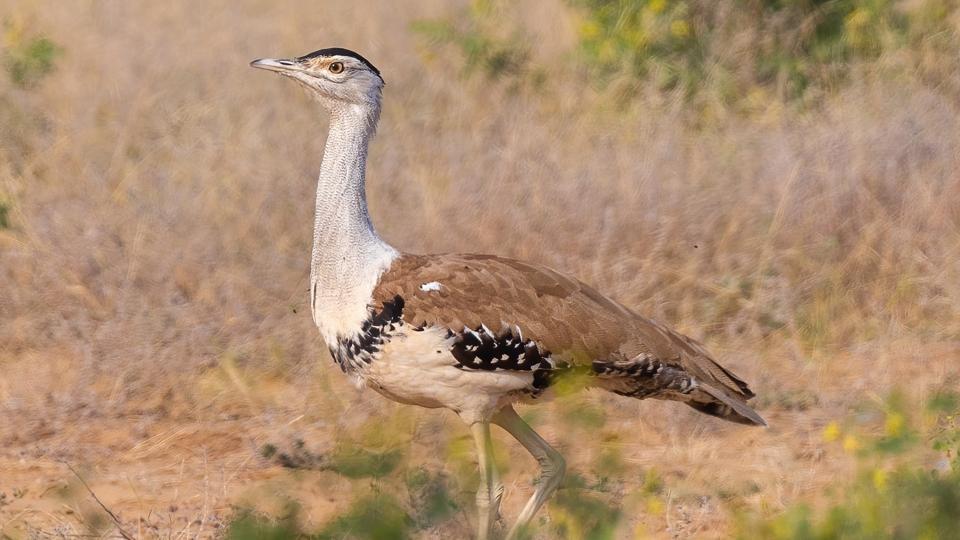
Monitoring implementation of its earlier order of April 19, 2021 directing installation of bird diverters and moving overhead transmission lines underground in areas of Gujarat and Rajasthan, where the bird is predominantly found, the court said that any order passed by it should be “judicially manageable”. The order was passed in a public interest litigation (PIL) filed by environment and wildlife activist MK Ranjitsinh and four others seeking measures to protect the GIB.
A bench headed by Chief Justice of India (CJI) Dhananjaya Y Chandrachud on Friday was confronted with applications filed by solar and wind energy producing companies complaining that the top court’s order was coming in the way of their business. The Union government also conveyed to the court the practical difficulties and the enormous cost involved in implementing the decision.
“We are conscious that we are dealing with an issue involving development where India has to achieve alternate energy goals. Our order has to balance both interests,” said the bench, also comprising justices JB Pardiwala and Manoj Misra.
To be sure, any question of balance needs to factor in the possible extinction of the species in this case. By some estimates, there are around 100, and possibly fewer, GIBs in the wild.
The court asked Attorney General R Venkataramani to propose a way forward by February 9, the next date of hearing in an order which said, “The AG states that a comprehensive status report will be filed indicating the various steps by the Union government for preservation of GIB and ensure solar power is made available, considering India’s commitment at the international level.”
India has not had much success in conserving the GIB, once a candidate for its national bird. There were around 1200 GIBs in the wild in the 1960s.
The ministry of new and renewable energy (MNRE) had previously filed an application for modifying the April 19 judgment and stated that it is “working towards achieving the target set by Government of India to install 1,75,000 MW (excluding large hydro) of renewable energy capacity by 2022 and further increase it to 4,50,000 MW by 2030.” Under the Paris Agreement, India is committed to achieve about 40% cumulative electric power installed capacity from non-fossil fuel-based energy resources by 2030.
“The ball is now in your court,” the bench told AG, adding, “Once the government states what the way forward can be, we will not be groping in the dark.” The top law officer agreed to file a comprehensive affidavit before the next hearing.
Solar energy producers represented by senior advocates Abhishek Manu Singhvi and Mukul Rohatgi noted practical difficulties in implementing the court’s order. “The entire area where the court’s order is to operate has solar power generating units. There are high tension wires running overhead. Undergrounding of wires will require them to be joined at places which can be hazardous,” Singhvi claimed.
The court said, “Anything we do must be judicially manageable. We don’t want to blame anyone but we are faced with a slew of applications while implementing our orders which is not feasible for us to manage. Do we have scientific study tracing deaths to transmission lines? Also, one has to be aware of practical realities as undergrounding will involve agricultural land.”
A 2018 report by the Wildlife Institute of India stated that surveys covering 80 km of power lines seven times over a year found that there were 289 deaths of birds from 30 species including some GIBs. At the time, there were estimated to be 128 GIBs in the wild.
The associations of solar power generators and power developers in the region estimated that the undergrounding of cable lines would cost ₹55,000 crore.
Rohatgi pointed out that since these birds have poor vision they tend to collide with the transmission lines. As directed by the court, bird diverters have been installed along the overhead wires. “These diverters can be seen easily by these birds. But undergrounding of these lines is not feasible,” he said.
The court wished to know if any credible study was conducted on how effective the bird diverters are to prevent further bird casualties. “We directed installation of bird diverters but we must be cognizant of what impact it is having on ground. Should we be spending public money on it without knowing its efficacy?”
Senior advocate Shyam Divan who represented the petitioners informed the court that despite all efforts by Centre and states, there was recently another death of GIB due to collision. While awaiting the Centre’s response, the bench said that the government could benefit by considering action taken by other countries such as UAE where these birds are found.
GIBs are found only in India. The court’s reference was possibly to the Houbara Bustard, native to North Africa. The UAE runs a very successful captive breeding programme of Houbara, releasing a few hundred thousand into the wild thus far (since the programme began in the late 1990s). Ironically, rich patrons from the UAE, including members of the royal family, frequent Pakistan to hunt the Houbara every winter.
The court further directed the chief secretaries of Rajasthan and Gujarat to place an updated status report on the steps taken pursuant to its April 2021 order.
A three-member expert committee constituted by the court to consider feasibility of laying power cables underground was also directed to provide an updated report of its work by the next date. This committee comprised Rahul Rawat of the ministry of new and renewable energy (MNRE), Sutirtha Dutta of Wildlife Institute of India (WII) and Devesh Gadhavi, deputy director of Corbett Foundation.
The Union government claimed that at the time when the expert committee was constituted, there were 150 GIBs and 16 more were added by breeding them in captivity. Predators preying on the eggs laid by these birds was seen as a major factor requiring their protective breeding
The GIB is listed as Critically Endangered by the International Union for Conservation of Nature (IUCN) in its Red List of threatened species. They are also protected under the Wildlife (Protection) Act, 1972.
According to Wildlife Institute of India, the potential GIB habitat in Rajasthan and Gujarat extends to 80,688 square kilometers, which includes approximately 13,550 sq km of priority habitat area. The WII report also recommended undergrounding of around 200 km of overhead power lines and installing bird diverters on all other power lines.
The area falling in GIB habitat covers heritage districts of Jaisalmer and Jodhpur and parts of Bikaner and Barmer. As this region is also crucial for the development of renewable energy, the state government and the Centre believe that making underground cables mandatory may prove counter-productive for the development of renewable energy sector in India.


