
 E-Paper



SC directs Tamil Nadu to submit probe details in Cauvery sand mining case
Top court seeks FIR details and probe status after ED flagged ₹4,700 crore loss from alleged illegal sand mining in Tamil Nadu

 Prefer HTon Google


New Delhi: The Supreme Court on Wednesday directed the Tamil Nadu government to place on record details of its probe into alleged illegal sand mining after a petitioner seeking a Central Bureau of Investigation (CBI) inquiry claimed the state was deliberately covering up the case, in which the Enforcement Directorate (ED) has estimated losses to the public exchequer at over ₹4,700 crore.
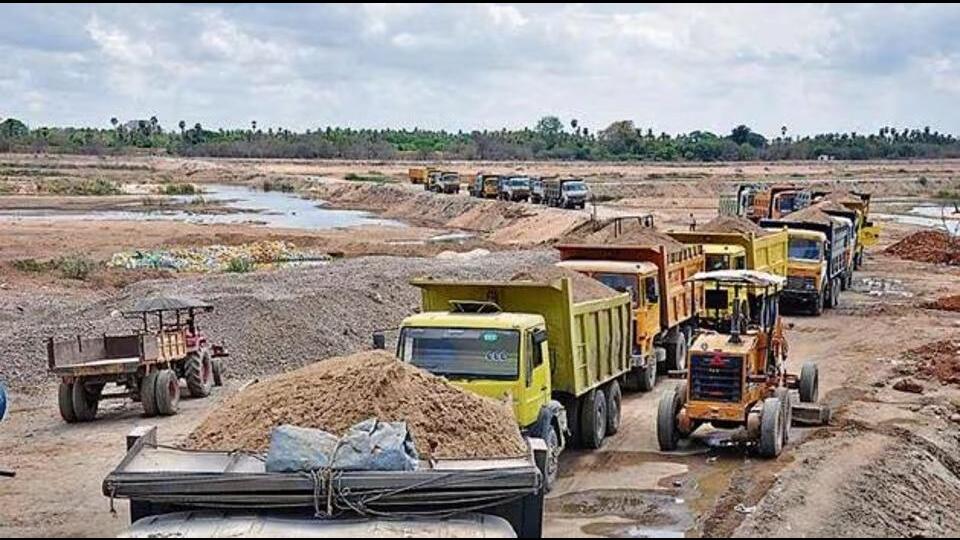
A bench of Chief Justice of India (CJI) Surya Kant and justice Joymalya Bagchi said, “The state shall provide details of the first information reports (FIRs) registered with regard to the theft of minor minerals (sand), and the status of investigation in these cases shall also be given in tabulated form.”
The court was hearing a petition filed by one M Lakshmanan challenging a June 2025 order of the Madras High Court closing petitions seeking a probe into sand mining in the Cauvery river, based on a statement by the state that no quarrying activities were taking place after quarry sites were officially closed in December 2024.
The petitioner, represented by advocates Prashant Bhushan and Pranav Sachdeva, pointed out that the high court failed to take note of an affidavit filed by the ED in the same proceedings, which revealed that private parties, in collusion with government officials, were involved in illegal and excessive sand mining, causing a substantial loss to public revenue to the tune of ₹4,730 crore.
Posting the matter after three weeks, the bench told the state, “The state should be more forthcoming in such cases and come forward to volunteer any probe, as it involves your money and resources.”
The court said the allegation was that minerals worth ₹4,730 crore had been misappropriated and that people had a right to know what happened. “The state should take a positive stand in these cases and come forward and say, let this be probed. The ED is helpless as there is no predicate offence. You have not given permission for the CBI to probe and your own police are not doing it. How will people know what happened?”
The state, represented by additional advocate general (AAG) Amit Anand Tiwari, said the petitioner had suppressed several facts from the court and alleged that he appeared to be acting out of political motives.
The court said, “The case he is presenting is that the ED cannot investigate, so let there be a CBI probe. You are more focused on his conduct. Let us assume that he has also colluded, but if somebody brings information to your notice that environmental clearance has been misused by certain mining leaseholders, is it not required of you to file FIRs and, if it is found to be false, close it?”
Tiwari told the court that the theft of sand was not by leaseholders but by petty criminals who were illegally extracting sand from the river. To curb such siphoning, the state has fitted all vehicles with GPS (Global Positioning System), installed CCTV cameras at mining sites, and constituted a central department to monitor mining activities across the state.
The court said that registering a case under the Minor Minerals Act and stating that it would not fall within the predicate offence capable of being probed by the ED was not the correct approach. “Nobody can be found to be blameworthy unless an investigating agency comes to the conclusion of connivance or collusion by state officials. As a state, you should be straightforward,” the bench observed.
Tiwari questioned the basis of the ED report, pointing out that the federal agency compared satellite images of the Cauvery riverbed to conclude the occurrence of sand mining, which he said was presumptive.
He also highlighted that the petitioner had directly approached the court without raising his grievance before any statutory authority.
The petitioner produced the ED affidavit before the top court to show that a huge loss had been caused to the exchequer within a span of just two years. To arrive at this figure, a technical study of all mining sites was conducted using drones and other scientific surveys, including satellite imagery processing, which established rampant illegal sand mining in five districts, according to the ED report.
The ED report further stated that the diversion or laundering of money was evident, as the state showed a paltry sum of ₹36 crore as revenue recorded in the books of the Water Resources Department. “When such is the magnitude of the crime and related proceeds of crime, the state government is simply trying to deflect attention from the culprits of the crime by making baseless allegations against the agency itself,” the petition said.
“Entrusting the investigation to state government agencies would serve no purpose, as the offences have been committed by private entities in apparent collusion with public officials. Therefore, an independent investigation by the CBI is imperative to ensure a fair and impartial inquiry into the large-scale illegal sand mining in the state,” the petition added.


