In the early months of 2009--sometime between February and March--David Coleman Headley called his friend Dr Tahawwur Rana in Chicago to make him hear an audio tape in which at least five top commanders of the Pakistani terror outfit Lashkar-e-Taiba (LeT) could be heard giving detailed instructions to the ten men who had been sent to Mumbai on a suicide mission in November 2008. One of the men particularly impressed Rana. This was Sajid Majid alias Sajid Mir alias Wasi, one of the absconding masterminds of 26/11. “After hearing him deliver instructions on the tape, Dr Rana said to me that what Sajid had accomplished was akin to what Khalid Ibn Walid had done,” Headley told a two-member team of the National Investigation Agency which interrogated him in June 2010. Khalid Ibn Walid is a 7th century Arab military general revered for his derring-do.
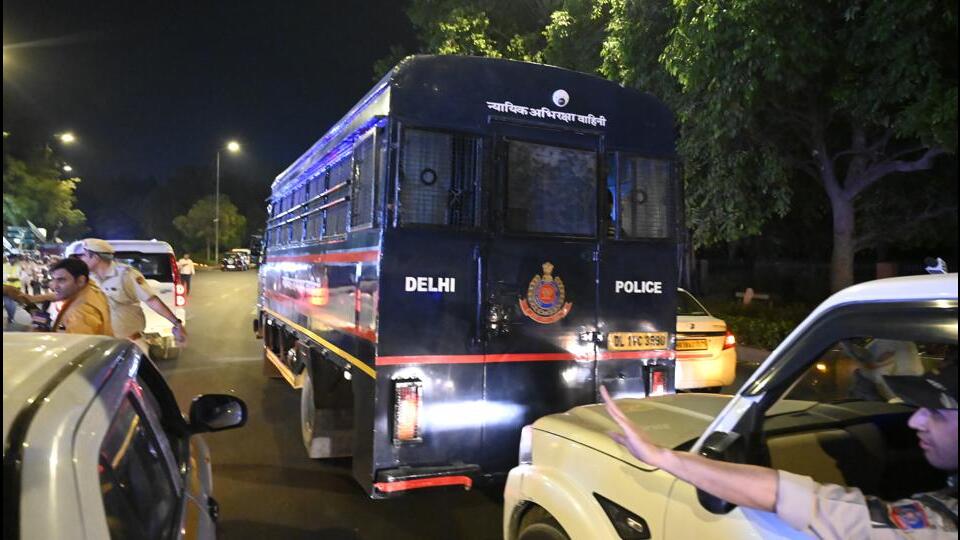
NIA team with 26/11 accused Tahawwur Rana, near Patiala House Court, in New Delhi, India, on Thursday. (Sanjeev Verma)
As Tahawwur Rana--only the second man after Ajmal Kasab-- to be caught for the 26/11 Mumbai terror attack that killed 166 people, reached India on Thursday following his extradition from the United States, it’s instructive to keep in mind that Rana’s story and his fate is inextricably linked to that of David Coleman Headley. The two men, both 64, met for the first time as school boys at the posh residential school, Cadet College at Hasan Abdal, Attock, in Pakistan. The school, whose motto is ‘Second to None’ was where the sons of Punjab’s elite went to become citizens of the world. Rana, son of a high school principal, decided to befriend Headley, then known as Daood Gilani, the son of a bureaucrat who stood out for being bi-racial and for his heterochromia (having eyes of two different colours).
Over the years, even though they followed different paths, the two men remained close friends. Headley moved back to Philadelphia to be with his mother after his parents’ divorce and eventually began dabbling in the twin trades of narcotics and information. Indian investigators believe him to have acted as a double agent who worked for the LeT and the Pakistani deep state as well as for the Central Intelligence Agency (CIA). Rana, on the other hand, trod the straight and narrow, studying medicine before joining the Pakistan Army Medical Corps as a captain. In 1997, Rana deserted the Pakistani army and migrated to Canada with his wife, also a doctor, and they became Canadian citizens in 2001. In Toronto, he set up an immigration service, First World Immigration Services, and eventually opened offices in Chicago and New York too.
It was through this company of his that Rana got involved in the 26/11 plot which was allegedly cooking since 2006 as per Headley’s statement to NIA. The same year Headley made his first trip to Mumbai during which he submitted a form to the Reserve Bank of India signed by a certain Raymond Joseph Sanders seeking permission to set up a liaison office in the name of Messrs Immigrant Law Centre, Chicago. This was the business name of Rana’s First World Immigration Services. Headley took up office space at Tardeo’s AC Market in Mumbai and used it as his base to travel in and out of India. In all he made eight reconnaissance trips to Mumbai before the 26/11 attacks. Two weeks before November 26, 2008, Tahawwur Rana too came to Mumbai for his first known trip. He stayed at a five-star hotel at Powai for ten days. His activities in this time would be something that Indian investigators would be keen to establish as they begin questioning him.
NIA investigators, speaking to HT, said that it was Rana who helped Headley obtain a visa for travel to India by misrepresenting his birth name, his father’s name and the purpose of his travel. As per NIA, during his eight trips to Mumbai Headley was in telephonic contact with Rana 231 times. In return for the favour done to him by Rana, Headley allegedly requested his ISI handler, a certain Major Iqbal, to help his friend to go back to visit Pakistan. As an army deserter, it was difficult for Tahawwur Rana to go back. Major Iqbal allegedly spoke to Rana over the phone in July 2008. Indian investigators believe that this was the time when Headley used Rana to communicate indirectly with his Lashkar handlers in Pakistan. He himself had been specifically instructed to not make or receive any calls to and from Pakistan.
Headley had allegedly told NIA in 2010 that Rana had genuine feelings to “fight for the cause of Islam” but in addition he also saw a “genuine business opportunity in India.” Until Headley’s interrogation in 2010 Indian authorities had never heard or known of Dr Tahawwur Rana.
End of a friendship
Headley also told the NIA that when he conveyed Rana’s admiration for Sajid Majid to the man, the 26/11 mastermind called Rana to thank him for his contributions to making 26/11 a successful campaign. In September 2009, Rana allegedly told Headley that the 9 Pakistani terrorists who died in 26/11 should be given Nishan-e-Haider, Pakistan’s highest military honour.
The alleged friendship and collaboration between Headley and Rana finally came to an end on October 3, 2009 with Headley’s arrest at Chicago’s O’Hare International Airport by the Federal Bureau of Investigation. Independent of the CIA for whom Headley allegedly worked, the Feds had been keeping an eye on Headley’s frequent trips in and out of Pakistan. In October 2009, he was headed from Chicago to Pakistan to allegedly meet LeT operative Abdur Rehman Pasha, a former Pakistani major who had quit the army to join the terror outfit. Emboldened by the success of 26/11, the LeT was planning a terror operation at Copenhagen. The Danish newspaper ‘Jyllands-Posten’, had published anti-Islamic content in solidarity with the French magazine ‘Charlie Hebdo’, and needed to be punished they believed.
Headley was arrested for terror conspiracy and has been in jail at an undisclosed location since. The Americans have refused to extradite him despite India’s request. Headley’s friend Tahawwur Rana was first arrested in 2009. On June 9, 2011, the US District Court For the Northern District of Illinois convicted him of involvement in the terror conspiracy in Denmark and providing support to LeT, but acquitted him of the charge of providing material support for the 26/11 attacks. In the trial, he defended himself by saying that he had been set up by Headley.
On January 17, 2013, the court sentenced him to 14 years in prison. Rana’s conviction in this case was enabled by David Headley who became the star witness in the US’s case against Rana. Earlier it emerged that it was Rana who had sent a mail to the Danish newspaper in the name of David Coleman Headley, pretending to be a potential advertiser in the paper forFirst World Immigration Services.
Rana was released on compassionate grounds during the Covid-19 pandemic in 2020. But, on June 10, 2020, the very next day after his release, the US government sought a warrant for his provisional arrest with a view towards extraditing him to India under the US-India extradition treaty. Five years later, that finally happened.
Get the latest India News, breaking headlines and real-time updates from across the country. Stay informed about politics, government policies, crime, weather and major national developments.
Home/India News/School Friends To Collaborators In Terror: The Rana Headley Nexus

 E-Paper